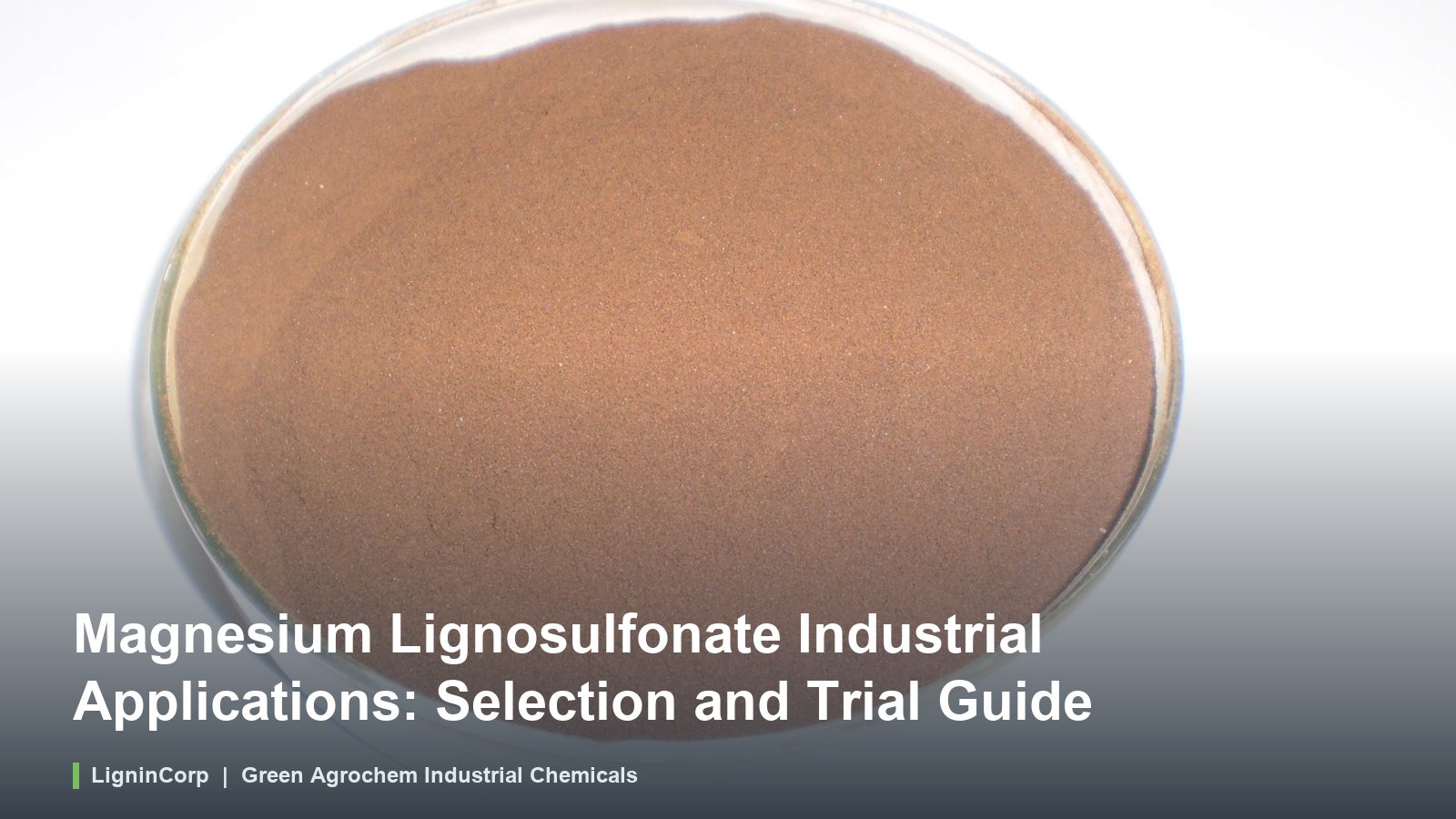
Magnesium lignosulfonate is a lignin-derived, anionic polymer salt evaluated in industrial formulations for dispersion, binding, conventional plasticizing and rheology control. It is not a single pure molecule, and the magnesium counter-ion alone does not establish performance. Commercial results depend on molecular distribution, sulfonation, sugars, salts, insolubles, solids or moisture, and the process in which the material is used.
This guide focuses on industrial applications. Agricultural uses belong to the Group’s Agriculture Solutions division, while feed-grade uses and pellet binding belong to LIGNINCHINA’s Animal Nutrition division.
Current industrial candidate grades
The current document set distinguishes GAC-MgLS-1 (Grade One powder), GAC-MgLS-2 (Grade Two powder) and GAC-MgLS-L (liquid). They differ in physical form and declared pH, insolubles, lignosulfonate content, mineral/reducing-matter fields and shelf life. Use the document-based magnesium grade comparison before selecting candidates.
Do not transfer feed-grade composition, inclusion rate or regulatory statements to these industrial grades. Fertilizer/micronutrient and feed uses belong to their respective agriculture and animal-nutrition divisions.
Industrial applications to evaluate
| Application | Potential function | Critical verification |
|---|---|---|
| Concrete and cement systems | Conventional dispersion, plasticizing or set modification | Flow, water demand, air, setting and strength with the actual cement |
| Ceramic and mineral slurries | Particle dispersion and rheology adjustment | Viscosity, sedimentation, filtration and green strength |
| Granulation and briquetting | Binding and fines control | Granule strength, abrasion, moisture response and drying |
| Dust-control formulations | Surface binding of fine particles | Sprayability, application rate, weathering and reapplication need |
| Drilling or mineral-processing fluids | Dispersion or viscosity modification in selected systems | Temperature, salinity, filtration, rheology and formation compatibility |
How it functions
Sulfonate-containing lignin fragments can adsorb onto solid surfaces and alter particle–water interactions. Depending on the substrate and water chemistry, this may provide electrostatic and steric stabilization or contribute to binding after water removal. High ionic strength, multivalent ions and cationic additives can change adsorption or destabilize a formulation, so compatibility testing is essential.
Do not select by counter-ion alone
Calcium, sodium and magnesium lignosulfonates may overlap in industrial use. Compare the actual grade’s specification and application results. Parameters worth reviewing can include moisture or solids, pH, water insolubles, reducing sugars, ash or specified ions, bulk density, particle size, viscosity, colour and odour.
There is no universal molecular formula, molecular weight, purity or dosage that applies to all magnesium lignosulfonates. The current TDS and COA must define the offered grade.
Concrete and cement limitations
Magnesium lignosulfonate may be evaluated as a conventional lignosulfonate water-reducing or plasticizing component. It should not automatically be called a high-range superplasticizer. Cement chemistry, sugars, salts, temperature and dosage can affect setting, air and early strength. Compare it with calcium or sodium grades, SNF and PCE using the intended mix design and applicable test standard.
Recommended industrial trial
- Define the target function and pass/fail test.
- Review the current specification, TDS, SDS and representative COA.
- Use a numerical supplier-recommended starting trial range only when a current technical document for the exact grade identifies the application, range, revision and calculation basis. Otherwise, design a non-promotional screening ladder from process constraints without publishing a generic dosage.
- Test compatibility with salts, cationic polymers and other additives.
- Measure immediate performance plus ageing or storage stability.
- Confirm a pilot or first commercial batch before full conversion.
Application boundaries
Bio-based origin does not automatically prove biodegradability, non-toxicity, heavy-metal removal, corrosion protection, environmental compliance or suitability under high-temperature/high-pressure conditions. Each claim requires grade-specific evidence and an application-relevant method. Similarly, the magnesium content should not be marketed as a crop nutrient or animal nutrient on an industrial page.
Industrial RFQ information
Provide the application, process pH, water hardness or salinity, solids loading, temperature, required test result, preferred form, packaging, destination and order quantity. State any limits for sugars, salts, insolubles, colour or particle size.
For grade selection and a current quotation, contact info@greenagrochem.com. Review the industrial magnesium lignosulfonate product page, the industrial-grade selection page, and the lignosulfonate powder comparison guide, and the matched magnesium-versus-sodium Grade One comparison.
Uses Listed in the TDS
- Plasticizer in concrete, improving flow while reducing water demand
- Grinding aid in cement milling and raw-mix slurry deflocculant
- Expander in lead-acid battery negative plates
- Binder and filler in ceramic tiles, fiberboard and foundry sand
- Dust suppression
- Dispersant for pesticide and dye formulations and carbon black
- Thinner in oil-well drilling mud
- Water-reducing additive in plasterboard
- Binder for iron ore fines, coal, coke and pelletized feed
Grade Data
| Grade (code) | Form | Lignosulphonate (dry basis) | pH | Other key values |
|---|---|---|---|---|
| Grade One (GAC-MgLS-1) | Yellow-brown powder | 55% min | 4 – 7 | Total Mg + Ca 8% min; insolubles 1.0% max; reducing matter 7% min |
| Grade Two (GAC-MgLS-2) | Powder | 50% min | around 10 | Total Mg + Ca 5% min; insolubles 1.5% max |
| Liquid (GAC-MgLS-L) | Liquid, about 45% solids | 50% min | — | Insolubles 1% max; reducing sugar about 7% |
| Feed Grade (GAC-MgLS-Feed) | Light to dark brown powder | 55% min | 4.5 – 6.5 | Pb 10, As 3, Cd 1 mg/kg max; Salmonella negative in 25 g |
Frequently Asked Questions
What are the industrial applications of magnesium lignosulfonate?
Concrete, cement milling, batteries, ceramics, foundry sand, dust control, dispersants, drilling mud, plasterboard and binders for ores and coal.
Which grade is used most?
Grade One.
