
Chemical Composition
Magnesium lignosulfonate is not a single, well-defined molecule but a complex mixture of sulfonated lignin polymers neutralized with magnesium ions (Mg²⁺). Lignin, its parent material, is a three-dimensional, amorphous biopolymer composed of phenylpropane units (coniferyl, sinapyl, and p-coumaryl alcohols) linked by ether and carbon-carbon bonds. During the sulfite pulping process, sulfonic acid groups (-SO₃H) are introduced to the lignin structure, increasing its solubility in water. Magnesium ions then bind ionically to these sulfonic groups, forming the magnesium salt.
- Simplified Representation: It can be denoted as [Lignin-SO₃]₂Mg, though this oversimplifies its variability.
- Molecular Weight: Ranges broadly from 1,000 to 100,000 Da due to the heterogeneity of lignin and the degree of sulfonation.
- Functional Groups: Contains sulfonic acid groups (-SO₃H), hydroxyl groups (-OH), and aromatic rings, contributing to its anionic and hydrophilic properties.
- Variability: The exact composition depends on the lignin source (e.g., softwood vs. hardwood), pulping conditions, and degree of sulfonation, leading to differences in molecular weight, sulfonation level, and functionality.
This chemical complexity underlies its versatility as a dispersant, binder, and chelating agent.
Production Process
Magnesium lignosulfonate is generated during the sulfite pulping process, a method used to extract cellulose fibers from wood for papermaking. The process involves the following steps:
- Wood Preparation: Wood chips (from softwood or hardwood) are prepared for pulping.
- Sulfite Pulping: The chips are cooked in a solution of magnesium bisulfite (Mg(HSO₃)₂) or magnesium sulfite (MgSO₃) under high temperature (120–180°C) and pressure. This process sulfonates the lignin, breaking it down into soluble lignosulfonic acid while leaving cellulose fibers intact.
- Separation: The cellulose fibers are separated for use in papermaking, leaving a spent sulfite liquor containing magnesium lignosulfonate.
- Byproduct Utilization: The process repurposes lignin, a waste product, into a valuable chemical, enhancing the sustainability of the pulp and paper industry.
Physical and Chemical Properties
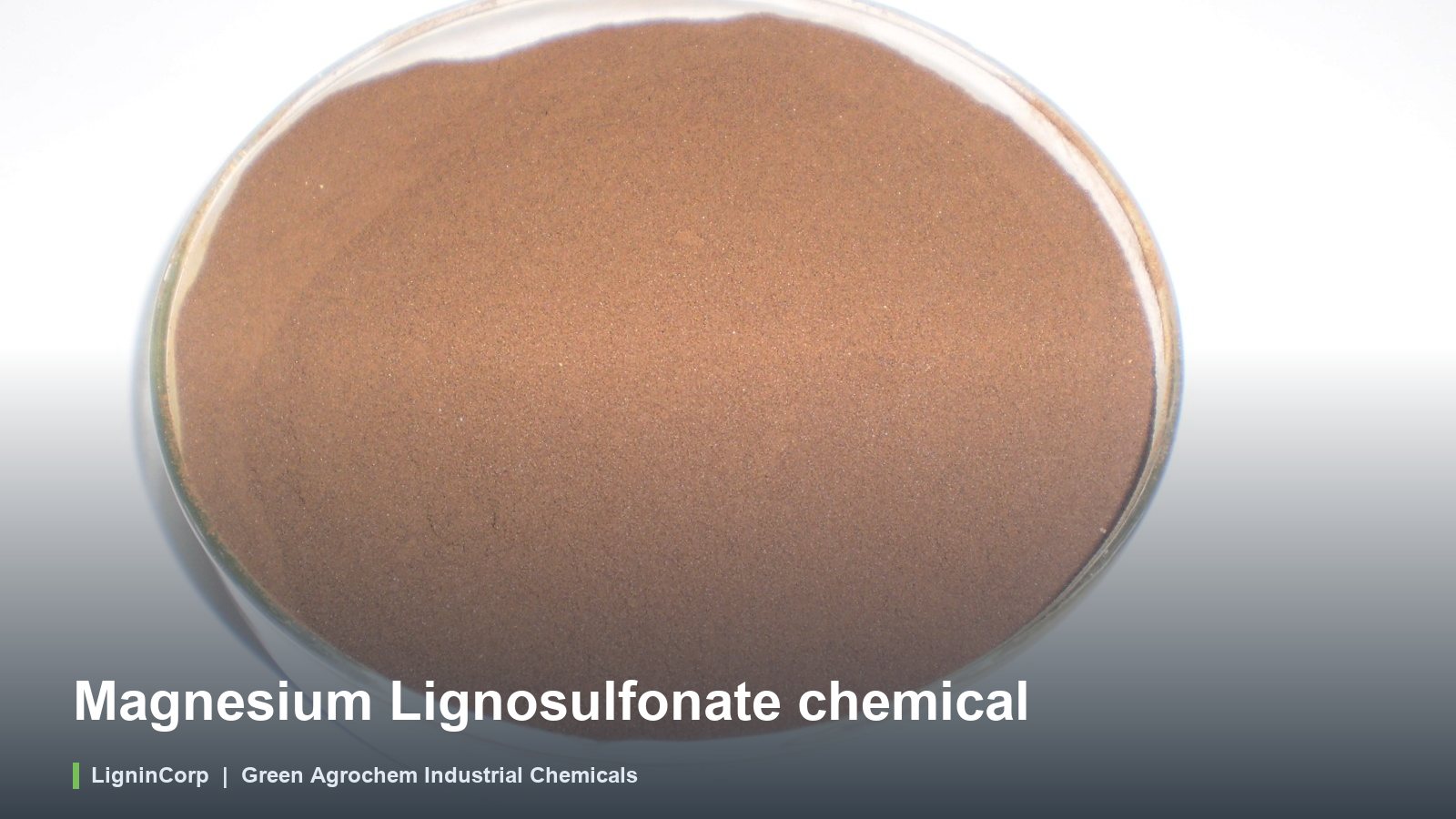
- Appearance: Typically a brown to dark brown powder or viscous liquid, depending on its concentration and processing.
- Solubility: Highly soluble in water, forming stable colloidal solutions; insoluble in most organic solvents (e.g., ethanol, acetone).
- pH: Aqueous solutions have a pH range of 4–7, depending on concentration and formulation, making it compatible with a variety of chemical environments.
- Molecular Weight Distribution: Broad, ranging from low-molecular-weight fragments to high-molecular-weight polymers, which affects its viscosity and binding strength.
- Thermal Stability: Stable at elevated temperatures (up to 200°C in some cases), suitable for high-heat processes like ceramic firing or pelletization.
- Anionic Nature: The sulfonic acid groups confer a negative charge, enabling it to act as a dispersant and chelating agent for metal ions.
- Viscosity: Solutions exhibit moderate viscosity, which can be adjusted by concentration, aiding in applications like concrete admixtures.
- Biodegradability: Derived from natural lignin, it is biodegradable and breaks down via microbial action, reducing environmental persistence.
These properties enable magnesium lignosulfonate to function as a binder, dispersant, plasticizer, and nutrient source across diverse applications.
Applications
Magnesium lignosulfonate’s unique chemical properties make it a valuable material in numerous industries. Its primary applications include:
3. Construction
- Concrete Admixture: Acts as a water-reducing agent and plasticizer in concrete mixes, improving workability and strength while reducing the water-to-cement ratio. Although calcium and sodium lignosulfonates are more common, magnesium lignosulfonate is used in specialized formulations.
- Soil Stabilization: Binds soil particles in road construction and erosion control, creating stable, load-bearing surfaces.
- Cement Production: Serves as a grinding aid, improving the efficiency of cement clinker processing.
4. Chemical and Industrial Applications
- Dispersant: Used in dyes, pigments, and ceramics to ensure uniform particle distribution and prevent clumping. In textiles, it stabilizes dye baths for consistent coloration.
- Oil Drilling: Functions as a fluid loss control agent in drilling muds, stabilizing viscosity and preventing water loss in high-pressure environments.
- Dust Control: Applied to roads, mines, and industrial sites to bind fine particles, reducing airborne dust and improving air quality.
- Carbon Black and Briquetting: Acts as a binder in the pelletization of carbon black, coal, or other materials, enhancing product durability.
5. Ceramics
- Binder and Plasticizer: Improves the green strength of ceramic bodies (e.g., tiles, bricks) during molding and drying, reducing cracking and breakage before firing.
- Slurry Stabilization: Enhances the flow and workability of ceramic slurries, ensuring uniform particle distribution.
6. Other Uses
- Mining: Used as a flotation agent or binder in ore agglomeration, improving mineral processing efficiency.
- Water Treatment: Acts as a chelating agent, binding metal ions to prevent scaling or precipitation in industrial water systems.
- Adhesives and Resins: Serves as a component in eco-friendly adhesive formulations, particularly for wood-based products.
Environmental and Safety Considerations
Magnesium lignosulfonate is widely regarded as an environmentally friendly and safe chemical:
- Sustainability: As a byproduct of the pulp and paper industry, it repurposes lignin that would otherwise be waste, aligning with circular economy principles. Its production relies on renewable wood resources.
- Biodegradability: Naturally degrades through microbial action, minimizing environmental persistence and reducing the risk of long-term ecological impact.
- Low Environmental Impact: Unlike synthetic binders or dispersants, it does not contribute to persistent pollution or bioaccumulation.
However, proper handling and dosage are critical to avoid potential issues:
- Over-Application: Excessive use in soil or water systems could alter pH or nutrient balances, requiring careful monitoring.
- Dust Handling: In powder form, it may cause respiratory irritation if inhaled, necessitating standard safety precautions (e.g., masks, ventilation).
Technical Considerations
To maximize the effectiveness of magnesium lignosulfonate, several factors must be considered:
- Chemical Compatibility: Its performance depends on the pH and chemical environment. For example, highly alkaline conditions in some concrete mixes may require adjustments.
- Environmental Conditions: Temperature, humidity, and drying times can affect its performance, particularly in ceramics or soil stabilization.
- Storage: Powdered forms should be stored in dry conditions to prevent clumping, while liquid forms require sealed containers to avoid contamination or evaporation.
Advantages and Limitations
Advantages
- Eco-Friendly: Renewable, biodegradable, and derived from waste, making it a sustainable alternative to synthetic chemicals.
- Cost-Effective: Affordable compared to synthetic binders, with comparable or superior performance.
- Process Efficiency: Reduces energy consumption in processes like pelletization and concrete mixing by improving workability and reducing viscosity.
Limitations
- Variability: Its heterogeneous composition can lead to inconsistent performance across batches, requiring quality control.
- Application-Specific Challenges: May not perform as well as specialized synthetic alternatives in certain high-performance applications (e.g., high-strength concrete).
- Limited Awareness: Less widely recognized than calcium or sodium lignosulfonates, potentially limiting adoption in some industries.

