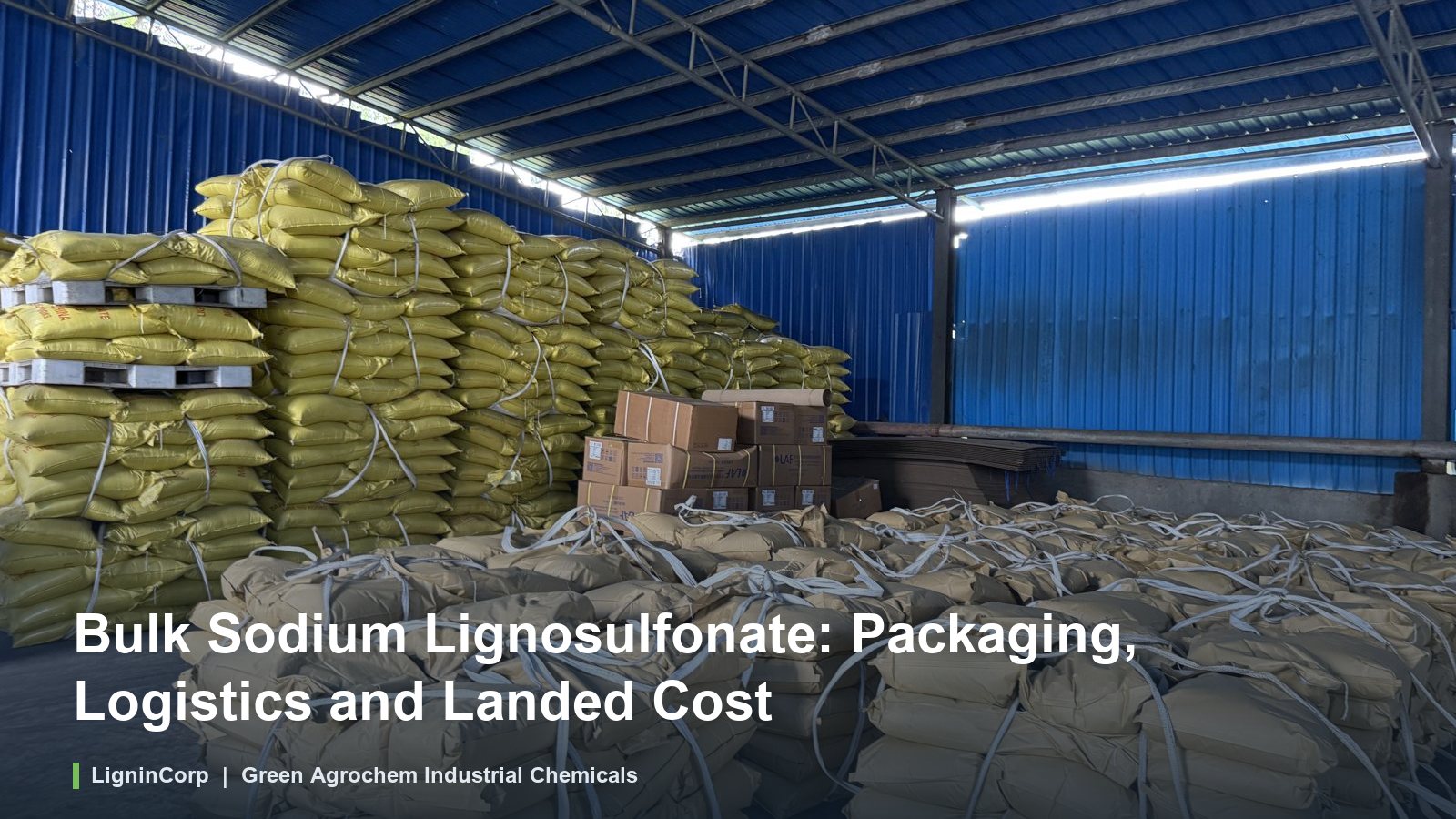
Bulk sodium lignosulfonate procurement is a packaging, logistics and inventory-control decision as well as a product decision. The lowest unit quotation is not necessarily the lowest usable cost if solids, packaging efficiency, freight, unloading, storage losses or lot consistency differ.
This guide covers industrial-scale order planning. For grade selection and current technical scope, use the LigninCorp sodium lignosulfonate product page. For preparing and comparing offers, see the sodium lignosulfonate RFQ guide.
Start with Consumption and Usable Inventory
Estimate consumption from verified production records rather than nominal plant capacity. Separate average use, peak use, safety stock and material already committed to open batches. Your reorder point should account for manufacturing lead time, document approval, booking, transit, customs, inland delivery and incoming inspection. Review shelf life and warehouse conditions before increasing order size.
| Planning input | Required basis | Decision supported |
|---|---|---|
| Consumption rate | Actual use by exact grade and dry-solids basis. | Order quantity and reorder point. |
| Lead-time components | Production, release, booking, transit, customs and local delivery. | Safety-stock window. |
| Storage capacity | Usable pallet, FIBC, IBC or tank positions plus handling access. | Maximum practical lot size. |
| Shelf-life control | Current SDS/TDS and supplier storage statement for the exact grade. | FIFO/FEFO plan and acceptable inventory age. |
| Incoming inspection | Sampling plan, test time and quarantine area. | Release timing and usable-stock calculation. |
Select Packaging for the Receiving System
Packaging must match the material form, unloading equipment, dosing method, dust control and local waste rules. Powder may be supplied in small bags or flexible intermediate bulk containers; liquid may use drums, IBCs, road tankers or other agreed bulk systems. Actual net weight, pallet pattern and container loading must come from the dated quotation and packing plan.
| Format | Operational questions | Qualification checks |
|---|---|---|
| Small powder bags | Manual handling limit, bag opening, dust extraction and pallet movement. | Liner, seal integrity, net weight, pallet protection and moisture barrier. |
| Powder FIBC | Forklift/crane capacity, lifting height, discharge station and earthing needs. | Safe working load, lifting-loop design, liner, discharge spout and applicable certification. |
| Liquid drum or IBC | Pump compatibility, connection, bunding, rinsing and empty-container handling. | Material compatibility, closure, solids/density basis, freeze or viscosity controls. |
| Bulk liquid delivery | Tank volume, dedicated line, filtration, unloading time and retained heel. | Pre-delivery inspection, hose/connection standard, segregation and traceability. |
Build a Comparable Landed-Cost Model
Compare offers using the same currency, grade, solids basis, quantity, packaging and delivery point. Include product value, export packing, inland origin transport, port and documentation charges, ocean or land freight, insurance, duties, brokerage, destination handling, demurrage exposure, final delivery, unloading and packaging disposal. For liquid grades, calculate cost per delivered dry tonne using a verified solids value.
Do not add claimed process savings to the model unless a controlled plant trial has defined the control, dosage basis, product identity, operating conditions and measured result. The price and landed-cost guide provides a broader quotation framework.
Legacy Bulk Figures Requiring Confirmation
| Former page figure | Evidence/status | Required treatment |
|---|---|---|
| 25 kg powder bag | Common packaging example, but not verified here as a current offer for every grade. | Confirm exact grade, net weight, liner and pallet plan in the quotation. |
| 500 kg / 600 kg FIBC | Illustrative industry range; no current grade-specific packing document cited. | Confirm safe working load, actual fill weight and handling design. |
| 13–16 MT per palletized 20-foot container | Unverified historical estimate. | Use a shipment-specific packing plan and carrier/container limits. |
| 20–22 MT per 20-foot container with FIBC | Unverified historical estimate. | Do not treat as a guaranteed payload; confirm legal weight and stowage. |
| Orders above 10 MT drastically lower unit cost | Unsupported universal commercial claim. | Compare dated quotations by quantity tier; no saving is guaranteed. |
These values came from the former page and are retained only for traceability. Current packaging, payload and commercial details must come from the exact-grade quotation and approved logistics plan.
Warehouse and Handling Controls
- Follow the current SDS and supplier storage instructions for the exact grade.
- Keep powder packaging closed, dry and protected from damage; define a procedure for torn or wet bags.
- Store liquid containers within compatible secondary containment and control temperature where viscosity, freezing or microbial stability may be affected.
- Segregate lots and maintain the link between packaging labels, receiving record and COA.
- Use FIFO or FEFO as appropriate and investigate aged, caked, separated or contaminated material before release.
- Document spill response, lifting controls, dust exposure controls and disposal requirements.
Pre-Shipment and Receiving Checklist
- Approve the exact grade and agreed specification after application qualification.
- Confirm quantity, packaging, Incoterm, destination, lead time and shipment split.
- Review the packing list, container/pallet plan, SDS and applicable transport documents.
- Require lot identity and COA before shipment or according to the agreed release procedure.
- At receipt, inspect seals, packaging condition, labels, quantity and lot traceability.
- Sample using the agreed plan; quarantine until incoming checks are complete.
- Record nonconformities and retain samples under the quality agreement.
Request a Bulk Supply Review
Current TDS, SDS and COA resources are available through the technical document centre. To obtain a shipment-specific proposal, contact LigninCorp with the exact application, grade, annual and shipment volumes, preferred packaging, destination, Incoterm and receiving constraints. Email enquiries may be sent to info@greenagrochem.com.
