
SNF 18% Sodium Sulfate Grade (product code GAC-SNF-18) is the standard commercial grade in the LigninCorp sodium naphthalene formaldehyde range: a high-range water-reducing dispersant for concrete admixtures and cement systems where the approved specification allows sodium sulfate up to 18%.
Product identity: Sodium naphthalene sulfonate formaldehyde condensate (SNF, also sold as PNS or NSF), CAS 36290-04-7, brown to dark-brown powder.
Selection point: This page covers the 18% grade only. The range has three grades, 5%, 18% and 20% sodium sulfate; select one and make sure the quotation, TDS and COA all name the same grade.
Specification (GAC-SNF-18 TDS)
| Parameter | Specification |
|---|---|
| Appearance | Brown to dark-brown powder |
| Sodium sulfate (Na2SO4) | 18% maximum |
| Solids content | 91% minimum |
| Net starch (cement paste) fluidity | 210 mm minimum |
| Chloride (Cl⁻) | 0.5% maximum |
| pH | 7–9 |
| Surface tension | (71 ± 1) × 10⁻³ N/m |
Values are from the current product TDS. The agreed sales specification and the batch COA govern each shipment; confirm test methods and document revision during qualification.
Commercial and Formulation Position
Standard-Grade Option
For buyers whose approved formulation permits the standard sodium sulfate level and who want a balance of dispersing performance and cost.
Concrete Workability
SNF adsorbs on cement particles and adds negative charge, so flocculated particles separate and trapped water is released. This can raise workability at constant water or allow water reduction at a set workability, when validated in the customer’s mix.
Incoming Quality Control
Shipments are supported by the current TDS, SDS/MSDS and batch COA for supplier qualification and routine inspection.
Not Interchangeable by Default
Moving between sulfate grades changes the salt load and the fluidity specification. Requalify whenever the grade or raw-material source changes.
5% vs 18% vs 20%: How the SNF Grades Compare
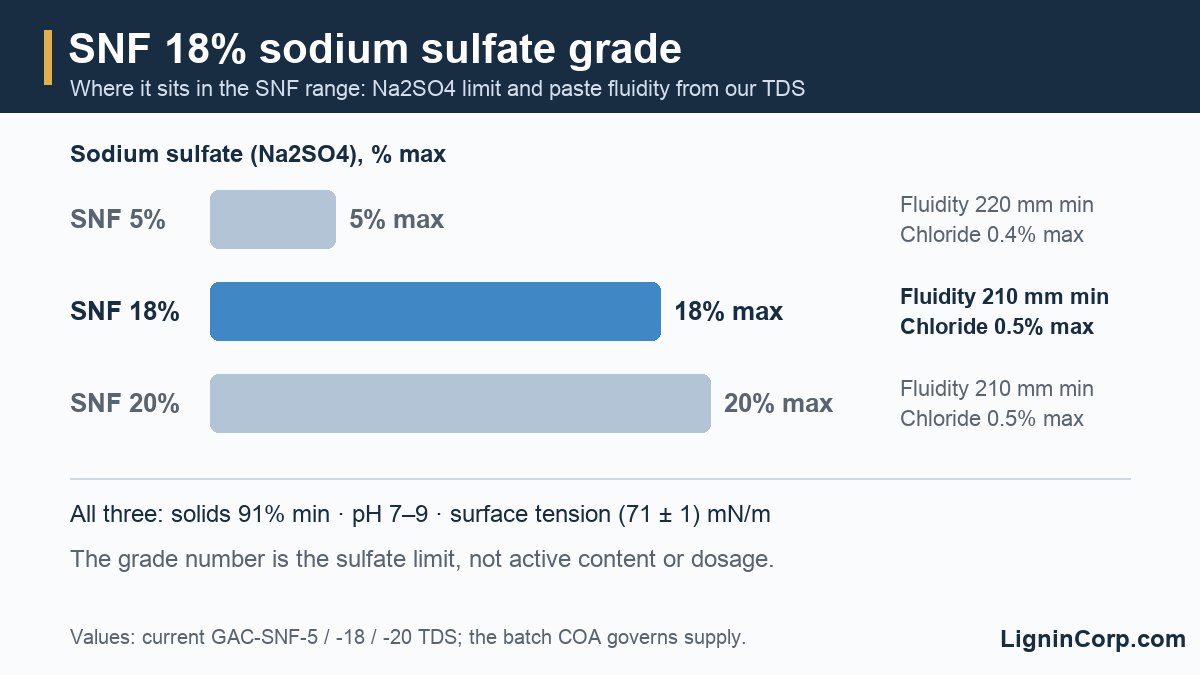
The number in each grade name is the maximum sodium sulfate content. Sodium sulfate is a by-product of neutralising the sulfonated condensate; lower-sulfate grades are purified further. The table compares the three TDS specifications.
| Parameter | SNF 5% | SNF 18% (this page) | SNF 20% |
|---|---|---|---|
| Product code | GAC-SNF-5 | GAC-SNF-18 | GAC-SNF-20 |
| Sodium sulfate (Na2SO4) | 5% max | 18% max | 20% max |
| Net starch (cement paste) fluidity | 220 mm min | 210 mm min | 210 mm min |
| Chloride (Cl⁻) | 0.4% max | 0.5% max | 0.5% max |
| Solids content | 91% min | 91% min | 91% min |
| pH | 7–9 | 7–9 | 7–9 |
| Surface tension | (71 ± 1) × 10⁻³ N/m | (71 ± 1) × 10⁻³ N/m | (71 ± 1) × 10⁻³ N/m |
Choose the 5% low-sulfate grade when the project limits soluble salts or when you make concentrated liquid admixtures. Choose the 20% grade only where the specification is written around the higher-sulfate option. The SNF superplasticizer product overview explains the shared chemistry.
Starting Trial Range and Evaluation Workflow
The current TDS gives a supplier-recommended starting trial range of 0.5–1.0% by weight of cementitious materials. Treat it as the start of a dosage series, state whether the figure is on as-supplied powder, and set the production dosage from trials with the actual cement, aggregates and companion admixtures.
- Define the cement system, target slump or flow, retention, setting and strength requirements.
- Confirm the grade designation and the test basis used for sodium sulfate.
- Run a dosage series starting from the TDS trial range.
- Check compatibility, air content, setting and strength as well as initial flow.
- Lock the approved grade, document revision and COA acceptance limits in the purchasing specification.
Packaging and Storage
25 kg woven or kraft bags, or 500 kg / 600 kg jumbo bags with inner liner; other packing by contract. Store sealed in a dry, ventilated warehouse.
Frequently Asked Questions
What does “18%” mean in SNF 18%?
It is the maximum sodium sulfate (Na2SO4) content allowed by the GAC-SNF-18 TDS. It is not the active content and not a dosage.
How does the 18% grade differ from the 5% grade?
The 5% grade allows at most 5% sodium sulfate and has a higher fluidity minimum (220 mm vs 210 mm) and a lower chloride limit (0.4% vs 0.5% max). Solids (91% min), pH (7–9) and surface tension are the same.
Why does sodium sulfate content matter?
It adds soluble salt to the admixture and to the concrete. Formulators of concentrated liquid admixtures and projects with salt limits often specify a lower-sulfate grade; others accept 18% when it meets their specification.
What dosage should I start with?
The current TDS gives a supplier-recommended starting trial range of 0.5–1.0% by weight of cementitious materials. The production dosage must come from trials with your own materials.
How is SNF 18% packed?
In 25 kg woven or kraft bags, or 500 kg / 600 kg jumbo bags with inner liner. Other packing can be agreed by contract.
Which documents come with an order?
The current TDS, SDS/MSDS and a batch COA for each shipment.