
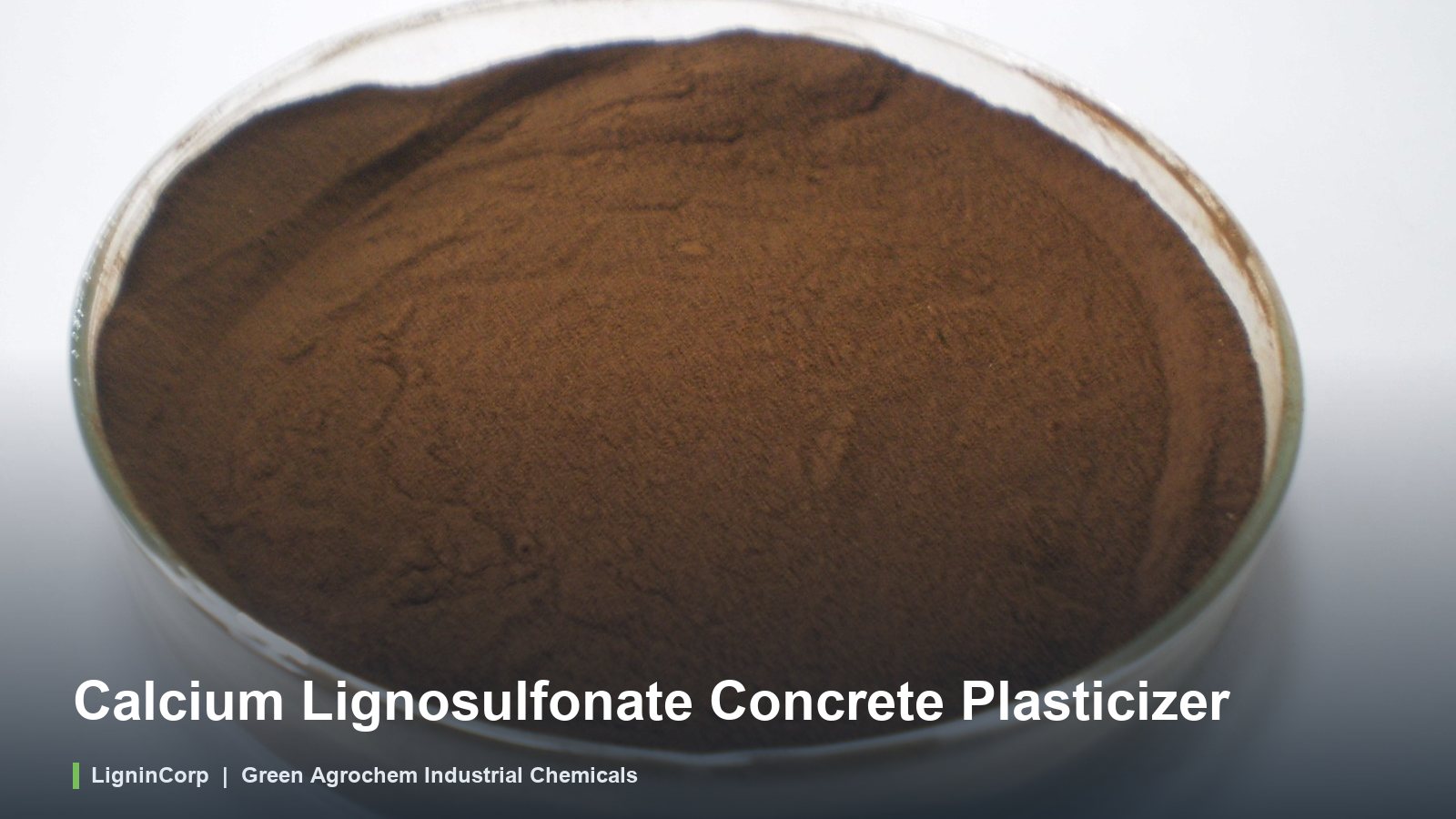
Calcium lignosulfonate is a low-cost plasticizer for precast concrete, concrete blocks and pavers. In precast it lowers water at a given workability; in dry-cast blocks and pavers it helps the mix compact. The catch is set delay, which can slow demoulding. This page covers dosage, the trade-off with early strength and how to test.
Where It Fits
| Product | Mix type | What it does | What to watch |
|---|---|---|---|
| Wet-cast precast (panels, pipes, beams) | Plastic concrete | Lower water at same slump | Early strength for demoulding |
| Concrete blocks | Dry-cast, zero slump | Easier compaction, better surface | Unit density and strength |
| Pavers | Dry-cast | Compaction and finish | Strength and abrasion of the unit |
Dosage
| Parameter | Construction Grade (GAC-CaLS-Construction), TDS Rev. 2.0 |
|---|---|
| Form | Light brown powder |
| Bulk density | 0.8 g/cm³ |
| Moisture | 5% max |
| pH (5% solution) | 4–6 |
| Recommended dosage | 0.20–0.30% by weight of cement; higher dosages may retard set beyond specified limits |
| Water-demand reduction | Up to 12% |
| Packaging | 25 kg woven bags with PE liner; 500 kg or 600 kg jumbo bags |
| Shelf life | 12 months |
Typical values from the current TDS. Each lot ships with a COA.
Start at the low end of the TDS range (0.20% by weight of cement) for precast that must be demoulded the next day, and move up only if 1-day strength allows. If the yard uses heat curing, check the delay in the actual cycle.
How It Works
- Dispersion: lignosulfonate adsorbs on cement and gives it a negative charge; the grains repel and release trapped water.
- Retardation: the same adsorption, and residual sugars, slow early hydration.
- Air: lignosulfonates can entrain some air; check it, especially in wet-cast elements.
Trial Plan for a Precast Yard
- Make a control and two dosage levels with the production mix.
- Cast in the actual moulds and run the normal curing cycle.
- Test strength at demoulding age and at 28 days.
- Check surface finish, edges and air content.
- For blocks and pavers, measure unit density and strength to the product standard (for example ASTM C90, ASTM C936 or EN 1338).
When to Use Something Else
For high early strength or self-compacting precast, high-range reducers (SNF or PCE) are the usual choice; a blend can lower cost (blending guide).
Frequently Asked Questions
Is calcium lignosulfonate used in precast concrete?
Yes. The GAC-CaLS-Construction TDS lists precast, pavers and masonry mortars among its typical applications, as a normal-range water reducer.
Does set delay matter in precast?
Yes. Precast yards need early strength for demoulding, so pick a dose that reduces water without pushing set beyond the curing cycle. Test 1-day strength against the control.
Can it be used in concrete blocks and pavers?
Yes, in dry-cast mixes it is used to help compaction and surface finish at low water. Results depend on the machine and mix, so test unit density and strength.
Which standards apply to blocks and pavers?
Common ones are ASTM C90 for concrete masonry units and ASTM C936 or EN 1338 for paving units. The finished unit is tested, not the admixture alone.
Samples and Documents
Send the cement type, mix design, target slump or setting time, and the test standard you work to, to info@greenagrochem.com or use the contact form.
Related: water reducing agent dosage · ASTM C494 · all construction uses
