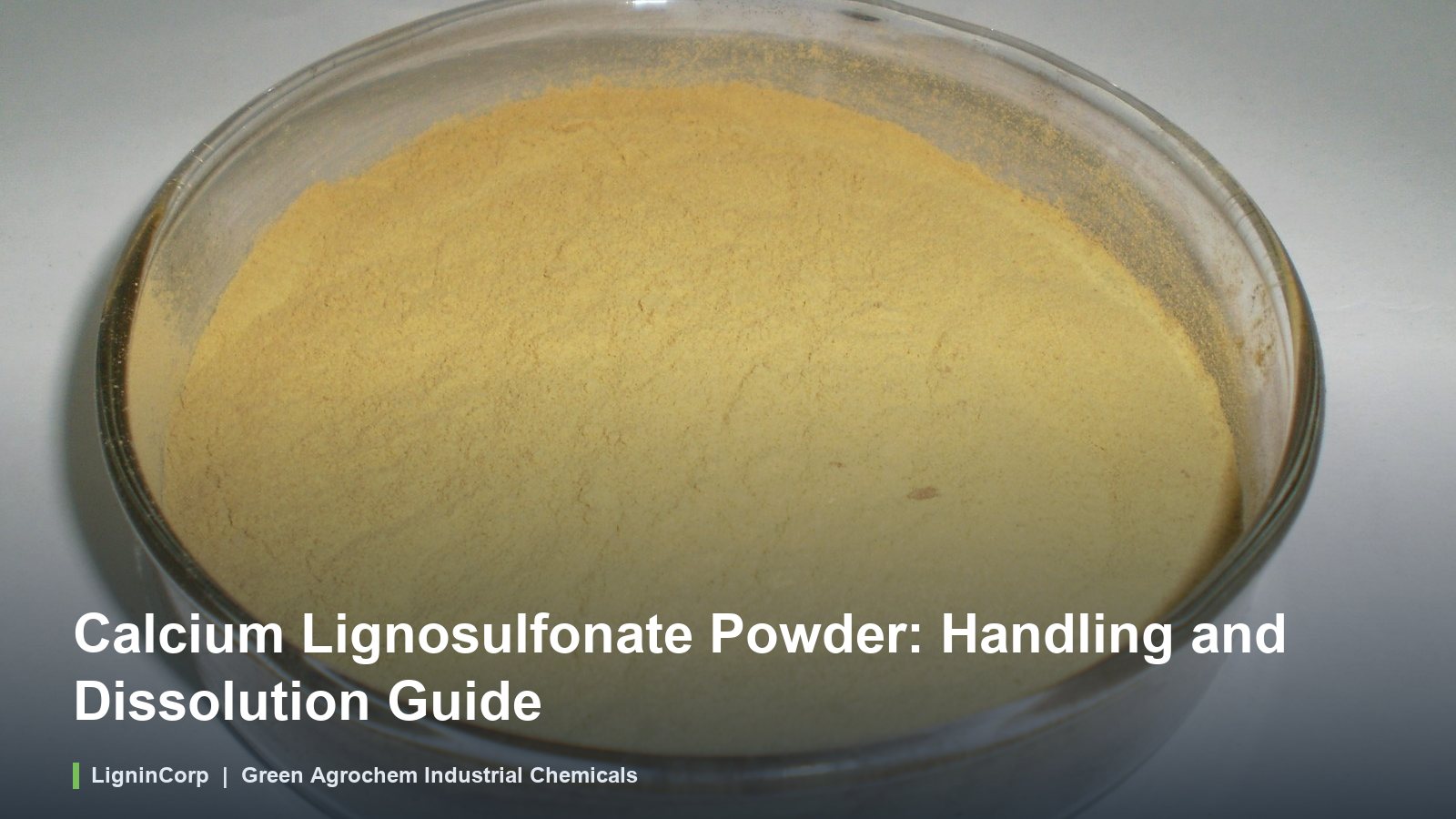
Calcium lignosulfonate powder is a dry form of a calcium-counter-ion lignosulfonate grade. Selecting powder instead of liquid changes freight, warehouse, dust-control, dissolution and dosing requirements; it does not by itself define purity, performance or application suitability.
This page focuses on powder handling and solution preparation. For current commercial scope and exact-grade documents, use the LigninCorp calcium lignosulfonate product page. Buyers comparing offers can also use the powder-grade purchasing guide.
Powder Form Does Not Define the Grade
Commercial powders may differ in moisture, water-insoluble matter, ash, calcium and sulfate profile, reducing sugars, pH at a stated concentration, apparent density, particle size, colour and solution viscosity. Feedstock, processing route, purification and drying conditions can also affect lot behaviour. Confirm the manufacturer and exact product code across quotation, TDS, SDS, COA and bag label.
| Property | Why it matters in powder use | How to control it |
|---|---|---|
| Moisture | Changes delivered dry material, flow and caking risk. | Use the current exact-grade TDS/COA and compare on a defined basis. |
| Water-insoluble matter | Can affect solution residue, filters, nozzles and visible defects. | Agree a method and inspect a prepared solution under representative conditions. |
| Apparent density and particle size | Affect feeder calibration, dusting, bag emptying and hopper behaviour. | Confirm the supplied form; validate the actual receiving and dosing equipment. |
| pH and inorganic profile | May influence compatibility, corrosion review and process response. | State sample concentration, temperature, units and method. |
| Reducing sugars and molecular distribution | May influence cement setting, binding or dispersion in sensitive systems. | Use application-relevant tests; do not infer performance from appearance alone. |
Receiving and Warehouse Checks
- Inspect vehicle/container condition, seals, pallet protection and evidence of water ingress.
- Match product, grade, lot and net quantity to the purchase order and COA.
- Quarantine torn, wet, contaminated or heavily compacted bags pending review.
- Store closed packaging in a dry covered area with suitable pallet separation and lot identification.
- Use the current SDS and site risk assessment for lifting, dust exposure, housekeeping, spill response and PPE.
- Apply FIFO or FEFO according to the exact-grade storage and shelf-life statement.
Do not call a powder “easy to handle” without reviewing bag weight, dust control, lifting, hopper design and worker tasks. A liquid grade may be operationally preferable where automated pumping is available; a powder may be preferable where freight water and freeze control are major constraints.
Preparing an Aqueous Solution
Solution preparation should be qualified with the actual water, equipment and target concentration. Water hardness, dissolved salts, temperature, mixing intensity, addition rate and final solids can affect wetting, dissolution time, foam, viscosity and residue.
- Confirm tank, mixer, seals and transfer materials are compatible with the exact product and operating conditions.
- Charge a controlled quantity of water and establish adequate circulation before powder addition.
- Add powder gradually to avoid floating rafts, local high-solids zones and persistent lumps.
- Control temperature and mixing energy; do not assume heating is acceptable without supplier and site review.
- After mixing, inspect for undissolved material, foam, sediment and viscosity consistency.
- Filter only when required by the downstream process, and record filter type and retained residue.
- Label the prepared solution with product grade, powder lot, concentration basis, preparation date and responsible operator.
Powder-to-Liquid Conversion Basis
When replacing a liquid with powder, calculate additions on a verified dry-solids basis rather than equal as-supplied mass. Include powder moisture, liquid solids, preparation water and any change in solution density or pump calibration. The conversion should be checked in the actual process because equal dry mass does not guarantee equal molecular distribution or application response.
Any numerical dosage must come from a current technical document for the exact grade, with revision and calculation basis. Present it only as a supplier-recommended starting trial range and optimize through laboratory and plant trials.
Compatibility and Application Screening
Calcium lignosulfonate powder may be evaluated for selected industrial binding, dispersion, concrete, ceramic, mineral or dust-control systems. Compatibility cannot be inferred from the words “water-soluble” or “lignosulfonate.” Test the actual substrate, pH, salts, other dispersants, binders, surfactants and process sequence.
For a purpose-built powder dispersant route, review the calcium lignosulfonate dispersant-grade powder. For surface binding and dust control, compare the appropriate application-specific powder or liquid grade rather than substituting solely on counter-ion.
Corrections to the Former Page
| Former statement | Status | Correct treatment |
|---|---|---|
| Calcium lignosulfonate powder is soluble in water. | Overgeneralized without residue, water or grade conditions. | Confirm exact-grade solubility/insolubles and test solution preparation under actual conditions. |
| Powder is convenient and can be easily measured and added. | Unqualified handling claim. | Evaluate dust control, bag handling, feeder accuracy, caking and dissolution equipment. |
| Compatible with various ingredients and additives. | Unsupported universal compatibility claim. | Run formulation-specific compatibility and performance tests. |
| Prevents settling or agglomeration. | Unverified performance claim. | Measure particle size, viscosity, settling, hard sediment and redispersibility against a control. |
Documents and Sample Review
Request the current exact-grade TDS and SDS, a representative COA, packaging details, storage statement and sample identity through the technical document centre. To review dissolution equipment, application conditions or a powder-versus-liquid conversion, contact LigninCorp or email info@greenagrochem.com.
