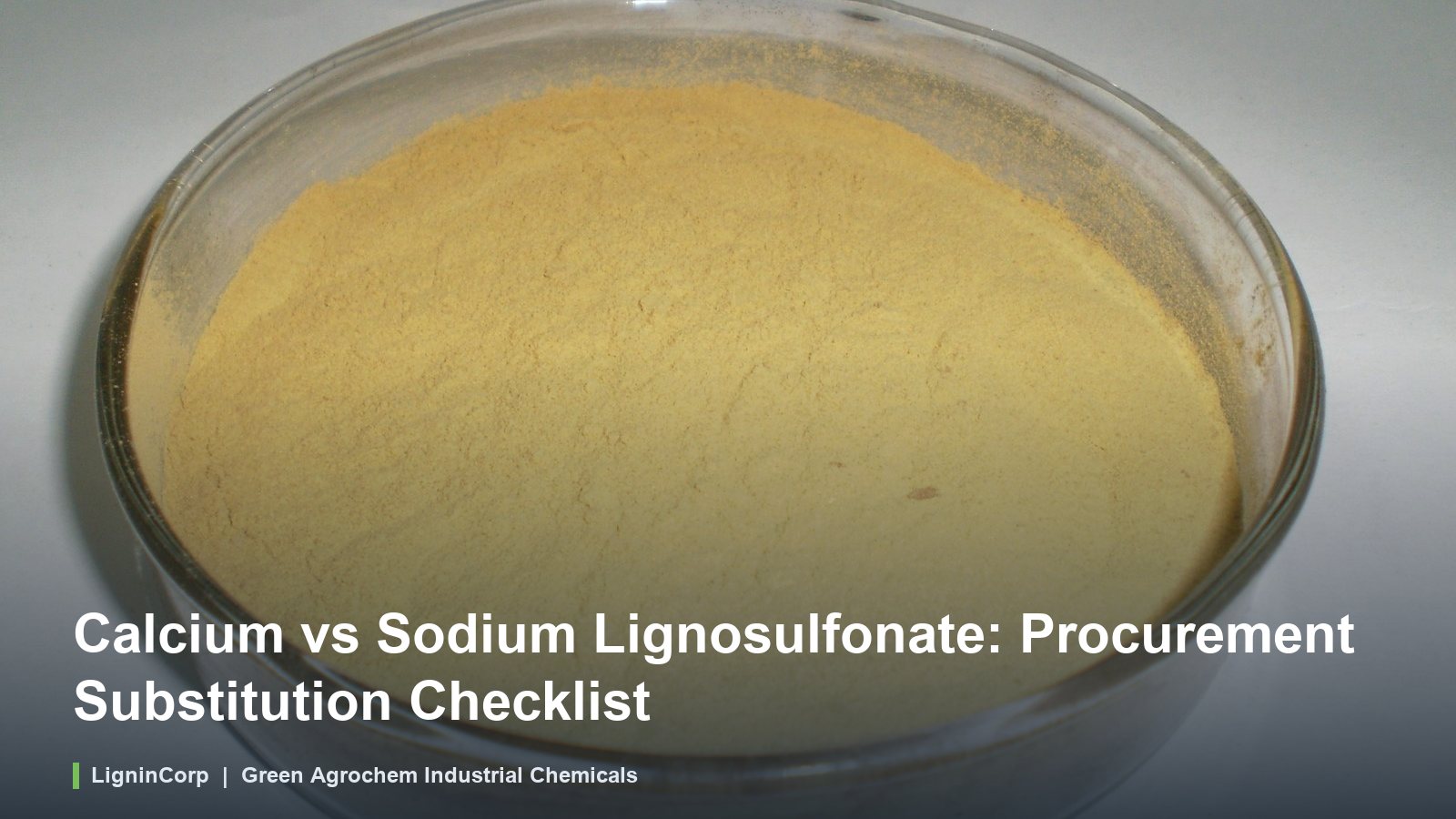
Choosing between calcium lignosulfonate and sodium lignosulfonate is not simply a choice between two counter-ions. For an industrial buyer, the practical question is whether a proposed grade can replace the approved material without changing dissolution, slurry behaviour, setting, binding, storage stability or downstream quality.
This procurement checklist focuses on controlled substitution and document comparison. For a neutral explanation of the chemistry and general differences, use the Calcium vs Sodium Lignosulfonate technical comparison at the Green Agrochem knowledge division.
Counter-Ion Is One Selection Variable
Calcium lignosulfonate contains calcium as the principal counter-ion; sodium lignosulfonate contains sodium. That distinction can affect the inorganic contribution and interactions within a formulation. It does not establish grade equivalence or predict every performance result. Commercial lignosulfonates are complex distributions whose behaviour also depends on feedstock, production route, degree of sulfonation, molecular-size distribution, inorganic salts, reducing substances, dry matter and insoluble matter.
Consequently, a buyer should not approve substitution from the product name, CAS reference or counter-ion alone. Compare the current documents for the exact offered grades and then test them in the actual process.
Side-by-Side Procurement Review
| Qualification point | What to compare | Why it matters |
|---|---|---|
| Exact grade identity | Product code, manufacturer, production site, physical form and document revision. | Prevents family-level information from being treated as an exact-grade specification. |
| Counter-ion and inorganic profile | Sodium or calcium identity plus relevant ash, sulfate, chloride and other declared inorganic constituents. | Formulation tolerance may depend on the total ionic load, not only the named counter-ion. |
| Concentration | Powder moisture or liquid solids, including the test method and whether results are typical or specification limits. | Equal as-supplied mass does not necessarily mean equal lignosulfonate dry solids. |
| pH | Result, solution concentration, preparation method, temperature and method. | pH values measured under different conditions are not directly comparable. |
| Dissolution and insolubles | Defined dissolution procedure, water quality, temperature, mixing time, filtration or residue method. | A generic statement such as “water soluble” does not predict plant make-down time or screen residue. |
| Organic profile | Lignosulfonate content, reducing substances and any grade-specific molecular or functional data that the supplier controls. | These variables may influence dispersion, binding, air, setting and interaction with other additives. |
| Batch consistency | Representative COAs from more than one batch and agreed acceptance limits. | A single typical data sheet cannot demonstrate routine variability. |
| Application response | Results against the approved control at equal dry solids under the same formulation and process. | Confirms whether a document-level difference has a material operating effect. |
When the Salt Form May Matter
The counter-ion deserves specific review when sodium or calcium loading is controlled, when hardness or multivalent-ion interactions affect the system, or when the formulation contains components sensitive to electrolyte balance. It may also affect how an existing make-down or metering system behaves. These effects remain application- and grade-dependent; neither salt form should be described as universally more compatible, more soluble or more effective.
Where the formulation is comparatively tolerant, differences in dry solids, molecular distribution, inorganic content or production consistency can be more important than whether the label says calcium or sodium. This is why purchasing specifications should contain measurable acceptance criteria rather than a product family name alone.
Controlled Substitution Workflow
- Define the approved control. Record its exact grade, batch, supplied form, dry-solids basis, normal preparation method and acceptance tests.
- Reconcile documents. Obtain current TDS and SDS documents plus representative COAs for both materials. Resolve different units, bases and test methods before comparing values.
- Prepare on an equal basis. Where technically appropriate, compare equal dry solids rather than equal as-supplied mass. Record water quality, temperature, mixing energy, order of addition and ageing time.
- Run a screening matrix. Include the control and candidate at more than one trial level. A numerical range is a supplier-recommended starting trial range only when the exact grade, source document, revision and calculation basis are identified.
- Measure the real endpoints. Select tests relevant to the process: dissolution residue, viscosity or flow, particle size, settling and redispersibility, foam or air, setting, strength, binding, filtration, drying and finished-product quality.
- Challenge compatibility. Test with the actual cement, mineral, pigment, binder, surfactant, electrolyte, water and other additives rather than simplified water-only systems.
- Confirm at scale. Verify the selected condition in pilot or plant equipment and establish incoming QC limits before routine substitution.
How to Read Numerical Data
| Data type | Acceptable evidence | How to use it |
|---|---|---|
| Product specification | Current exact-grade TDS or agreed specification with revision, units, basis and method. | Use as an incoming acceptance requirement; do not convert it into a dosage claim. |
| Representative batch result | COA that identifies product code, batch and test methods. | Use to examine consistency; do not treat one batch as a permanent limit. |
| Supplier starting trial range | Current application document for the exact grade with a defined calculation basis. | Use to design trials, then optimize and validate in the customer’s system. |
| Application performance | Defined control, formulation, dosage basis, conditions, method and source. | Treat as a result under those conditions, not a guaranteed customer outcome. |
Corrections to the Former Comparison
| Former statement | Evidence status | Correct purchasing treatment |
|---|---|---|
| Sodium lignosulfonate is highly water-soluble while calcium lignosulfonate has lower solubility and may require more heat or agitation. | Over-generalized family comparison; no exact grades or test method were identified. | Compare dissolution and residue for the offered grades under one defined make-down procedure. |
| Sodium grades are compatible with sodium-based systems and calcium grades with calcium-based formulations. | Unsupported compatibility shortcut. | Test the complete formulation; counter-ion identity alone does not establish compatibility. |
| The counter-ion determines behaviour in various applications. | Incomplete causal statement. | Evaluate counter-ion together with organic distribution, inorganic profile, concentration and process conditions. |
Product and Document Routes
Review the current Calcium Lignosulfonate product family and Sodium Lignosulfonate product family. Request exact-grade TDS, SDS and representative COA files from the LigninCorp technical document centre.
For substitution support, send the approved grade, application, current addition basis, critical acceptance limits, water chemistry, formulation components, equipment and destination market through the industrial enquiry page or email info@greenagrochem.com.
Related: sodium vs calcium lignosulfonate by application · calcium lignosulfonate product page and TDS.
