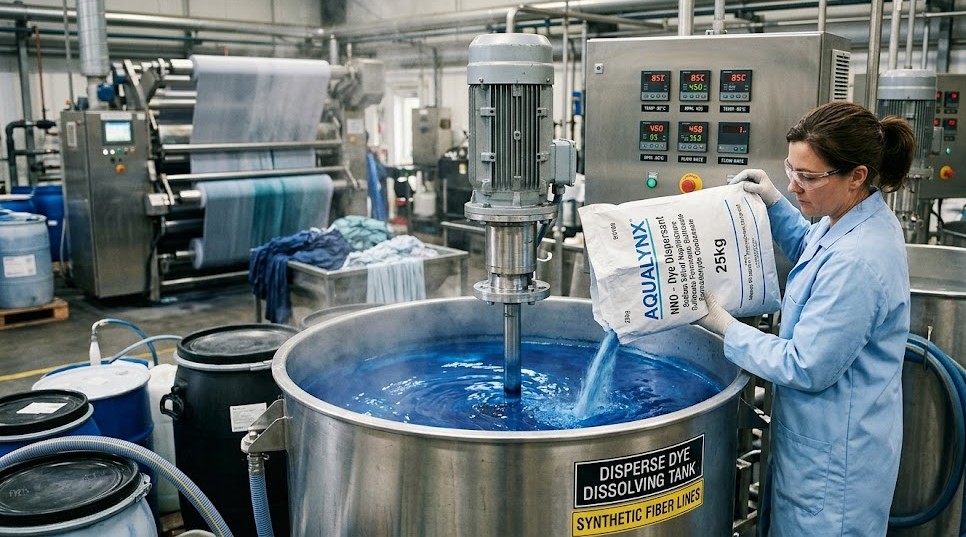
Dispersant NNO (Sodium Naphthalene Sulfonate Formaldehyde Condensate) is an industrial-grade anionic surfactant that solves the universal problem of uneven coloring in manufacturing. By preventing dye particles from clumping in aqueous solutions, dispersant NNO ensures vibrant, uniform, and color-fast results across synthetic textiles (polyester, nylon), premium leather goods, and specialty papers, significantly reducing product defect rates and dye waste.
Chemical Mechanism: How Dispersant NNO Works
Many industrial dyes—especially disperse dyes, vat dyes, and reactive dyes—have inherently low water solubility. Without a chemical intervention, these dye molecules agglomerate (clump) in the dye bath, causing streaks, spots, and uneven fabric penetration.
Dispersant NNO resolves this through a dual-action mechanism:
- Electrostatic Repulsion: The NNO molecules adsorb onto the surface of the dye particles, imparting a strong negative charge. This creates an electrostatic “force field” that pushes the dye particles apart.
- Steric Hindrance: The physical structure of the naphthalene-formaldehyde polymer creates a spatial barrier between dye molecules, physically preventing them from recombining.
Additionally, Dispersant NNO functions as a wetting agent. By lowering the surface tension of the water, it accelerates the dye’s penetration into the fiber matrix, improving overall color fastness (resistance to fading from washing or UV light).
Key Industrial Applications
1. Synthetic Textile Dyeing
Synthetic fibers like polyester and acetate require high temperatures and specific chemical conditions to accept color.
- The Role: Dispersant NNO stabilizes the dye bath under extreme conditions (often exceeding 130°C for polyester), preventing the dye from breaking down or clumping during hours-long, high-shear machine cycles (like jet dyeing).
2. Leather Manufacturing
In leather tanning and finishing, uneven dye uptake results in visually defective, lower-value hides.
- The Role: Dispersant NNO ensures that dyes spread uniformly across the porous and sometimes inconsistent surface of animal hides, producing rich, uniform finishes for high-end shoes, jackets, and upholstery.
3. Paper & Pulp
- The Role: In the production of colored tissue, wrapping paper, or cardstock, Dispersant NNO ensures that pigments are evenly distributed within the pulp slurry, eliminating blotchiness and ensuring consistent batch-to-batch coloration.
Technical Guidelines & Application Metrics
To maximize dye uptake and prevent formulation issues, manufacturers should adhere to the following operational parameters:
- Standard Dosage: 0.5% to 2.0% of the total dye bath’s weight. Overdosing can lead to excessive foaming, while under-dosing risks dye agglomeration.
- High-Temperature Stability: Fully stable in high-heat environments (up to and exceeding 130°C).
- Water Hardness Mitigation: High levels of calcium or magnesium in hard water can neutralize the dispersant’s negative charge. In hard water environments, manufacturers must use water softeners or slightly increase the NNO dosage.
- Compatibility: Highly compatible with other dyeing auxiliaries, such as leveling agents and carriers.
Note: In high-shear systems like jet dyeing, the fast-moving water may cause foaming. Integrating a compatible defoaming agent alongside Dispersant NNO is a standard industry practice.
