
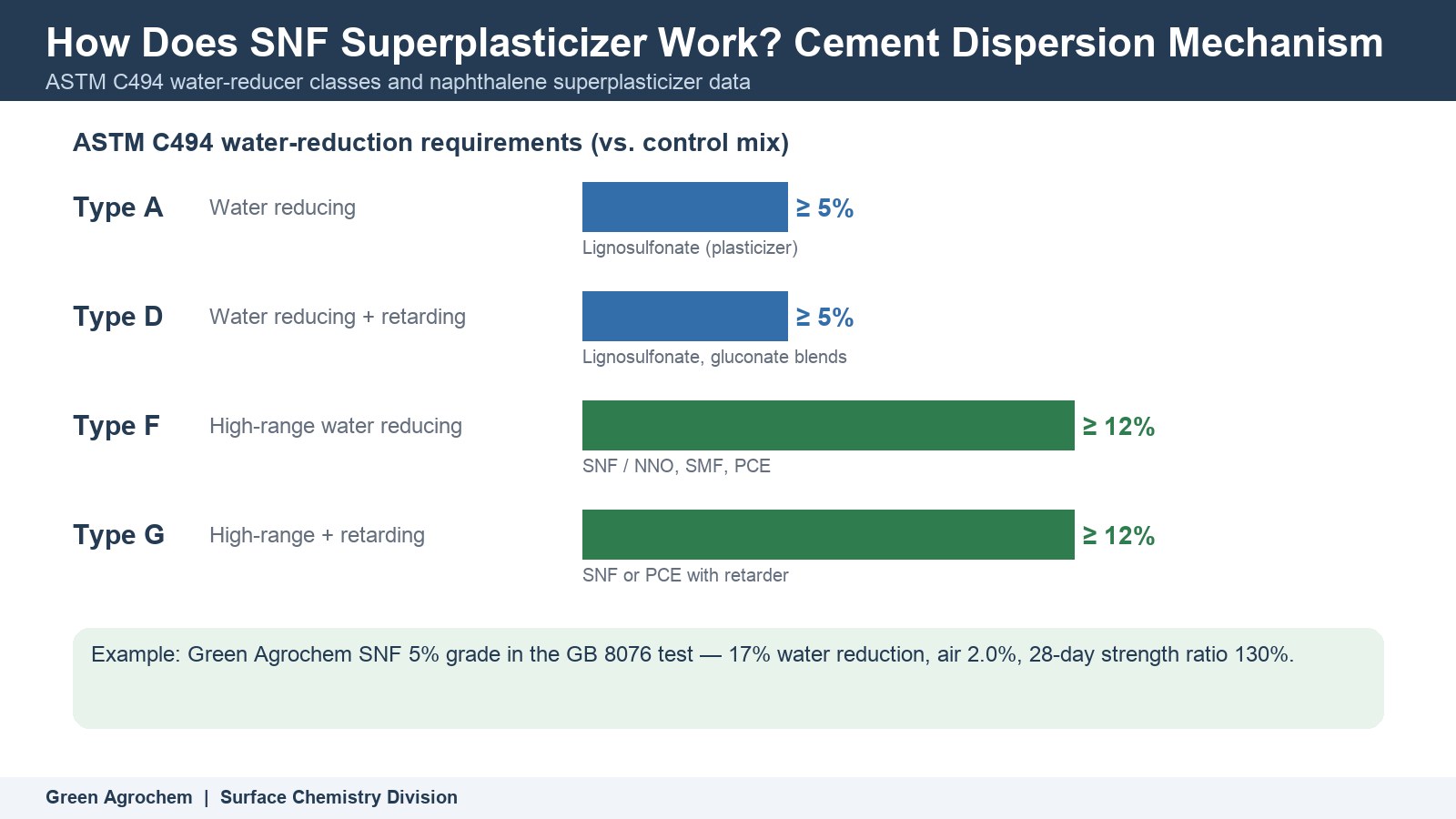
SNF (sodium naphthalene sulfonate formaldehyde condensate) improves the flow of a cementitious mix mainly by dispersing cement particles. It does not “make water”; it allows more of the existing mixing water to participate in lubrication instead of remaining trapped inside flocculated particle clusters. The practical result can be higher workability at the same water content, or lower water demand at a selected workability.
This article explains the mechanism and the variables that control field performance. For product specifications, samples and commercial support, see LigninCorp sodium naphthalene formaldehyde (SNF).
What happens before SNF is added?
After cement contacts water, fine particles do not remain evenly separated. Surface forces and early hydration products encourage them to form flocs. These loose clusters enclose part of the mixing water, so that water contributes less effectively to flow. A mix may therefore appear stiff even though it contains enough total water for the intended water-to-binder ratio.
Adding extra water can restore slump, but it also changes the designed water-to-binder ratio. An effective dispersant takes a different route: it breaks down a portion of the flocculated structure and releases entrapped water back into the paste.
How SNF disperses cement particles
SNF is an anionic, water-soluble condensate containing sulfonate groups. Once introduced into the mix, part of the polymer adsorbs on cement-particle surfaces. The exposed ionic groups alter the surface charge and increase electrostatic repulsion between adjacent particles. As the flocs become less stable, the paste flows more readily under mixing and placement forces.
This distinction matters when comparing admixture chemistries. SNF is normally described as relying primarily on electrostatic dispersion. Polycarboxylate ether (PCE) products also use steric effects created by their side-chain architecture. Treating the two mechanisms as identical can lead to misleading expectations about dosage, slump retention and cement compatibility.
Two valid ways to use the dispersion effect
Maintain water and increase workability
Where the water-to-binder ratio is fixed, SNF may increase slump or flow and improve placement. This can be useful for reinforced sections, pumping and precast production, provided that segregation, bleeding and air remain within the project specification.
Maintain workability and reduce water
Where the target slump is fixed, the mix designer may reduce mixing water while using SNF to retain the required workability. The achievable reduction is not a universal percentage. It depends on cement, supplementary cementitious materials, aggregate grading, temperature, mixing procedure and the selected SNF grade.
Why the same dosage produces different results
SNF performance is system-dependent. A dosage that works in one plant may not transfer directly to another mix. The following variables deserve particular attention:
- Cement chemistry and sulfate balance: these affect adsorption, early hydration and flow response.
- Cement fineness: a higher surface area can increase admixture demand.
- SCMs and fine contaminants: fly ash, slag, silica fume and clay-bearing fines can change the response.
- Temperature and transport time: they influence early hydration and slump retention.
- Order of addition: adding SNF with the initial water can perform differently from delayed addition.
- Other admixtures: air entrainers, retarders, accelerators and defoamers may create useful or adverse interactions.
Recommended laboratory evaluation
Use the supplier dosage range as a recommended starting range for trials, not as a guaranteed field dose. Compare products on an active-solids basis when liquid and powder grades are involved. A practical screening program should record:
- initial slump, flow or mortar spread;
- retained workability at project-relevant intervals;
- air content, density and temperature;
- setting behaviour and finishing response;
- bleeding, segregation and visual stability;
- early and later-age strength under the specified curing regime.
The preferred dosage is the lowest level that satisfies the complete performance requirement—not simply the dose that produces the highest initial flow. Excess addition can reduce stability or disturb setting in some systems, so laboratory results should be confirmed in a plant trial before routine use.
SNF or PCE?
The choice depends on the mix and the commercial objective. SNF remains relevant where dependable initial dispersion, established production practice and cost control are important. A suitable PCE may be preferred where very high water reduction or extended slump retention is required. Neither family should be selected from chemistry name alone; cement compatibility and the full performance specification decide the result.
Technical support and product selection
When requesting a sample, provide the cement type, SCM content, target water-to-binder ratio, required slump or flow, retention time, temperature range and companion admixtures. These details allow a more useful starting recommendation. Review the SNF product page or contact LigninCorp for the current specification, COA parameters and trial support.
