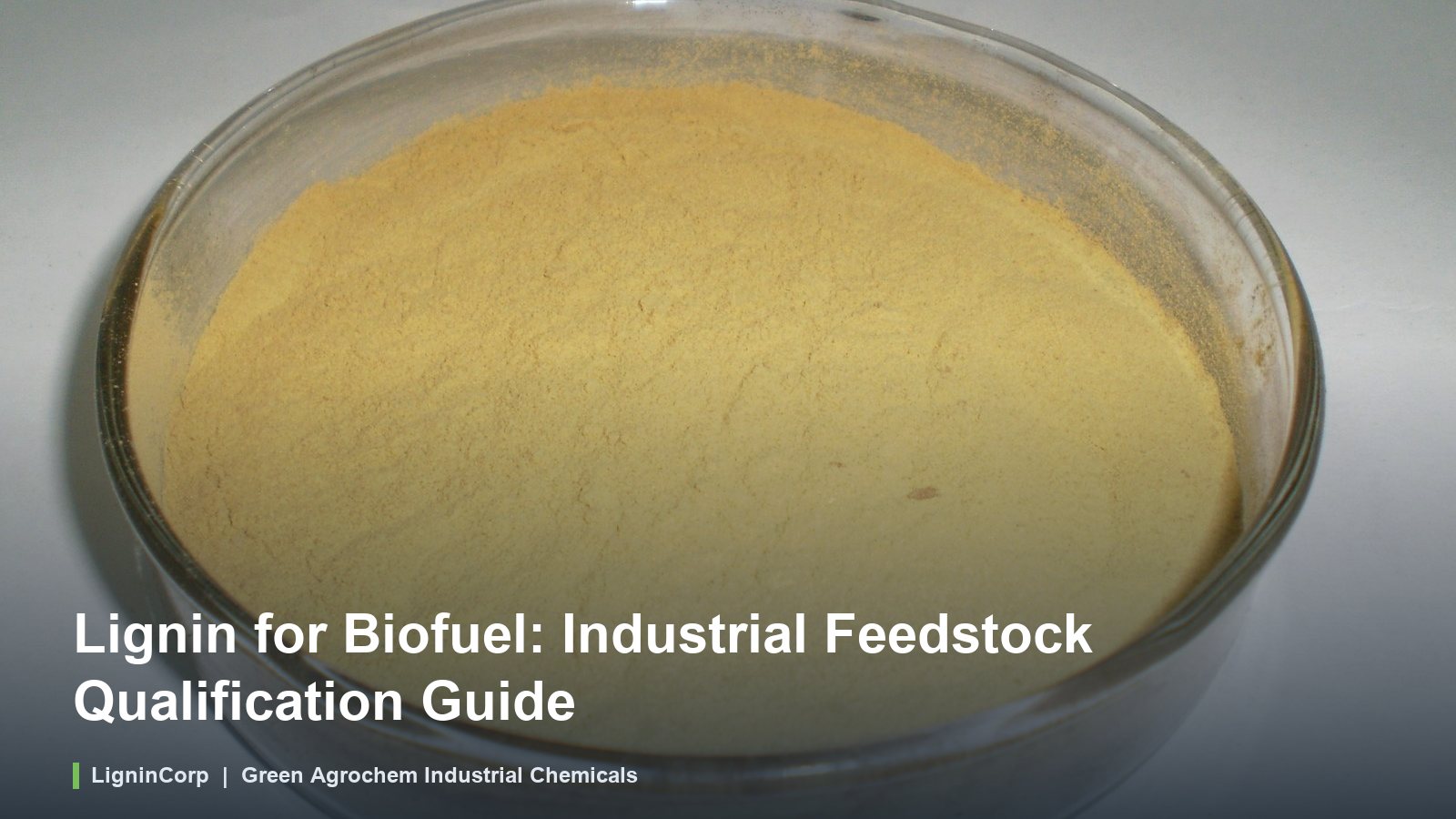
Lignin-rich materials can be evaluated as industrial energy streams or as feedstocks for pyrolysis, gasification and upgrading, but “lignin biofuel” is not one interchangeable commercial product. Fuel behaviour depends on lignin source, isolation process, moisture, ash, sulfur, alkali metals, chlorine, particle form, heating value and the intended conversion equipment.
This page is a procurement and qualification guide for industrial users. It does not claim that every lignin or lignosulfonate grade is suitable for transport fuel, aviation fuel or direct combustion.
First Define the Material and Conversion Route
| Material/route | Qualification focus | Important boundary |
|---|---|---|
| Mill lignin-rich stream or black liquor | Solids, inorganic recovery requirements, sulfur/alkali balance, viscosity, pumping and boiler integration. | Site-integrated recovery streams are not equivalent to isolated merchant lignin. |
| Isolated kraft lignin | Moisture, ash, sulfur, volatile matter, fixed carbon, particle form and thermal behaviour. | Suitability depends on isolation/washing and the downstream reactor. |
| Lignosulfonate | Counter-ion, inorganic profile, moisture/solids, sulfur-containing constituents and combustion residue. | A dispersant or binder grade is not automatically a fuel-grade feedstock. |
| Pyrolysis feed | Particle size, drying, feeding, char/coke tendency, vapour yield and bio-oil quality under defined conditions. | Raw bio-oil is not automatically a drop-in transport fuel. |
| Gasification feed | Ash chemistry, slagging/fouling risk, feed handling, gas composition, contaminants and cleanup duty. | Syngas requires conditioning and a defined downstream use. |
| Upgraded liquid-fuel pathway | Oxygen removal, hydrogen demand, catalyst stability, distillation range and final fuel testing. | Meeting aviation, diesel or gasoline specifications must be demonstrated for the finished fuel. |
Feedstock Data to Request
- Identity and origin: biomass source, pulping or fractionation route, isolation/washing steps and product code.
- Physical supply: powder, granule, cake or liquid; particle-size distribution; bulk density; flow and storage behaviour.
- Proximate/ultimate analysis: moisture, ash, volatile matter, fixed carbon and elemental composition using stated methods.
- Inorganic and contaminant profile: sulfur, sodium, calcium, magnesium, potassium, chlorine and other equipment- or catalyst-relevant elements.
- Thermal data: higher/lower heating value with basis, thermogravimetric behaviour where useful, and ash-fusion or deposition indicators for the selected route.
- Process response: feedability, conversion yield, gas/liquid/char distribution and product quality under defined reactor conditions.
- Safety and logistics: current SDS, dust controls, storage limits, packaging, transport classification and destination requirements.
Qualification Workflow
- Define the intended route, equipment envelope, feed rate and finished-product specification.
- Establish a reference feedstock and pass/fail limits for handling, conversion and emissions-control equipment.
- Obtain current exact-material TDS/SDS, representative COAs and analytical methods. Do not substitute family-level web values.
- Complete mass and energy balances on the same moisture and ash basis.
- Run bench screening for feeding, conversion, char/coke, condensable quality, gas cleanup and residue handling.
- Conduct a controlled pilot campaign long enough to evaluate deposits, catalyst deactivation, corrosion and product consistency.
- Verify the finished fuel or intermediate against its applicable specification and destination-market rules before making commercial claims.
Environmental Claims Require a Defined System
Greenhouse-gas reduction, carbon neutrality, waste reduction and lower emissions cannot be inferred from “lignin-based.” A defensible assessment must define the feedstock origin, allocation method, system boundary, land-use assumptions, electricity and hydrogen sources, transport, conversion yield, coproduct treatment and end use. Stack emissions also depend on equipment and controls, while finished transport fuels must meet the applicable regulated specification.
Economic assessment likewise requires current feedstock cost, drying and preprocessing duty, hydrogen/catalyst demand, yield, upgrading, utilities, residue disposal, logistics and product value. A global market forecast does not establish the viability of one project.
Former Numerical Claims and Evidence Status
| Former statement | Status | Correct treatment |
|---|---|---|
| Lignin represents 15–30% of biomass and contains 55–65% carbon versus 40–45% for cellulose. | Unverified broad ranges; source, species, analytical basis and material type were not stated. | Retained for traceability only. Use measured exact-feedstock data or a fully cited literature system. |
| Lignin biofuels reduce greenhouse-gas emissions by 50–70% or up to 70%. | Unsupported universal life-cycle result. | Do not publish as a product outcome; require a route-specific, cited life-cycle assessment. |
| Lignin-derived jet fuel meets aviation fuel standards. | Overbroad qualification claim. | Only a finished, tested fuel approved under the applicable pathway/specification can make this claim. |
| 10–20% blends can be used to meet renewable-fuel standards. | Unverified blend and regulatory statement. | Blend limits depend on finished-fuel chemistry, specification and jurisdiction. |
| Global biofuel production would reach 250 billion litres by 2025 and the market would exceed USD 200 billion by 2030. | Undated/unsupported forecast, and the 2025 forecast date has passed. | Excluded from commercial decision-making unless replaced by a current named source, scope and publication date. |
Commercial Enquiry Checklist
Send the material origin, process route, annual volume, required physical form, moisture/ash limits, elemental requirements, conversion technology, test methods, packaging and destination to the LigninCorp industrial enquiry team. For general lignin supply context, review the industrial lignin product route and technical document centre. Email: info@greenagrochem.com.
