Lignin research is a rapidly advancing scientific field driven by the urgent global need to replace petroleum-based products with sustainable, renewable alternatives. As the second most abundant biopolymer on Earth (after cellulose), lignin represents a massive, largely untapped resource.
Found naturally in plant cell walls, it provides vital structural support and biological defense mechanisms. Today, scientists are actively exploring how to extract and transform this complex organic compound for use in modern industries ranging from bioenergy to advanced biomedicine.
1. What is Lignin?
Structurally, it is composed of phenylpropane units derived from three primary building blocks (monolignols):
- p-Coumaryl alcohol
- Coniferyl alcohol
- Sinapyl alcohol
These units are linked together by various highly stable chemical bonds (such as β-O-4, 5-5, and β-5). In living plants, this sturdy, heterogeneous structure serves three critical functions:
- Structural Rigidity: Strengthens plant cell walls, allowing trees and plants to grow upward against gravity.
- Water Transport: Reinforces vascular tissues so water can be efficiently pumped throughout the plant.
- Biological Defense: Acts as a physical and chemical barrier against microbial pathogens and environmental stress.
2. Recent Developments in Lignin Research
Historically, lignin was treated merely as an industrial waste product of the paper industry—usually burned for low-grade heat. Recent breakthroughs have shifted the focus toward understanding its structure, improving how we extract it, and finding high-value applications.
A. Structural Characterization and Biosynthesis
To utilize lignin, scientists must first understand its highly variable structure.
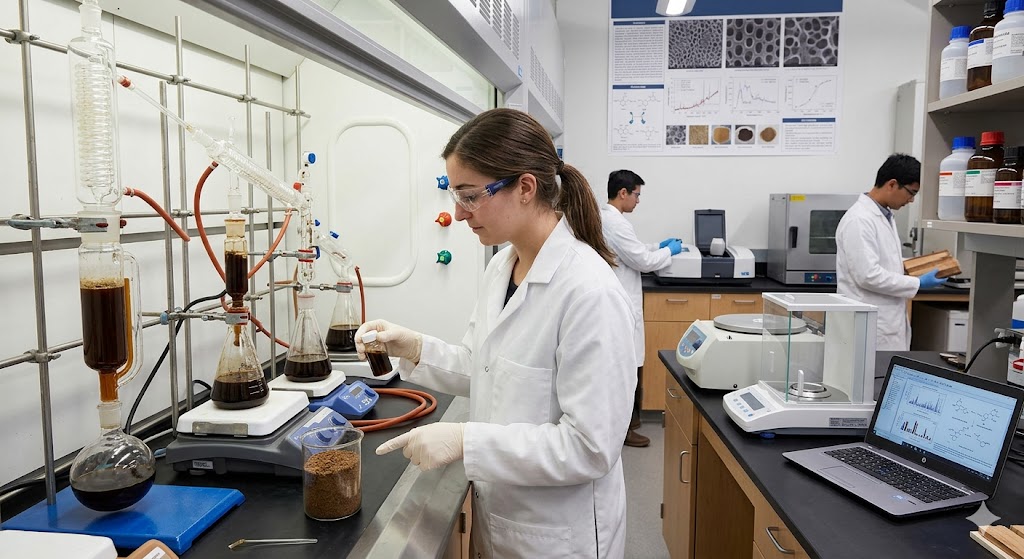
- Advanced Analytics: Researchers now utilize tools like Nuclear Magnetic Resonance (NMR) spectroscopy and Size Exclusion Chromatography (SEC) to map lignin’s complex molecular weight and bonding patterns.
- Genetic Engineering: By studying lignin biosynthesis (how plants naturally produce it), scientists are exploring how to genetically modify crops to produce “designer lignin” that is much easier to extract and process industrially.
B. Extraction and Fractionation Methods
| Extraction Method | Technology / Solvents Used | Characteristics & Impact |
| Traditional Pulping | Kraft and Sulfite processes | Harsh chemicals; highly degrades the lignin structure; historically used just to remove lignin to access cellulose for paper. |
| Green Alternatives | Organosolv, Deep Eutectic Solvents (DES), Ionic Liquids | Environmentally friendly; preserves the natural polymer structure; allows researchers to tailor the chemical properties for high-value uses. |
C. Valorization: High-Value Industrial Applications
Modern research is successfully transforming extracted lignin into high-performance commercial materials:
- Biomedical Uses: Because it is highly biocompatible and naturally rich in antioxidants, Lignin Nanoparticles (LNPs) are being engineered for targeted drug delivery and gene therapy. Lignin-based hydrogels are also being developed for advanced wound dressings.
- Energy Storage: Due to its dense carbon content, lignin is being utilized to manufacture supercapacitor electrodes and sustainable carbon fibers for battery technologies.
- Sustainable Materials: Lignin is being integrated into bioplastics, industrial resins, and 3D printing filaments, directly replacing petroleum-based plastics.
- Chemical Production: Through controlled depolymerization (breaking the polymer down), lignin yields valuable aromatic chemical compounds like vanillin and catechol, which are essential in global pharmaceutical and fragrance supply chains.
3. Environmental Implications and the Bio-Economy
Lignin is entirely renewable. Its successful commercialization plays a central role in the transition to a global, bio-based economy.
- Carbon Reduction: By utilizing lignin to manufacture plastics and chemicals, industries can significantly reduce their reliance on fossil fuels, directly lowering global greenhouse gas emissions.
- Biorefinery Efficiency: Converting lignin waste into advanced biofuels boosts the economic viability of green biorefineries, ensuring no part of the harvested plant is wasted.
4. Current Challenges in the Field
Despite its immense potential, lignin research must overcome several significant hurdles before achieving widespread commercial adoption:
- Structural Complexity: Lignin’s chemical makeup varies wildly depending on the plant species and the extraction method used. This lack of uniformity makes it difficult to standardize for mass manufacturing.
- Industrial Scalability: Many green extraction techniques (like Deep Eutectic Solvents) perform exceptionally well in controlled laboratories but are currently too expensive or complex to scale up for heavy industrial use.
- Economic Competition: Lignin-based products are currently competing against heavily subsidized, highly optimized, and exceptionally cheap petrochemical alternatives. Breakthroughs in cost-efficiency are required to make lignin economically competitive.
Conclusion
Lignin research is successfully unlocking the commercial and environmental potential of a material once discarded as industrial waste. From sustainable bioplastics to cutting-edge biomedical hydrogels, lignin offers a wealth of global opportunities. While challenges regarding its structural complexity and scalability remain, ongoing innovations in green extraction and chemical valorization are positioning lignin to become a cornerstone of modern, sustainable industry.
