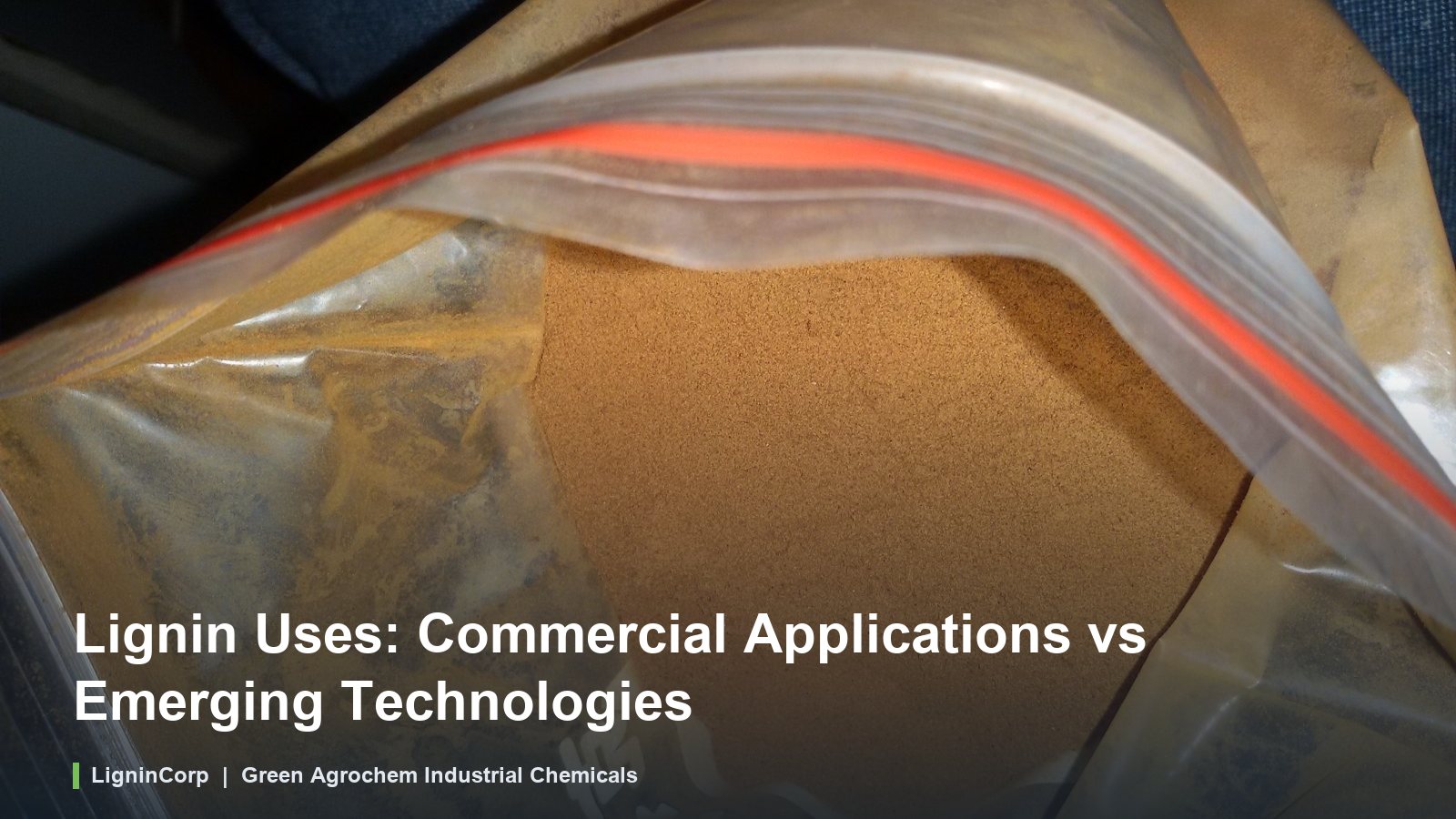
“Lignin uses” covers several different materials and maturity levels. Native lignin in biomass, Kraft lignin, soda lignin, organosolv lignin and lignosulfonates are not interchangeable. Some uses—particularly lignosulfonate dispersants and binders—have long commercial histories. Others, including high-performance carbon fibre, drop-in fuels and advanced polymer platforms, remain dependent on feedstock, purification, modification, process economics and qualification.
This page is an industrial buyer’s application map. For neutral chemistry and technical background, continue to the Lignosulfonate Knowledge Hub’s lignin uses guide.
First identify the lignin material
| Material stream | Important characteristics | Typical decision issue |
|---|---|---|
| Lignin-containing black liquor | Kraft-mill process stream containing organics and pulping chemicals | Usually integrated with chemical recovery and energy generation; not a purified commercial lignin grade |
| Kraft lignin | Sulfur-containing technical lignin isolated from black liquor; generally not water soluble without modification | Purity, ash, sulfur, molecular distribution and functionalization determine use |
| Lignosulfonates | Water-soluble sulfonated lignin-derived materials with Ca, Na, Mg or ammonium counter-ions | Grade composition, sugars/salts, insolubles and application response must be matched |
| Soda/organosolv or other technical lignins | Different extraction history and functional-group profile | Do not transfer Kraft or lignosulfonate data without characterization |
| Purified, fractionated or chemically modified lignin | Narrower or intentionally altered properties | Additional processing may enable higher-value uses but changes cost, specification and scale |
Industrial uses by commercial maturity
| Use area | Relevant material/function | Maturity and buyer qualification |
|---|---|---|
| Pulp-mill energy and chemical recovery | Lignin-rich process liquor contributes fuel value in integrated recovery systems | Established mill operation; assess within the mill mass/energy and chemical-recovery balance, not as a packaged lignin product |
| Concrete, cement and mineral systems | Lignosulfonates may provide conventional dispersion, plasticizing, grinding or rheology support | Commercially established category; verify exact grade, dosage basis, cement/mineral system, flow, air, setting and strength |
| Industrial binding and granulation | Lignosulfonates can bind mineral fines, carbonaceous materials and other granules | Commercial category; test green/dry strength, abrasion, moisture response, drying and downstream compatibility |
| Dust control | Liquid or dissolved lignosulfonates bind fine particles on suitable surfaces | Commercial category; qualify soil/fines, climate, traffic, runoff, corrosion, rate basis and maintenance interval |
| Dispersants and formulation aids | Lignosulfonates or modified lignins may adsorb on particles and influence colloidal stability | Commercial in selected systems; measure viscosity, particle size, sedimentation, salt/pH tolerance and storage |
| Adhesives, resins and composites | Technical lignin may replace part of a phenolic component or function after modification | Commercial maturity varies by formulation; verify substitution level, cure, emissions, bond strength, water resistance and durability |
| Vanillin and aromatic chemicals | Controlled lignin oxidation/depolymerization can yield aromatic products | Some established lignin-derived production exists, but selectivity, yield and economics depend strongly on route and feedstock |
| Carbon fibre, advanced carbon materials, fuels and high-performance polymers | Purified/fractionated lignin or converted intermediates | Predominantly developing or application-specific; require technology-readiness, scale, consistency, lifecycle and cost evidence |
What LigninCorp supplies—and what it does not imply
LigninCorp’s relevant commercial scope is industrial lignosulfonate grades and associated procurement/application support. A lignosulfonate product page does not establish that the offered grade is Kraft lignin, carbon-fibre precursor, fuel intermediate, food/flavour feedstock or polymer-grade purified lignin. Buyers should request the exact product code and current TDS/SDS/COA for the intended industrial application.
- Industrial lignosulfonate products
- Industrial application routes
- Neutral background: lignin origin, structure and recovery
Published research and industry data
| Reported information | Material/system | Source and conditions | How to interpret it |
|---|---|---|---|
| Approximately 25.6 MJ/kg fuel value reported in a structural-materials review | Waste/technical lignin discussed as an energy coproduct | Review of lignin in structural materials and composites (2020) | Literature context, not a calorific-value specification for a Green Agrochem grade or for black liquor |
| Bioplastics, carbon fibres, composites, adhesives, foams and phenolic products are active valorization areas | Multiple technical lignins and modified materials | Review of lignin integration in sustainable materials (2021) | Evidence of development/application fields, not proof of commercial readiness or equivalent performance |
| Heterogeneity and mechanical performance constrain pure lignin-based carbon-fibre commercialization | Functionalized/fractionated lignin carbon-fibre research | Review of functionalized lignin in polymeric materials (2020) | Use technology-readiness and product-specific evidence; do not advertise aerospace/automotive performance generically |
These figures and conclusions were reported for the cited materials and contexts. They are not Green Agrochem product specifications, universal recommendations or performance guarantees.
Evidence status of former broad claims
| Former statement | Evidence/status | Correct treatment |
|---|---|---|
| Energy output around 25–30 MJ/kg, comparable to coal | A value near 25.6 MJ/kg is reported for technical/waste lignin in literature, but no exact offered grade or test method was stated on the former page | Retained above as literature context; obtain lot-specific calorific data for fuel decisions |
| Lignin creates bioplastics with vastly improved heat resistance and strength | Polymer, lignin type, loading, compatibilization, control and method missing | Treat as a formulation-dependent research/application question |
| Lignin automatically extends packaging life without toxic additives | No package, migration, safety, ageing or regulatory evidence | Requires material, food-contact/end-use and durability qualification |
| Lignin carbon fibre is lightweight/high-strength for automotive and aerospace use | Overstates commercial/mechanical readiness | Use product-specific mechanical data and technology-readiness evidence |
| Lignin adhesives eliminate toxic emissions while maintaining structural strength | Confuses partial phenol substitution and multiple adhesive chemistries; formaldehyde may still be present | Measure formulation-specific emissions, cure, bond and durability against the applicable standard |
| Lignosulfonates automatically reduce water/cement and infrastructure carbon footprint | No exact grade, mix, dosage basis, strength equivalence or lifecycle boundary | Verify concrete performance first; make environmental claims only from a defined comparative assessment |
Buyer qualification checklist
- Name the exact material class and commercial product code.
- Define the intended function and measurable application target.
- Request current TDS/SDS, signed COA, methods, source/process information and change control.
- Compare candidates on a defined active or dry-solids basis using appropriate controls.
- Evaluate impurities, compatibility, processing, final performance, safety and destination-market requirements.
- Separate laboratory potential, pilot demonstration and commercial production evidence.
For industrial lignosulfonate grade matching, documents and samples, contact info@greenagrochem.com.
