
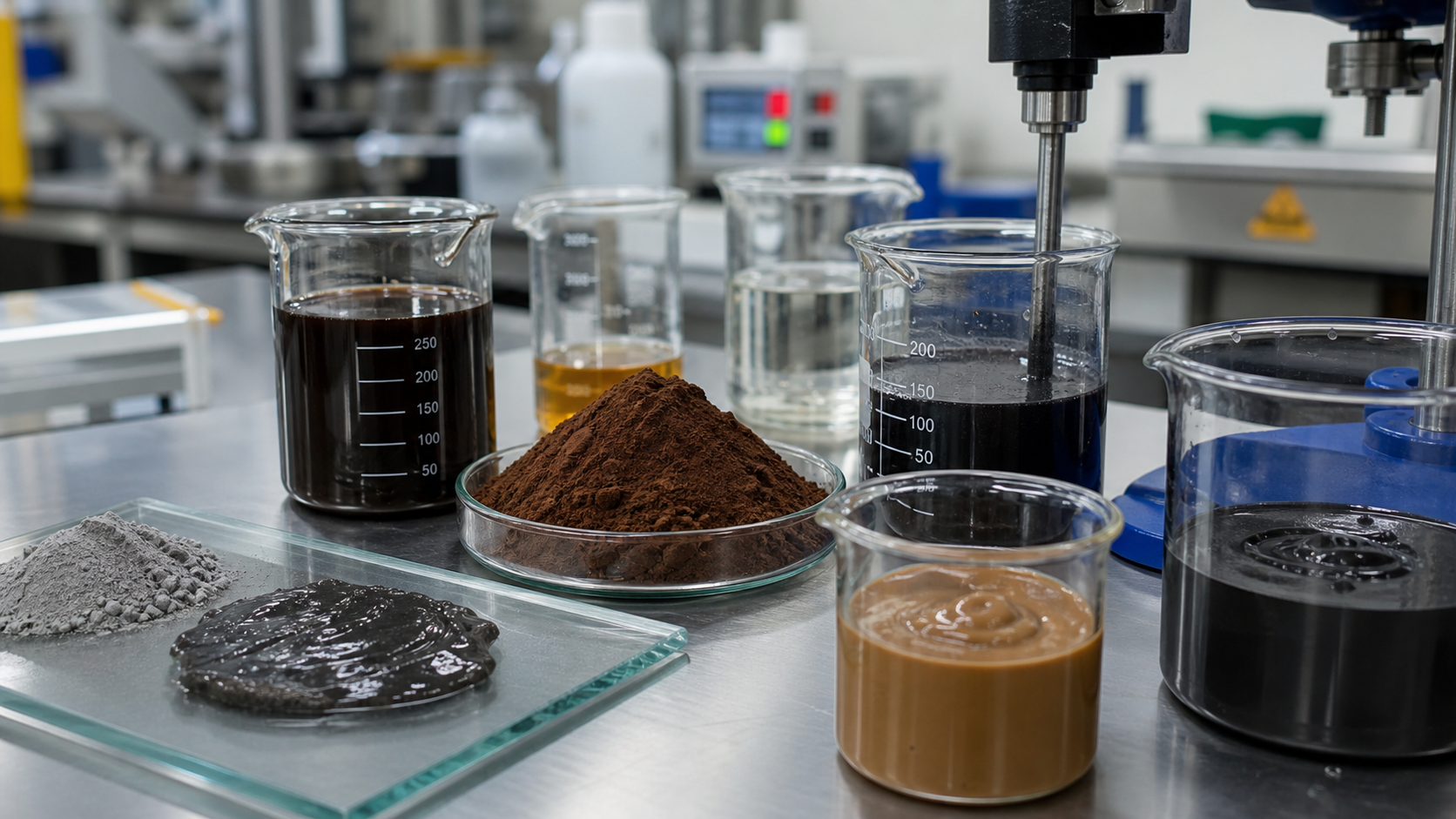
Lignosulfonates can function as binders, dispersants and emulsion-supporting additives, but these terms describe different jobs in a formulation. Performance depends on the lignosulfonate grade, counter-ion, molecular distribution, solids, pH, water chemistry, particles or oil phase, and processing conditions. Buyers should select a grade by measurable application results rather than assuming one product performs all three functions equally.
For available industrial grades and current documentation, start with Sodium Lignosulfonate, Calcium Lignosulfonate or Magnesium Lignosulfonate.
Three functions, three qualification methods
| Target function | What the additive is expected to do | Useful qualification measurements |
|---|---|---|
| Binder | Promote cohesion between particles during granulation, compaction or drying. | Green strength, cured strength, attrition, fines, moisture, density and re-wetting behavior. |
| Dispersant | Adsorb at solid–liquid interfaces and help reduce agglomeration or slurry viscosity. | Viscosity versus dosage, yield stress, particle-size stability, sedimentation and aging. |
| Emulsion-supporting additive | Contribute interfacial activity or stabilization in selected oil–water systems. | Droplet size, separation, creaming, viscosity, temperature cycling and storage stability. |
A lignosulfonate that disperses one mineral slurry may not stabilize a different emulsion or deliver adequate binding after drying. “Emulsifier” should therefore not be treated as a universal grade claim; some systems may require a dedicated surfactant or co-emulsifier.
Lignosulfonate as an industrial binder
In briquettes, granules, mineral agglomerates and selected board or ceramic processes, lignosulfonate solution can distribute through the particle bed and contribute cohesion as water is removed. The result is affected by particle-size distribution, surface chemistry, moisture, compaction pressure, curing or drying profile, and final exposure to water.
Binder trials should compare dry and wet strength, drop resistance, abrasion or attrition, generated fines and process throughput. Dark color, soluble salts, residual sugars and hygroscopic behavior may be relevant limits in some finished products.
Lignosulfonate as a dispersant
The anionic groups and polymeric structure of lignosulfonates can support adsorption and electrostatic or steric effects at particle surfaces. This may improve flow or allow a higher solids loading in suitable mineral, ceramic, gypsum or cementitious systems. Response can change with calcium or magnesium ions, salinity, pH, temperature and competing additives.
Generate a dosage-response curve instead of evaluating one arbitrary addition level. Measure viscosity immediately and after aging, observe settling or hard packing, and verify the final product property. For concrete-specific selection, see Lignosulfonate Concrete Admixtures.
Role in emulsions
Lignosulfonates have surface-active character, but emulsion performance is highly formulation-specific. Oil polarity, phase ratio, electrolyte concentration, shear, droplet size, temperature and other surfactants all influence stability. A screening result in one emulsion should not be transferred to another without testing.
Evaluate initial emulsification, separation over time, creaming, sediment, viscosity and recovery after temperature cycling. If the primary requirement is pesticide, dye or pigment formulation technology, use the group’s specialist Surface & Interface Technology lignosulfonate dispersant guide rather than assuming an industrial lignosulfonate grade is suitable.
Recommended laboratory screening
Treat supplier guidance as a recommended trial range and calculate additions on an active-solids basis.
- Define the primary function and measurable pass/fail criteria.
- Characterize the actual solids, liquid phase, salts, pH and processing temperature.
- Compare several dosages against an untreated control and the current additive.
- Keep mixing energy, addition order, residence time and test method constant.
- Measure both immediate performance and stability after relevant storage or processing.
- Confirm the selected grade and dosage in a controlled production trial.
Grade and supplier checklist
- Counter-ion and product form: sodium, calcium, magnesium; powder, granule or liquid.
- Moisture or liquid solids, pH, solubility, insolubles and ash.
- Reducing sugars and relevant inorganic ions where the application is sensitive.
- Current TDS, SDS, lot-specific COA and stated test methods.
- Packaging, storage, shelf life, traceability and change-notification controls.
Important limitations
No fixed strength gain, viscosity reduction, water reduction, emulsion life or cost saving applies across formulations. Compatibility with cement, salts, polymers, surfactants, preservatives and other additives must be demonstrated experimentally. Safety, biodegradability, environmental and regulatory claims require current grade-specific evidence and an end-use assessment.
Send the intended material system, required function and acceptance tests to info@greenagrochem.com for grade selection and a trial plan.
