
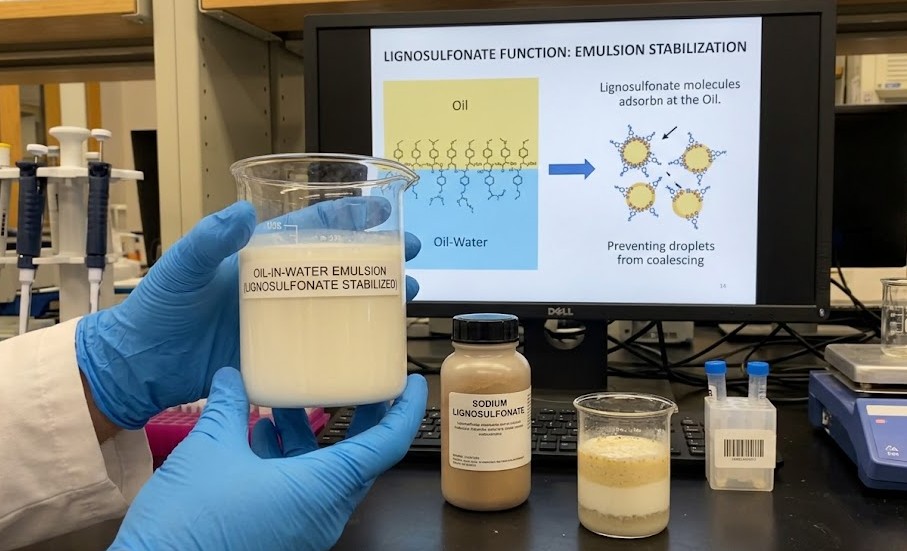
Lignosulfonate may support oil-in-water emulsions through interfacial adsorption, electrostatic and steric effects, and changes in the aqueous phase. Performance is not inherent to the product name: it depends on grade hydrophobicity, molecular-size distribution, sulfonation, residual salts, oil chemistry, water composition, pH, temperature, shear and other surfactants. Industrial selection should therefore be based on a controlled emulsion test rather than a universal dosage or compatibility claim.
What lignosulfonate can do at an oil–water interface
The aromatic and aliphatic regions of lignosulfonate can interact with hydrophobic phases while sulfonate and other ionizable groups remain associated with the aqueous phase. Adsorbed material may lower interfacial tension and help form a protective interfacial layer around droplets. Charge repulsion, steric effects and the rheology of that layer can slow coalescence. These mechanisms can operate together, but their relative importance changes with the lignosulfonate and formulation.
Lower interfacial tension can assist droplet formation during mixing; it does not by itself prove long-term stability. Droplet-size distribution, density difference, continuous-phase viscosity, interfacial-film strength, creaming, flocculation and coalescence must also be evaluated.
Grade and formulation variables
| Variable | Why it matters | Practical check |
|---|---|---|
| Hydrophobicity and molecular distribution | Influence adsorption, interfacial activity and solution behaviour. | Compare candidate grades in the same oil/water system on equal dry solids. |
| Sulfonation and counterions | Affect charge density, solubility and electrolyte response. | Record exact grade, ion form, ash and water analysis. |
| Oil or hydrophobic phase | Polarity, viscosity and dissolved components change adsorption and droplet formation. | Use the customer’s actual oil lot or a defined representative control. |
| pH and electrolyte | Change ionization, conformation, aggregation and precipitation risk. | Test the operating window, not only deionized water. |
| Other surfactants and polymers | May cooperate or compete at the interface and can form complexes. | Screen the complete formulation and addition sequence. |
| Shear and temperature | Control initial droplet formation and can change adsorption or viscosity. | Match plant equipment, residence time and temperature cycle. |
What published research establishes
Ruwoldt and co-workers compared commercial sodium lignosulfonates using mineral-oil/water emulsions, separation and rheological testing, droplet-size analysis and spinning-drop interfacial-tension measurements. In that experimental set, more hydrophobic samples generally stabilized the emulsions better, while samples with greater salt tolerance tended to show lower emulsion-stabilization efficiency. The effect on interfacial tension depended on sample, concentration and oil phase. See the original ACS Omega study on salt tolerance and emulsion stability.
A related study reported that low-molecular-weight alcohols could alter lignosulfonate accessibility to hydrophobic interfaces and affect emulsion stabilization in the tested systems. This is a formulation-specific research observation, not a recommendation to add alcohol to a commercial product. See the published alcohol–lignosulfonate emulsion study.
These literature results explain useful mechanisms and screening variables. They are not LigninCorp product specifications, supplier-recommended dosage ranges or guarantees for a customer’s formulation.
Laboratory qualification workflow
Define the control and acceptance criteria
Document oil/water ratio, water chemistry, pH, salt profile, temperature, mixing device, speed, time, sequence and hold period. Use the current emulsifier system as a control. Define acceptable droplet-size distribution, phase separation, viscosity, redispersibility and appearance before testing begins.
Prepare an equal-solids screening matrix
Correct powder and liquid products to the same dry-solids or active basis. Test several candidate grades and controlled addition levels. A number may be called a supplier-recommended starting trial range only when a current document identifies the exact grade and calculation basis. Otherwise, establish the matrix experimentally and do not present it as a general dosage.
Measure formation and ageing separately
Measure initial droplet size and distribution immediately after emulsification, then repeat after defined storage, temperature cycling and shear. Track creaming, sedimentation, flocculation, coalescence, viscosity and ease of redispersion. If interfacial tension is measured, interpret it alongside—not instead of—the finished-emulsion results.
Confirm robustness before scale-up
Challenge the preferred formulation with water and raw-material lot variation, upper and lower pH, electrolyte changes, process temperature and realistic plant shear. Confirm compatibility with preservatives, defoamers, thickeners, pigments, salts and any co-surfactant.
Common failure modes
Procurement and technical enquiry checklist
Request the current TDS, SDS and representative COA for the exact grade, including supply form, solids or moisture, pH and method, water-insoluble matter, ash and inorganic-ion information, and any available molecular-size or application-test data. Send the formulation type, oil phase, water analysis, salt profile, process conditions, control system and acceptance methods to info@greenagrochem.com.
For a focused electrolyte qualification method, use the lignosulfonate salt-tolerance and emulsion-stability testing guide. Buyers may also review the sodium lignosulfonate product route or submit an industrial technical enquiry.
