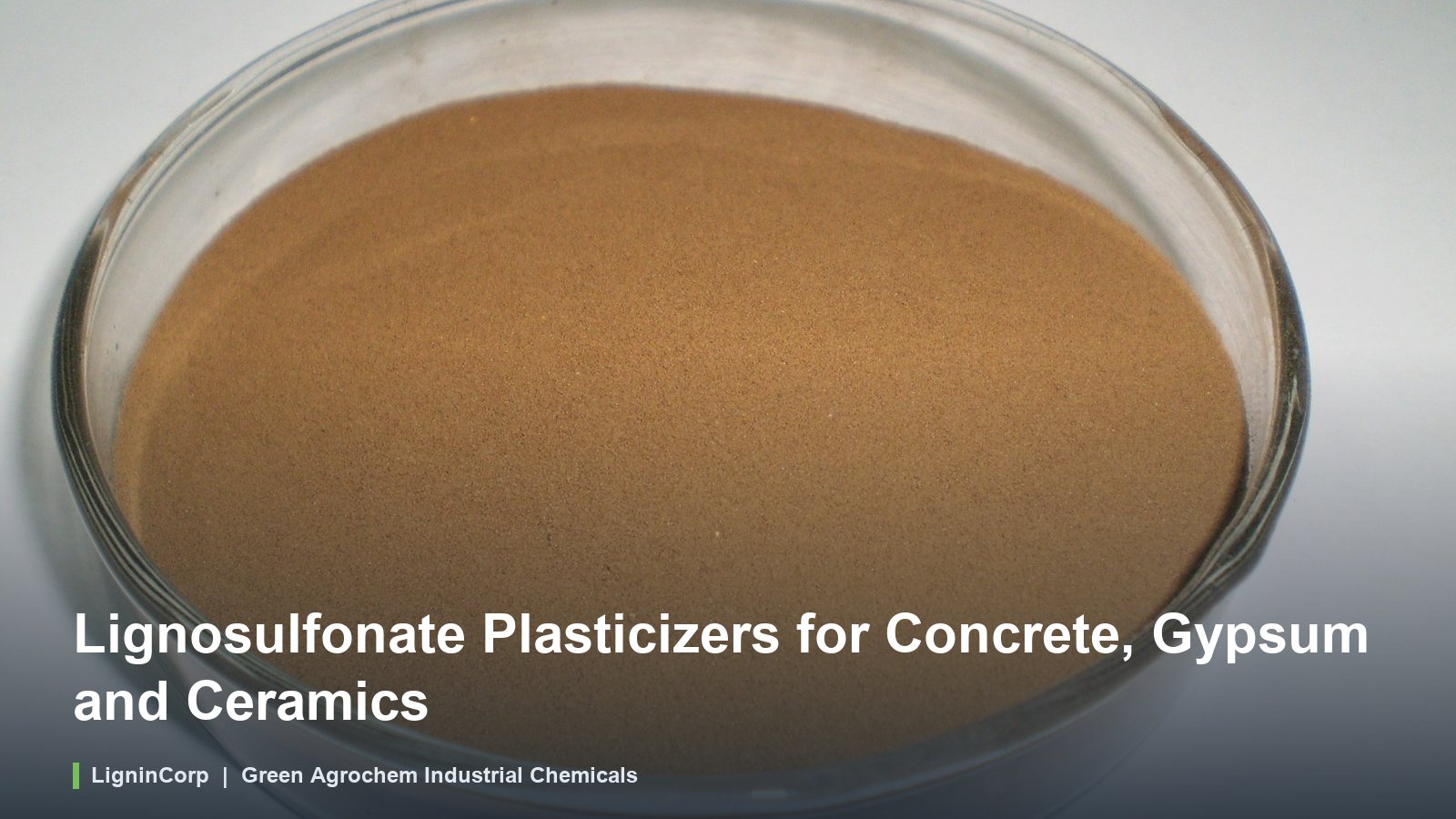
Lignosulfonate plasticizers are water-soluble process additives used to modify particle dispersion, liquid demand, flow and handling in mineral-based systems. The word “plasticizer” does not describe one identical function in every material. In concrete it usually refers to workability and water-demand control; in gypsum it concerns slurry rheology and forming; in ceramics it may combine dispersion, temporary binding and green-body handling. A grade should therefore be selected against the actual raw materials and process—not from a universal dosage or performance claim.
What “plasticizer” means in different material systems
| Material system | Primary technical role | Important variables | Useful trial measurements |
|---|---|---|---|
| Concrete and mortar | Disperse cement particles and adjust workability or water demand | Cement chemistry, supplementary cementitious materials, temperature, mixing sequence and air system | Slump or flow, air content, setting behaviour, bleeding, strength development and finishability |
| Gypsum and plaster | Control slurry flow and water demand during mixing, casting or board forming | Gypsum source, calcination route, particle size, accelerator or retarder package and foam system | Spread, viscosity, set time, wet handling, drying behaviour and final board or plaster properties |
| Ceramic bodies and slurries | Improve mineral-particle dispersion and processing while contributing temporary binding where required | Clay and mineralogy, solids loading, electrolyte balance, pH, forming method and firing route | Viscosity, thixotropy, casting or spray behaviour, green strength, drying defects and fired quality |
Choose the page that matches the technical question
- For adsorption, cement compatibility, dosage basis and published concrete research data, use the concrete plasticizer mechanism and testing guide.
- For supplier documents, grade comparison, incoming quality and approval workflow, use the concrete-admixture selection and qualification guide.
- For liquid-grade specifications, dry-solids correction and ceramic processing trials, use the liquid sodium lignosulfonate for ceramics guide.
This page remains the cross-material comparison. Keeping mechanism, procurement and liquid-ceramic questions on their dedicated pages reduces repetition and helps readers follow the correct qualification route.
How lignosulfonate chemistry affects selection
Lignosulfonates contain sulfonate groups that support water solubility and adsorption on many mineral surfaces. Their performance also reflects molecular-weight distribution, counter-ion, residual sugars, inorganic salts, pH, ash and insoluble matter. Two products sold under the same generic name can therefore behave differently in a cement paste, gypsum slurry or ceramic body.
Procurement should begin with grade identity and consistent batch documentation. Request the current technical data sheet, safety data sheet and a representative certificate of analysis. Confirm whether reported values are specifications, typical results or limits, and compare test methods before treating two supplier documents as equivalent.
Concrete and mortar: workability with compatibility controls
In cementitious systems, lignosulfonates are commonly evaluated as conventional water-reducing or workability-modifying admixture components. Adsorption and dispersion can help release water trapped in particle agglomerates, but the observed response depends on the complete binder and admixture system. Residual sugars and other grade variables may influence setting behaviour; air entrainment, bleeding and finishing characteristics also require direct measurement.
For a deeper discussion of the mechanism and limitations, see the lignosulfonate concrete plasticizer guide. Industrial buyers can review the Green Agrochem Industrial Chemicals Division’s concrete-admixture application route and the relevant sodium lignosulfonate product information.
Gypsum and plaster: slurry rheology is system-specific
Gypsum board, blocks, moulding plaster and dry-mix formulations do not respond identically. A lignosulfonate may change slurry spread, water demand and ease of forming, but it must be screened with the actual gypsum, accelerator, retarder, starch, foam and other additives. A formulation that flows well can still be unsuitable if it disrupts set control, foam stability, wet handling or drying.
A useful evaluation records addition basis and sequence, initial and time-dependent flow, set behaviour and the properties of the dried product. For industrial application support, use the gypsum-board additives guide.
Ceramics: separate dispersion from binding
In ceramic processing, the required function may be slurry deflocculation, plasticity adjustment, temporary binding or a combination of these effects. The right balance depends on the clay and non-clay minerals, solids loading, forming method and thermal cycle. Excessive organic addition can alter drying or burnout behaviour, while an incompatible electrolyte balance can increase rather than reduce viscosity.
Trials should distinguish low-shear and high-shear viscosity, recovery after shear, sedimentation, casting or spray performance, green strength and defect formation. Review the Industrial Chemicals Division’s ceramic and refractory additives guide for application-specific qualification.
A practical comparative trial plan
- Define the required function. State whether the objective is dispersion, reduced liquid demand, workability, forming stability, temporary binding or a combination.
- Fix the reference formulation. Record raw-material lots, temperature, water quality, mixing energy, addition sequence and conditioning time.
- Screen grades on a common basis. Compare as-supplied and dry-solids addition correctly; do not compare percentages whose basis is undefined.
- Measure process and final-product properties. A flow improvement alone is insufficient if set, drying, strength, air, finish or defects become unacceptable.
- Confirm robustness. Repeat promising conditions across realistic raw-material and temperature variation before plant adoption.
Dosage and performance claims
There is no universal lignosulfonate-plasticizer dosage for concrete, gypsum and ceramics. A numerical range should be used only when it comes from the current supplier document for the exact grade and clearly states whether the basis is as-supplied product, dry solids, binder mass or total formulation mass. Treat it as a supplier-recommended starting trial range, then optimize through laboratory and plant trials. Water reduction, strength, set time, shrinkage or durability figures are application test results, not guaranteed product properties.
Information to include in a technical enquiry
- Material system, raw-material identity and intended processing route
- Target function and the current control formulation
- Required specification, test methods and regulatory market
- Known compatibility constraints and unacceptable side effects
- Annual demand, packaging, destination and sample quantity
Send the formulation context and required documents to info@greenagrochem.com. The enquiry can then be routed to the correct industrial product and application team.
