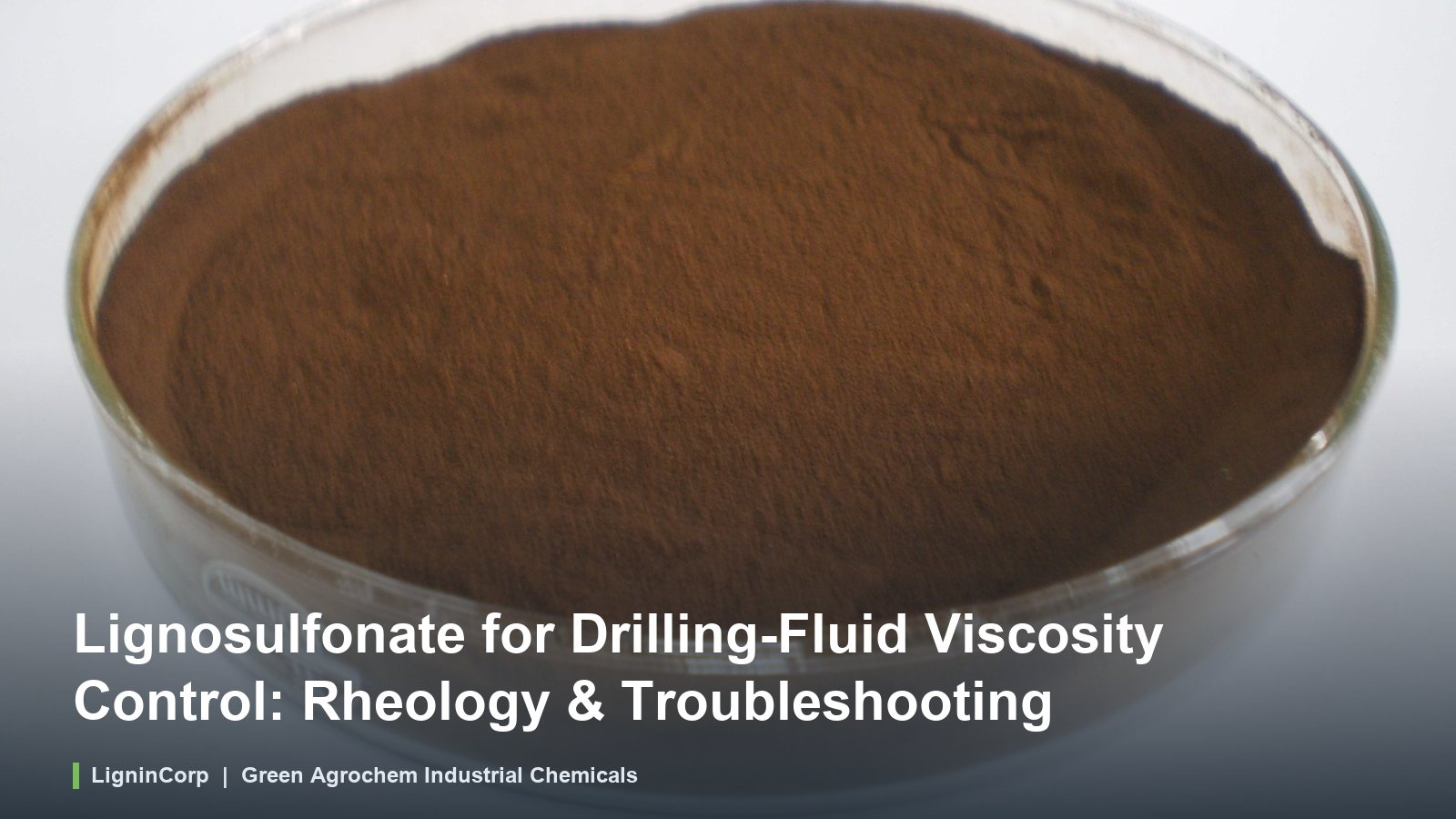
Drilling-fluid “viscosity” is not one number. A water-based mud may become difficult to pump because clay particles have flocculated, drilled solids have accumulated, salinity or cement has changed the water chemistry, or the polymer package no longer matches the operating conditions. Lignosulfonate can be evaluated as a deflocculant and rheology-control additive, but the treatment decision should follow diagnosis rather than a universal dose.
What lignosulfonate can—and cannot—control
In compatible water-based systems, lignosulfonate adsorbs on reactive solids and changes particle interactions. This can reduce excessive flocculation and help moderate yield point and gel development. It does not remove drilled solids, correct every source of high viscosity, or replace a complete filtration-control and inhibition program. If solids loading is the primary cause, dilution, solids-control equipment and removal efficiency must be addressed alongside chemical treatment.
Read the rheology profile before treating
- Plastic viscosity (PV): commonly reflects mechanical resistance associated with solids concentration, particle size and liquid-phase viscosity. A high PV may indicate excessive fine solids rather than insufficient dispersant.
- Yield point (YP): reflects the fluid’s stress response and particle interactions. A disproportionate increase can be consistent with flocculation, but interpretation must include the complete mud history.
- Gel strengths: progressive or excessive gels may increase surge pressure and restart pressure. Flat, controlled gels are generally easier to manage, subject to hole-cleaning requirements.
- Apparent viscosity: useful as a summary measurement, but insufficient by itself to identify the cause of a rheology change.
Trend the measurements rather than relying on a single sample. Compare the current fluid with its conditioned baseline, recent dilution, drilled-solids loading, temperature exposure and contamination events.
Diagnostic workflow for rising viscosity
1. Confirm the sample and test condition
Verify sampling location, conditioning time, test temperature, instrument condition and reporting units. A field result should not be compared directly with a laboratory value obtained under a different conditioning procedure.
2. Separate solids loading from flocculation
Review density, retort or solids data, low-gravity solids trends and equipment performance. If both PV and solids loading are rising, adding more dispersant may mask rather than solve the underlying problem. When YP and gels rise rapidly after a contamination event, chemical interaction becomes a stronger hypothesis.
3. Check water chemistry and contamination
Measure pH and the relevant indicators for salinity, calcium, magnesium, carbonate or cement contamination. Multivalent ions can alter clay behavior and lignosulfonate adsorption. Record additions of salt, weighting material, make-up water and other treatment chemicals before selecting a corrective sequence.
4. Test compatibility and treatment order
Screen the candidate grade in a representative mud sample. Add it incrementally on a clearly defined mass or active-solids basis, with controlled mixing energy and contact time. Compare rheology, filtration, foam tendency and recovery after shear. Test the intended sequence with filtration reducers, inhibitors, lubricants, defoamers and weighting agents.
Temperature and aging qualification
Performance after surface mixing does not establish downhole suitability. Condition and hot-age the fluid at a representative temperature and duration, then repeat the same rheology and filtration measurements. Compare untreated, treated and contaminated samples. Temperature limits must be established for the complete formulation and the exact lignosulfonate grade; they should not be inferred from a generic product name.
Grade selection and documentation
Sodium, calcium and modified lignosulfonates can differ in counter-ion, ash, insolubles, solubility and batch consistency. Chrome lignosulfonate has historical use in drilling-fluid thinning, but chromium-containing grades may be restricted by operator requirements, environmental rules or disposal practices. Grades should not be treated as interchangeable without comparative testing and review of the current TDS, SDS and COA.
See the oil-drilling functions and qualification guide for the broader application framework, the oil-well drilling-fluid application page, and the chrome lignosulfonate product page when comparing candidate grades.
Recommended treatment-development procedure
- Define the rheology problem and acceptance criteria before treatment.
- Use a representative baseline mud and document its composition and history.
- Add the candidate grade incrementally with a stated calculation basis.
- Measure PV, YP, gels, filtration, pH, density and relevant contamination indicators.
- Repeat after representative aging and contamination exposure.
- Confirm the laboratory result through a controlled field pilot and trend the response.
No dosage is universal across drilling-fluid systems. The recommended starting range must come from the current technical document for the exact grade and must be validated under the actual water chemistry, solids profile, temperature, mixing sequence and test method. For grade comparison or documentation, contact info@greenagrochem.com.
