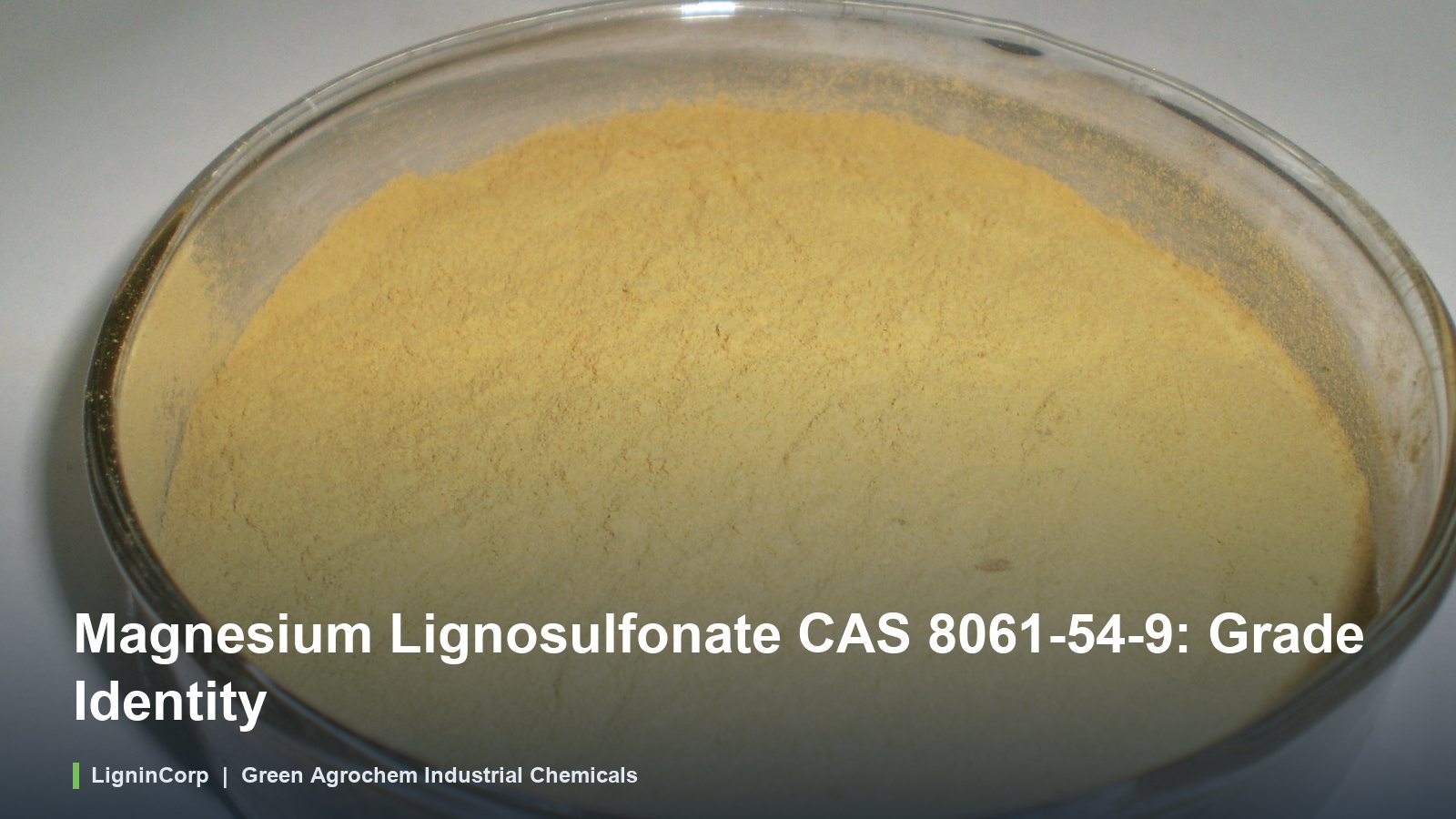
CAS 8061-54-9 is used in Green Agrochem’s current magnesium lignosulfonate SDS documents to identify the magnesium salt product family. It is useful for chemical identity and document matching, but it does not define one molecular formula, molecular weight, purity, pH, physical form, composition, application performance or regulatory approval.
Why one CAS number can cover different commercial grades
Magnesium lignosulfonate is a heterogeneous, polydisperse mixture of sulfonated lignin-derived macromolecules with magnesium as the principal counter-ion designation. Feedstock, sulfite-pulping conditions, recovery, purification, fractionation, ion adjustment, concentration and drying can change the commercial material. Powder and liquid products under the same family identity may therefore require different specifications and handling systems.
A statement that magnesium lignosulfonate is always made by neutralizing isolated “lignosulfonic acid” with magnesium oxide or hydroxide is incomplete. Some materials originate directly from magnesium-base sulfite liquor; others may undergo counter-ion adjustment or post-processing. The supplier should identify the route applicable to the offered grade without disclosing proprietary details.
CAS identity versus grade identity
| Identifier or document | What it establishes | What it does not establish |
|---|---|---|
| CAS 8061-54-9 | Chemical-family identifier used in the reviewed magnesium lignosulfonate SDS documents | Grade, composition limits, purity, application or assured equivalence |
| Product code | Specific commercial grade such as GAC-MgLS-1, GAC-MgLS-2 or GAC-MgLS-L | Actual shipment values without a lot COA |
| Current TDS | Grade description, listed properties, packaging, storage and intended-use guidance | Lot-specific conformity or universal performance |
| Current SDS/MSDS | Hazard communication, handling, storage, first aid, transport and regulatory-information framework | Product performance, dosage or destination-market approval by itself |
| Signed shipment COA | Reported test results for the identified batch against the listed parameters | Suitability in the customer’s formulation without an application trial |
| Sales specification | Contracted limits, methods and acceptance responsibilities | Unlisted properties or performance outcomes |
Current industrial product codes under review
- GAC-MgLS-1, Grade One: yellow-brown powder; current TDS Rev. 1.0 lists pH 4–7, dry matter 95% min, water-insoluble matter 1.0% max and lignosulphonate content 55% min.
- GAC-MgLS-2, Grade Two: yellow-brown powder; current TDS Rev. 1.0 lists pH around 10, dry matter 95% min, water-insoluble matter 1.5% max and lignosulphonate content 50% min.
- GAC-MgLS-L, Liquid: black liquid; current TDS Rev. 1.0 lists solids around 45%, water-insoluble matter 1.0% max and lignosulphonate content 50% min.
These selected values demonstrate why CAS-only purchasing is inadequate. Use the complete exact-grade TDS and signed lot COA rather than this summary for acceptance. See the full industrial grade comparison.
Information required on a purchase specification
- Exact product code and physical form;
- intended application and measurable acceptance test;
- required properties, limits, units, calculation bases and methods;
- as-supplied versus dry-solids basis for any dosage or comparison;
- package, shipment quantity, storage and shelf-life requirement;
- current TDS/SDS revision and signed batch COA;
- destination-market chemical inventory, use and labelling review.
Evidence status of the former universal data
| Former statement | Evidence/status | Correct use |
|---|---|---|
| Molecular weight 1,000–50,000 Da | No exact grade, distribution method or current supplier document identified | Do not use as a purchasing specification; request a method-defined distribution only when application relevant |
| One universal pH of 4.0–7.0 | Contradicted by the current Grade Two TDS value of around 10 | Use exact-grade data and confirm solution concentration/method |
| Light/dark brown powder or viscous brown liquid as one standard | Blends different physical forms and grade descriptions | Specify the product code and its documented appearance |
| Highly soluble in water and insoluble in ethanol/acetone | Qualitative family description without a grade-specific dissolution or solvent test | Use insolubles, clarity, filtration and compatibility tests under actual process conditions |
| Automatically increases concrete strength, stabilizes drilling mud or improves ceramic green strength | No grade, dosage, control, material system or test method stated | Treat as application hypotheses requiring controlled trials |
| Fully biodegradable, non-toxic and no significant human/environmental risk | Absolute safety/environmental claims unsupported by CAS identity | Use the exact current SDS and application/market-specific environmental assessment |
Division and regulatory boundaries
Industrial procurement remains with LigninCorp. GAC-MgLS-Feed is a separate feed grade and belongs to LigninChina animal nutrition; fertilizer or magnesium-micronutrient intent belongs to ChinaLignin agriculture. A shared or related CAS identity does not authorize transfer of specifications, dosage, safety claims or regulatory status between these grades.
Review the industrial magnesium lignosulfonate product page. For exact-grade TDS/SDS, a signed lot COA, sample and qualification discussion, contact info@greenagrochem.com.
Downloads
Compared With Calcium and Sodium
| Property (Grade One) | Magnesium (GAC-MgLS-1) | Calcium (GAC-CaLS-1) | Sodium (GAC-NaLS-1) |
|---|---|---|---|
| CAS | 8061-54-9 | 8061-52-7 | 8061-51-6 |
| Lignosulphonate (dry basis) | 55% min | 55% min | 55% min |
| Ca + Mg | 8% min (total Mg + Ca) | 5 – 8% | 0.5% max |
| Water-insoluble matter | 1.0% max | 1.5% max | 1.5% max |
| pH | 4 – 7 | — | 7.0 – 9.5 (10% solution) |
| Moisture | 5% max | 5% max | 5% max |
Frequently Asked Questions
What is CAS 8061-54-9?
The CAS number of magnesium lignosulfonate (lignosulfonic acid, magnesium salt).
Is the CAS number enough to define a grade?
No. All magnesium grades share it; specify the product code and TDS revision.
What are the CAS numbers of calcium and sodium lignosulfonate?
Calcium 8061-52-7; sodium 8061-51-6.
