
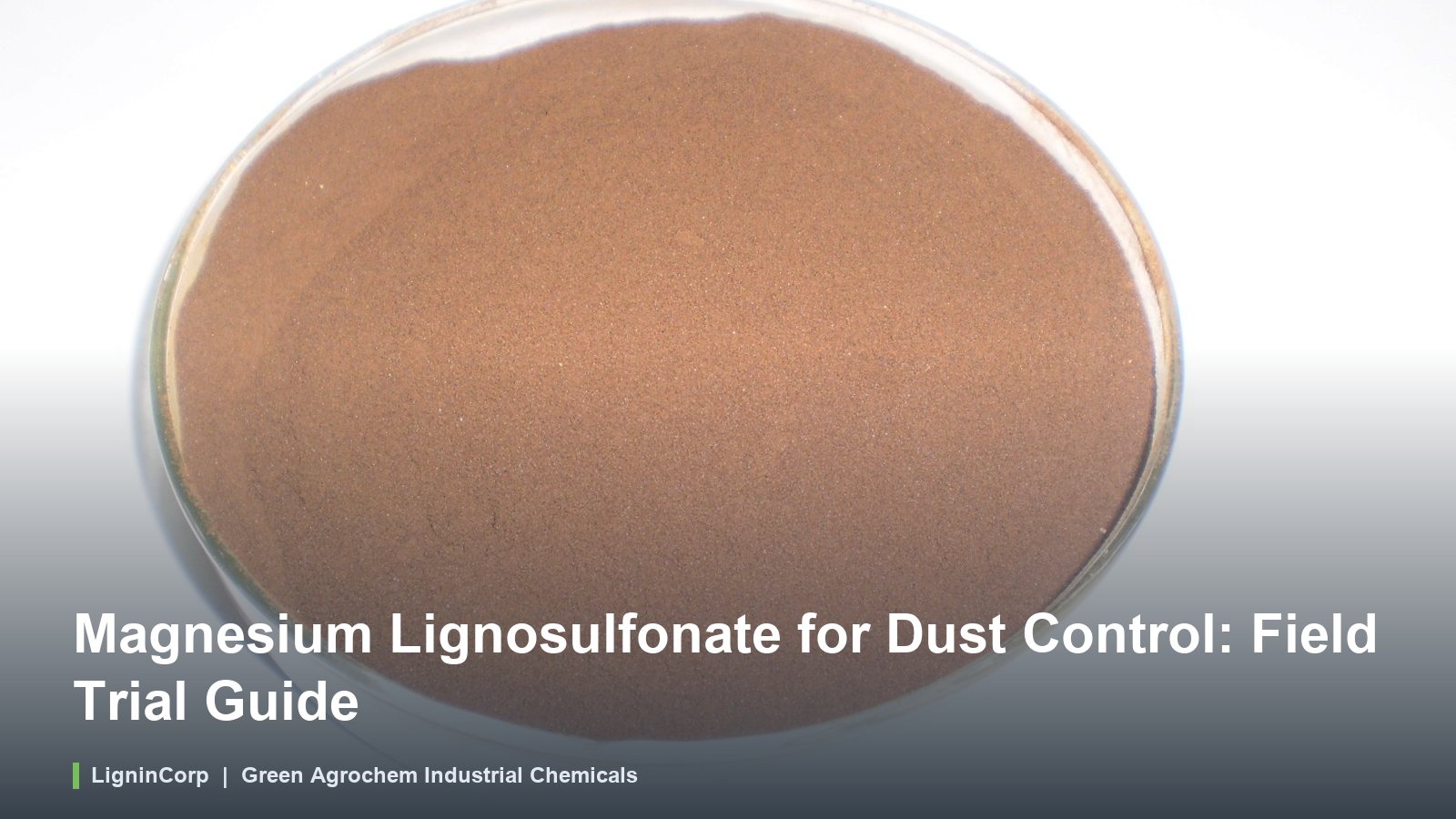
Magnesium lignosulfonate can be evaluated as a binder-based dust-control treatment for compatible unpaved roads, haul roads, stockpiles and material-handling areas. It is normally applied in water so that the solution wets surface fines; as water is lost, lignosulfonate helps bind particles into a more cohesive surface. Performance depends on the supplied grade, substrate, climate, traffic, preparation and maintenance—not simply on the magnesium counter-ion.
Where the treatment may be evaluated
- unpaved industrial access and haul roads;
- mine and quarry traffic areas;
- aggregate, mineral and compatible bulk-material stockpiles;
- construction access routes and staging areas;
- other surfaces where binding of loose fines is an appropriate control method.
It should not be assumed suitable for every dust source. Reactive chemicals, food-contact materials, sensitive vegetation, drainage pathways and environments with specific discharge limits require a separate assessment.
How lignosulfonate dust control works
After dilution and application, the liquid distributes through the prepared surface layer. Lignosulfonate can promote adhesion and agglomeration of fine particles. Compaction and drying then help form a denser treated layer that is less easily disturbed by wind or vehicle movement. The result is influenced by fine-particle content, aggregate grading, moisture, compaction and curing conditions.
Magnesium lignosulfonate should not automatically be described as more durable than calcium or sodium grades. Commercial composition and field conditions can outweigh the identity of the counter-ion. Compare representative grades using the same solids basis and test section.
Site factors controlling performance
| Factor | Why it matters |
|---|---|
| Surface gradation and fines | Insufficient or unsuitable fines can limit formation of a coherent treated layer |
| Existing moisture | Affects dilution, penetration, compaction and curing |
| Traffic and vehicle type | Heavy turning, braking and tracked equipment can disturb the surface |
| Rainfall and drainage | Water movement can dilute, redistribute or remove soluble treatment |
| Temperature and drying | Influence application window and development of the treated surface |
| Product solids and composition | Determine the amount of active material delivered and possible interactions |
| Preparation and compaction | Often determine whether treatment is uniform and mechanically stable |
Recommended field-trial procedure
- Characterize the site. Record road or stockpile material, grading, traffic, climate, drainage, sensitive receptors and existing dust level.
- Review the product documents. Confirm solids, pH, relevant ions, handling and storage from the current TDS, SDS and COA.
- Prepare comparable test sections. Repair drainage and grade, moisture-condition and compact sections consistently.
- Use a supplier-recommended trial range. Calculate application on a delivered-solids basis and record dilution, spray volume and treated area.
- Monitor defined outcomes. Observe visible dust and, where required, use an appropriate particulate or surface-performance method.
- Track durability and maintenance. Record traffic, rainfall, surface defects, regrading and retreatment rather than claiming a universal service life.
Application and equipment considerations
Use compatible storage, pumps, hoses, spray bars and nozzles. Maintain agitation or circulation when required by the supplied product. Uniform distribution is important; excessive local application can create slippery, sticky or uneven areas, while insufficient coverage can leave untreated dust sources. Restrict traffic during preparation and curing when the trial plan requires it.
Environmental and safety controls
Bio-based origin does not establish that unrestricted application is environmentally acceptable. Review local requirements, product composition and the current SDS. Protect drains and surface water, control overspray, evaluate runoff and avoid application immediately before unsuitable weather. The management plan should also consider workers, nearby communities, vegetation and the characteristics of the material being treated.
Choosing between lignosulfonate grades
Compare magnesium, calcium, sodium or blended lignosulfonate grades by delivered solids, viscosity, pH, ash, soluble salts, application behavior, field durability and landed cost. See Magnesium Lignosulfonate Industrial Applications and Calcium Lignosulfonate for Dust Control for related selection considerations.
Request documents and a field-trial recommendation
Send the substrate, treated area, traffic, climate, available application equipment, water source, packaging and destination to info@greenagrochem.com. Request the current TDS, SDS, representative COA and supplier-recommended trial range. Final application conditions must be validated on the actual site.
Grade Data
| Grade (code) | Form | Lignosulphonate (dry basis) | pH | Other key values |
|---|---|---|---|---|
| Grade One (GAC-MgLS-1) | Yellow-brown powder | 55% min | 4 – 7 | Total Mg + Ca 8% min; insolubles 1.0% max; reducing matter 7% min |
| Grade Two (GAC-MgLS-2) | Powder | 50% min | around 10 | Total Mg + Ca 5% min; insolubles 1.5% max |
| Liquid (GAC-MgLS-L) | Liquid, about 45% solids | 50% min | — | Insolubles 1% max; reducing sugar about 7% |
| Feed Grade (GAC-MgLS-Feed) | Light to dark brown powder | 55% min | 4.5 – 6.5 | Pb 10, As 3, Cd 1 mg/kg max; Salmonella negative in 25 g |
Field Trial Steps
- Choose a test strip with typical traffic and road material.
- Grade and pre-wet the surface.
- Apply the diluted solution evenly; record the amount per square metre.
- Keep traffic off until dry.
- Compare dust with an untreated strip over several weeks, including after rain.
Frequently Asked Questions
Can magnesium lignosulfonate be used for dust control?
Yes, the TDS lists dust suppression. It binds surface fines; heavy rain can wash it out.
How much should be applied?
Set the rate in a field trial and record it per square metre; our magnesium TDS gives no fixed rate.
