
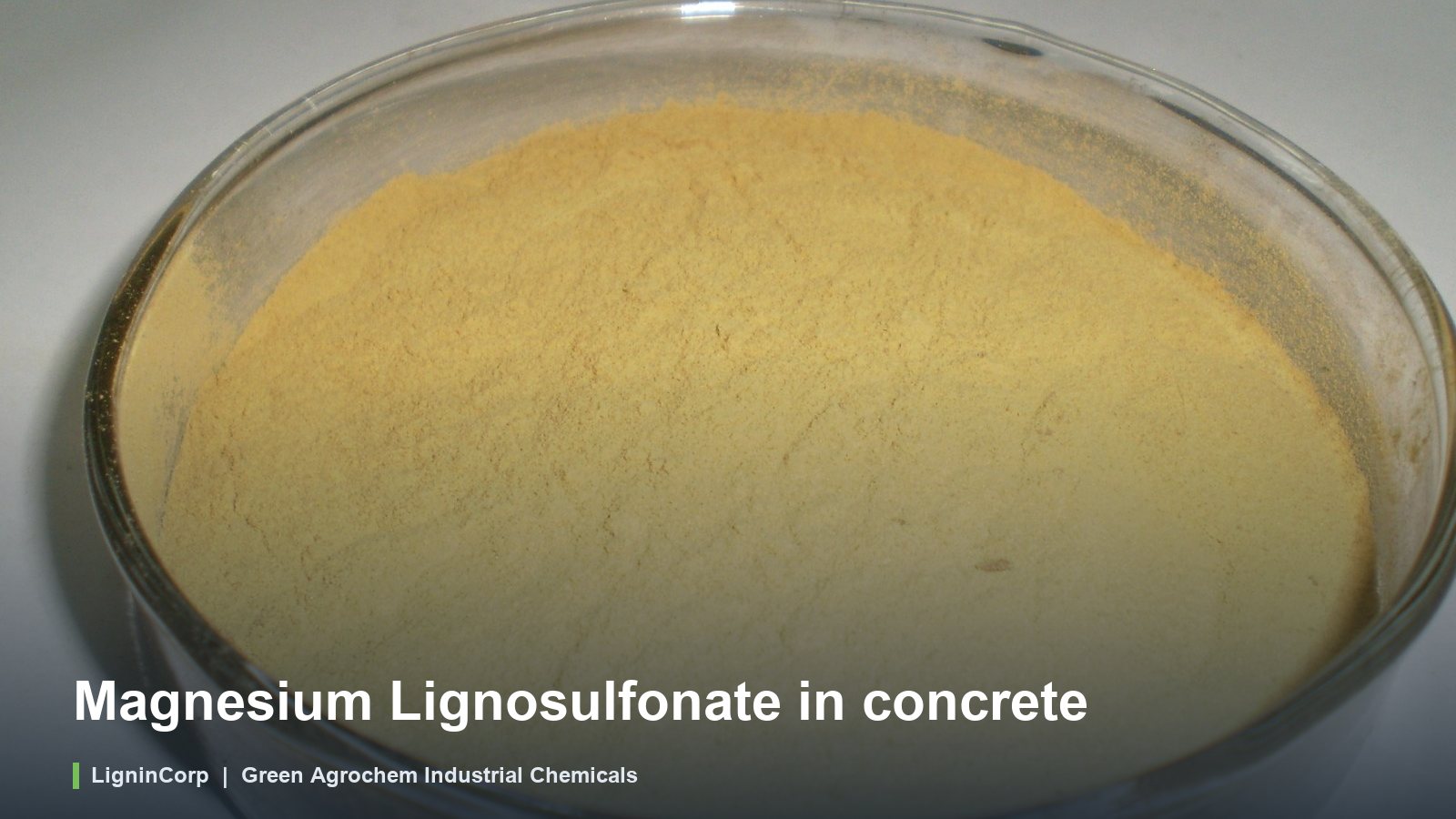
Magnesium lignosulfonate in concrete works by dispersing cement particles. This page explains the mechanism and the effects on fresh and hardened concrete; for grade choice and dosing see magnesium lignosulfonate for concrete.
How It Works
- The lignosulfonate polymer adsorbs on cement grains.
- Its sulfonate and carboxyl groups give the grains a negative charge.
- The grains repel each other and release water trapped in flocs.
- The mix flows better at the same water, or needs less water for the same slump.
Effects on Fresh Concrete
| Property | Typical direction | Check |
|---|---|---|
| Workability (slump) | Increases at the same water | Slump test |
| Water demand | Decreases at the same slump | Mix water |
| Setting time | Longer, more at higher dose | Setting test |
| Air content | May increase | Air meter |
Effects on Hardened Concrete
Strength and durability benefits come from the lower water-cement ratio. The size of the effect depends on the cement, aggregates, temperature and dose, so it must be measured in your own mixes.
Limits
- Not a superplasticizer: for high-range water reduction use SNF or PCE, alone or blended.
- Overdosing can delay setting beyond specification.
- Results vary with cement chemistry and supplementary materials.
Grade One Data
| Parameter | Grade One (GAC-MgLS-1) |
|---|---|
| Appearance | Yellow-brown powder |
| pH | 4 – 7 |
| Dry matter | 95% min |
| Moisture | 5% max |
| Water-insoluble matter | 1.0% max |
| Total magnesium and calcium | 8% min |
| Lignosulphonate content | 55% min (dry basis) |
| Sulphate | 2% min |
| Total reducing matter | 7% min |
| Density | 0.55 g/cm³ |
Compared With Other Water Reducers
| Type | Water reduction class | Setting | Typical use |
|---|---|---|---|
| Lignosulfonates (Ca, Na, Mg) | Normal range (ASTM C494 Type A/D) | Retard, more at high dose | Ready-mix, precast, blends |
| Naphthalene (SNF) | High range (Type F) | Little effect at normal dose | High-strength concrete |
| Polycarboxylate (PCE) | High range (Type F) | Depends on design | Self-compacting, high-performance concrete |
Testing It in Your Mix
| Mix | Dry dose (% of cement) | Measure |
|---|---|---|
| Control | 0 | Slump, air, setting time, strength |
| Low | 0.20% | Same |
| Mid | 0.25% | Same |
| High | 0.30% | Same |
Frequently Asked Questions
How does magnesium lignosulfonate work in concrete?
It adsorbs on cement particles, charges them negatively so they repel each other, and releases trapped water, improving workability.
Does magnesium lignosulfonate increase concrete strength?
Only indirectly, through a lower water-cement ratio. Measure strength in trial mixes.
Does magnesium lignosulfonate retard setting?
Yes, it can extend setting time, more so at higher doses.
Is magnesium lignosulfonate a superplasticizer?
No. It is a normal-range water reducer; superplasticizers such as SNF and PCE reduce much more water.
Can it be used with fly ash or slag?
Yes, but supplementary materials change the response; test with your actual blend.
