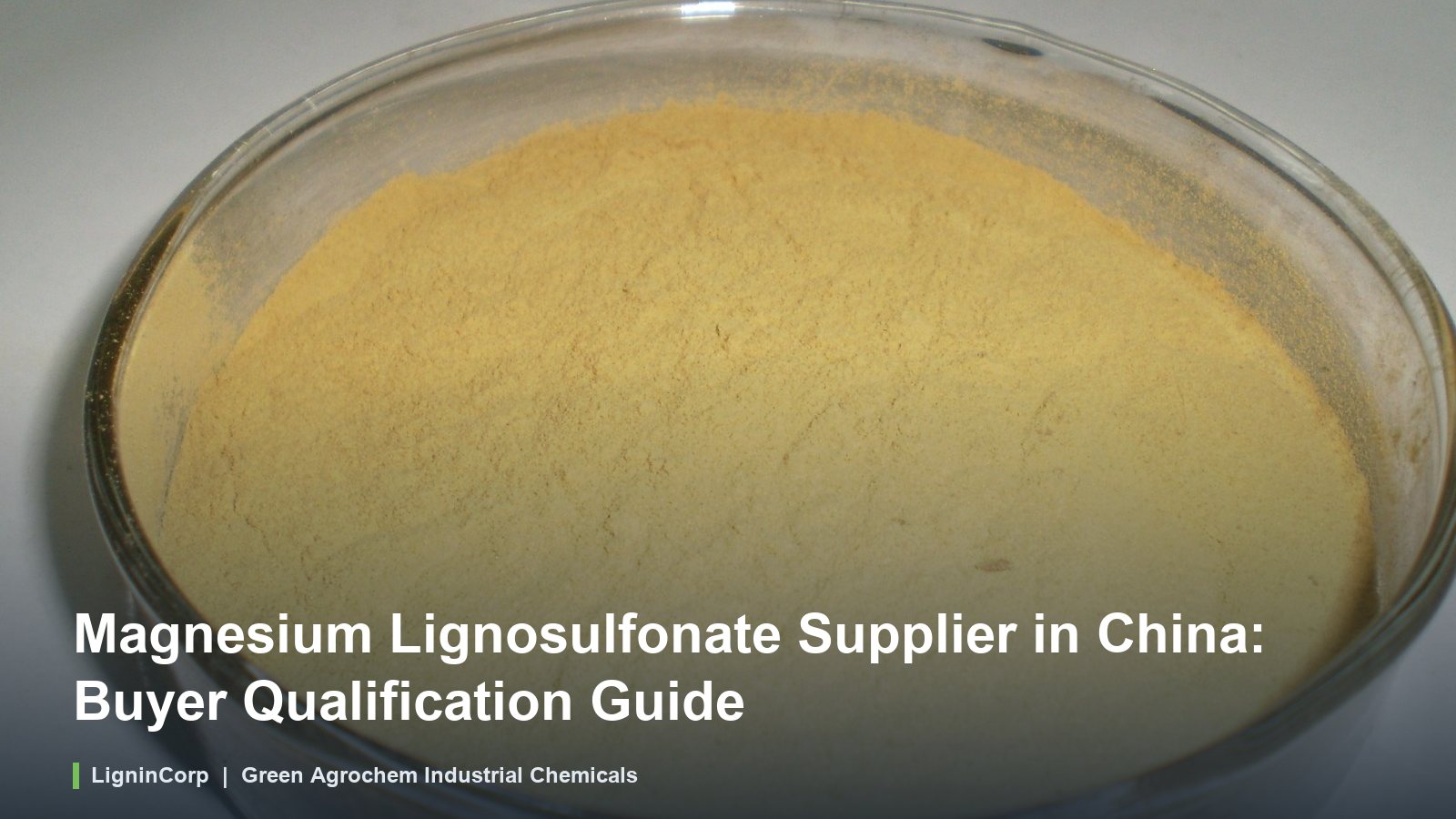
Buying magnesium lignosulfonate from China requires more than comparing a product name and a price per tonne. Commercial grades can differ in solids, moisture, pH, ash, reducing sugars, solubility, counter-ion content, particle form and batch consistency. A useful supplier review therefore starts with the buyer’s application and test method, then confirms whether the offered grade is supported by current technical and batch documents.
Define the required grade before requesting a quotation
Tell the supplier whether the material will be evaluated as an industrial binder, dispersant, dust-control ingredient, concrete-admixture component or another process aid. The same salt name does not ensure equivalent performance across these systems. Specify powder or liquid form, required solids or moisture basis, target pH test method, solubility expectations, packaging, annual demand and destination port.
For the underlying product family and available forms, review our magnesium lignosulfonate product page. Neutral chemistry and grade-comparison information is maintained by the group’s Lignosulfonate Knowledge Hub.
Current industrial identities for a comparable RFQ
State an exact candidate code in the RFQ: GAC-MgLS-1 (Grade One powder), GAC-MgLS-2 (Grade Two powder) or GAC-MgLS-L (liquid). These grades have different pH, insolubles, lignosulfonate content, mineral contribution, packaging and shelf-life data. Compare the current grade-property table before requesting technically equivalent offers.
Feed-grade and fertilizer/micronutrient enquiries are separate regulated use cases and must not reuse these industrial documents or specifications.
Documents to request from a magnesium lignosulfonate supplier
| Document or evidence | What the buyer should verify |
|---|---|
| Current TDS | Test items, methods, typical or assured status, form and revision date |
| Current SDS | Supplier identity, composition disclosure, handling, storage, transport and emergency information for the offered grade |
| Recent lot COA | Actual batch results against the purchase specification, including units and test methods |
| Sample identity | Sample code, production or retained-lot relationship, and whether it represents the proposed commercial grade |
| Quality-system evidence | Certificate scope, legal entity, site address, validity and issuing body |
| Packaging and logistics data | Net weight, liner, palletization, loading plan, shelf-life statement and storage conditions |
Do not copy a generic internet specification into a purchase order. Acceptance limits should come from the supplier’s current documents and the buyer’s validated application requirements.
Supplier qualification workflow
- Screen the legal and manufacturing entity. Confirm whether the quotation comes from the manufacturer, an authorized exporter or a trader, and identify the actual production and quality-control locations.
- Compare documents on the same basis. Check whether results are reported on an as-received or dry basis and whether the proposed test methods are comparable.
- Test a traceable sample. Measure incoming properties and run the material in the buyer’s real formulation, raw materials and process conditions.
- Set a written purchase specification. Agree on critical limits, sampling, retest procedure, change notification and treatment of non-conforming lots.
- Approve a trial shipment. Confirm packaging integrity, documents, batch traceability and performance before scaling to recurring supply.
Application validation
A certificate of analysis confirms the reported properties of a batch; it does not by itself prove performance in the customer’s process. A numerical value may be called a supplier-recommended starting trial range only when the current technical document for the exact grade identifies the application, range, revision and calculation basis. Otherwise, do not publish or import a generic number. Evaluate the candidate against a control and relevant alternative grades while holding water, solids, mixing energy, temperature and curing or drying conditions constant.
For concrete and mineral systems, check compatibility, water demand, workability retention, setting behavior, air effects and strength using the applicable laboratory standard. For binding and granulation, examine green strength, finished-particle durability, fines, moisture and process throughput. For dispersion, record viscosity, stability, dilution behavior and any interaction with electrolytes or other additives.
Commercial and logistics checks
- State the quotation basis and applicable Incoterms version, port, currency and validity period.
- Confirm whether freight, insurance, pallets, documentation and destination charges are included.
- Match the packing form and container loading plan to warehouse and unloading capability.
- Require advance notice for changes in raw-material source, manufacturing site, process or specification.
- Agree on batch traceability, retained samples and the claim-handling process before the first commercial shipment.
China export and shipment-document review
| Document or field | Buyer check |
|---|---|
| Commercial invoice and packing list | Legal seller, buyer, exact grade/code, lot, quantity, package, currency, Incoterm and contract consistency |
| COA and SDS | Same grade and lot identity, current revision, units, methods and language/market suitability |
| Bill of lading or transport document | Shipper/consignee, package count, gross/net weight, port and container/seal details |
| Origin or preference document where requested | Issuer, legal entity, product description and destination customs requirements |
| Tariff classification | Buyer/importer and broker confirm the destination-country code and duty treatment; do not rely on an undated website HS code |
| Wood packaging evidence where applicable | Pallet/material declaration and destination phytosanitary or treatment requirements |
Document names and import requirements vary by country, use and shipment. Confirm them with the importer, customs broker and relevant authority before dispatch; this page does not provide a universal customs classification or compliance approval.
How to request a comparable quotation
Send the intended application, target form, required test items and methods, estimated order size, delivery destination and requested documents in one inquiry. This produces quotations that can be compared on technical and landed-cost grounds rather than headline price alone.
For grade selection, sample coordination, current TDS/SDS/COA availability and an export quotation, contact info@greenagrochem.com. Final suitability and dosage should be validated in the buyer’s actual formulation and process before commercial use.
Grade Data
| Grade (code) | Form | Lignosulphonate (dry basis) | pH | Other key values |
|---|---|---|---|---|
| Grade One (GAC-MgLS-1) | Yellow-brown powder | 55% min | 4 – 7 | Total Mg + Ca 8% min; insolubles 1.0% max; reducing matter 7% min |
| Grade Two (GAC-MgLS-2) | Powder | 50% min | around 10 | Total Mg + Ca 5% min; insolubles 1.5% max |
| Liquid (GAC-MgLS-L) | Liquid, about 45% solids | 50% min | — | Insolubles 1% max; reducing sugar about 7% |
| Feed Grade (GAC-MgLS-Feed) | Light to dark brown powder | 55% min | 4.5 – 6.5 | Pb 10, As 3, Cd 1 mg/kg max; Salmonella negative in 25 g |
Documents to Request
Frequently Asked Questions
How do I qualify a magnesium lignosulfonate supplier in China?
Check grade code and TDS revision, SDS, a recent COA with methods, a sample test in your process, and packing and export documents.
What incoterms are used?
FOB, CFR and CIF are common.
