
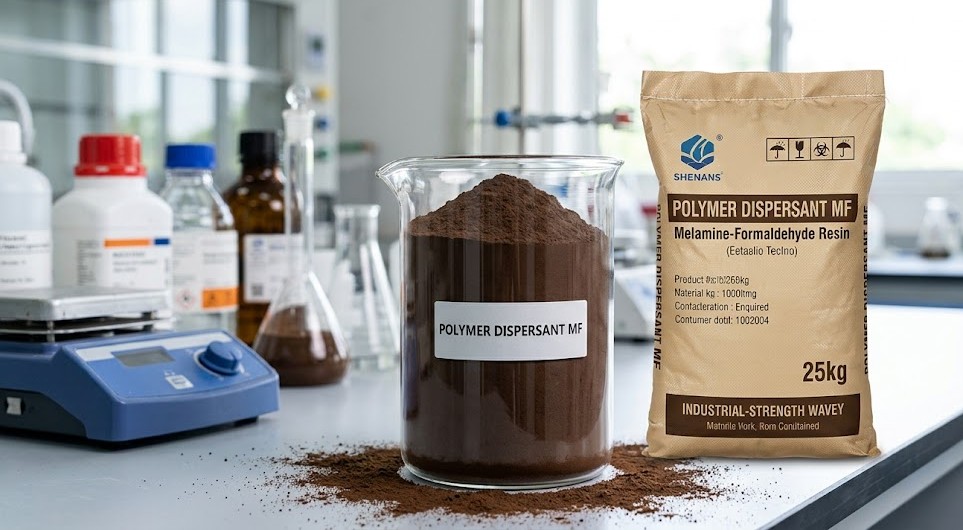
Polymer Dispersant MF (Sodium Salt of Naphthalene Sulfonate Formaldehyde Condensate) is an industrial-grade, high-performance anionic surfactant. Utilizing a dual mechanism of electrostatic repulsion and steric hindrance, it prevents the flocculation (clumping) of fine particles in aqueous suspensions. It is an essential chemical additive for maximizing color yield in textile dyeing, improving the rheology of concrete admixtures, and stabilizing pigment pastes in the paints and coatings industry.
Chemical Profile & Mechanism of Action
Polymer Dispersant MF is synthesized via the sulfonation of naphthalene, followed by condensation with formaldehyde and neutralization with sodium hydroxide. This process creates a long-chain polymeric surfactant engineered specifically for particle separation.
When introduced to a liquid suspension (such as a dye bath or cement slurry), Dispersant MF operates through two simultaneous physical chemistry mechanisms:
- Electrostatic Repulsion: The highly hydrophilic, negatively charged sulfonate groups adsorb onto the surface of the suspended particles. Because all particles receive the same negative charge, they forcefully repel one another, preventing agglomeration.
- Steric Hindrance: The bulky, long-chain molecular structure of the naphthalene-formaldehyde polymer creates a physical barrier around each particle, preventing them from colliding and reforming into flocs.
Key Technical Properties:
- Exceptional Thermal Stability: Capable of withstanding extreme processing temperatures—remaining structurally stable up to 330°C.
- Hard Water Tolerance: Maintains full dispersion efficacy in the presence of high concentrations of calcium and magnesium ions (hard water).
- Low Foaming: Unlike standard surfactants, Dispersant MF does not reduce surface tension to the point of causing excessive foam, ensuring smooth operation in high-shear mixing environments.
- Compatibility: Highly compatible with other anionic and nonionic chemicals (Note: Must not be mixed with cationic substances, which will neutralize the anionic charge and cause precipitation).
Core Industrial Applications
1. Textile Dyeing & Printing
In the textile industry, uniform dye penetration is critical for product quality.
- The Role: Dispersant MF is the primary leveling agent used with disperse dyes, vat dyes, and reactive dyes.
- The Impact: It accelerates the grinding of raw dye particles into a fine powder and prevents the dye from re-agglomerating in the high-heat dye bath. This ensures vibrant, uniform coloration across the fabric and prevents costly defects like color spotting or streaking.
2. Construction & Concrete Admixtures
- The Role: Functions as a highly effective superplasticizer (High-Range Water Reducer).
- The Impact: By dispersing cement grains, it releases trapped water into the mix. This allows ready-mix operators to reduce the water-to-cement ratio by up to 15-25%, dramatically increasing the cured compressive strength and durability of the concrete without sacrificing pumpability. Standard dosage is 0.5% to 2.0% by weight of cement.
3. Paints, Coatings, and Pigment Pastes
- The Role: Acts as a primary pigment stabilizer in water-based formulations.
- The Impact: Prevents heavy pigment particles (like titanium dioxide or carbon black) from settling at the bottom of the can during storage. It maximizes color development (tinting strength) and ensures a smooth, high-gloss finish upon application.
4. Additional Manufacturing Sectors
- Rubber Production: Stabilizes liquid latex emulsions, preventing premature coagulation during compounding.
- Leather Tanning: Used as a tanning auxiliary to ensure tanning chemicals and dyes penetrate animal hides evenly.
- Agrochemicals: Keeps active pesticide ingredients uniformly suspended in liquid spray formulations, preventing nozzle clogging and ensuring even crop coverage.
Handling, Storage, and Environmental Compliance
To maintain chemical efficacy and adhere to industrial safety standards, facility managers should observe the following protocols:
- Storage Conditions: Dispersant MF is highly hygroscopic (absorbs moisture from the air). It must be stored in tightly sealed containers in a cool, dry environment to prevent the powder from caking.
- Mixing Protocol: When preparing liquid solutions from the powder form, the dispersant should be added gradually to water under continuous mechanical agitation to prevent lumping.
- Environmental Impact: While considered non-toxic and non-flammable, naphthalene sulfonate polymers exhibit low natural biodegradability. Industrial facilities must utilize appropriate wastewater treatment systems (such as chemical flocculation or activated sludge processing) prior to effluent discharge to comply with local environmental regulations.
