
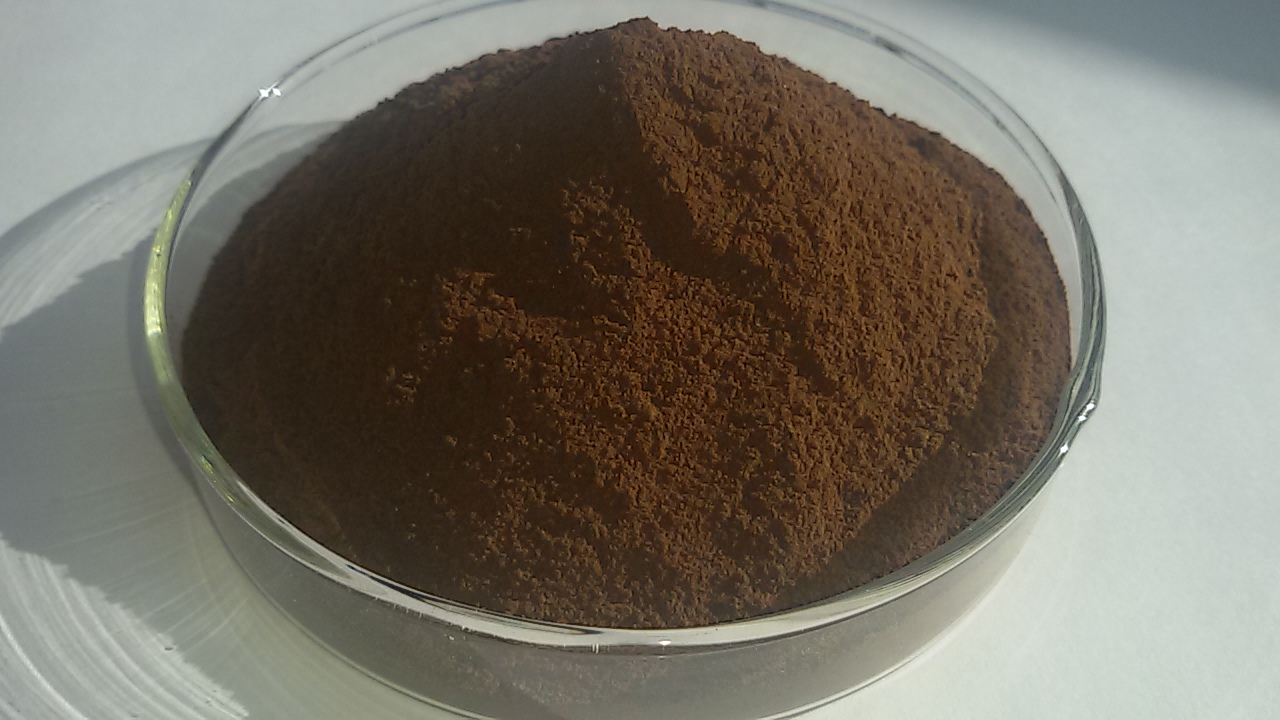
Super sodium lignosulfonate is refined sodium lignosulfonate with 95% minimum lignosulphonate, giving it a stronger dispersing and emulsifying capability than standard grades. In plant-protection products it is used as a dispersant and suspension stabilizer in wettable powders, water-dispersible granules, suspension concentrates and seed dressings.
What the Dispersant Does in Each Formulation Type
In every solid or suspended pesticide formulation the active ingredient is present as fine particles. The dispersant’s job is to keep those particles separate, first in the pack and then in the spray tank. What that means in practice, and how formulators usually check it, differs by formulation type:
| Formulation | What the lignosulfonate does | Typical checks |
|---|---|---|
| Wettable powder (WP) | Keeps the milled active and filler particles apart once the powder is mixed into the spray tank, so they stay suspended instead of settling. | Suspensibility (CIPAC MT 184.1); wet sieve residue (MT 185.1) |
| Water-dispersible granule (WDG / WG) | Helps the granule break down quickly in water and the released particles disperse rather than re-agglomerate; it can also contribute to holding the granule together. | Dispersibility (MT 174); suspensibility (MT 184.1); wet sieve (MT 185.1) |
| Suspension concentrate (SC) | Adsorbs on the particles during wet milling and keeps them from flocculating or growing during storage, which protects viscosity and pourability. | Spontaneity of dispersion (MT 160.1); suspensibility (MT 184.1); checks after accelerated storage |
| Seed-treatment suspensions (FS) | Keeps the active evenly suspended in the slurry applied to seed. | Suspension stability of the slurry; evenness of loading on seed |
CIPAC method numbers as currently published; older versions (for example MT 160 and MT 184) are still cited in existing specifications. For a comparison of lignosulfonate with naphthalene-sulfonate and polymeric dispersants in SC and WDG, see dispersants for SC and WDG agrochemicals compared on GreenAgrochem.net.
Which Specification Values Matter to a Formulator
| Value on the TDS | Why it matters in a pesticide formulation |
|---|---|
| Lignosulphonate 95% min (dry basis) | More dispersant per kilogram, so a given active dose takes less room in the recipe. |
| Water-insoluble matter 0.5% max | Insoluble specks add to wet sieve residue and can block nozzles or filters. Fewer insolubles help keep that residue low. |
| Calcium & magnesium 0.5% max | Divalent ions can bridge anionic surfactants and particles. Low levels in the dispersant reduce that risk, especially with other anionic components. |
| Moisture 5% max | Matters in WP and WDG, where water in the co-formulants adds to the moisture of the finished product. |
| No pH on the TDS | Measure the pH in your own formulation, especially with actives that are sensitive to hydrolysis, or ask for it on the COA. |
Values from TDS GAC-NaLS-Super Rev. 2.0. Full specification, packing and documents: sodium lignosulfonate super grade product page.
Super Grade or Standard Dispersant Grade?
| Super grade | Dispersant grade | |
|---|---|---|
| Lignosulphonate | 95% min (dry basis) | 70% min (dry basis) |
| Water-insoluble matter | 0.5% max | 0.5% max |
| Calcium & magnesium | 0.5% max | 0.5% max |
| Agrochemical use on the TDS | Dispersant for agrochemical formulations | Dispersant for fungicides and other agrochemical actives |
| Documents | TDS · MSDS | TDS · MSDS |
Because the two grades differ mainly in lignosulphonate content, compare them at equal lignosulphonate dose rather than equal weight. If the dispersant grade passes your suspensibility and storage checks, it is usually the lower-cost choice; the super grade is worth testing where the recipe has little room for co-formulants or where results are borderline.
A Practical Screening Plan
- Fix the base recipe: active ingredient, target particle size, wetting agent, filler or carrier.
- Choose a dispersant range with your formulation chemist and run the super grade against your current dispersant at equal lignosulphonate dose.
- Run the checks for your formulation type (table above), first on the fresh sample.
- Repeat after accelerated storage, for example CIPAC MT 46.3 (14 days at 54 °C), and look for changes in suspensibility, viscosity and sediment.
- Test dilution in both soft and hard standard water (CIPAC waters A and D) if the product will be used in hard-water regions.
- Ask for the COA of the lot used in the trial, so production lots can be compared against it.
Formulator Questions
What dosage of super sodium lignosulfonate is used in a WDG or SC?
The TDS does not give a dosage, and the right level depends on the active ingredient, its particle size and loading, and the other surfactants in the recipe. Set the range in your own screening and compare grades at equal lignosulphonate content.
Does it work in hard water?
The product itself contains 0.5% max calcium and magnesium, so it adds little hardness. How the finished formulation behaves in hard spray water must be tested, for example in CIPAC standard water D alongside soft standard water A.
Super grade or dispersant grade for pesticides?
Both have the same insoluble and calcium-magnesium limits. The super grade carries 95% min lignosulphonate against 70% min for the dispersant grade. Try the super grade where the recipe has little room for dispersant or suspensibility is borderline; otherwise the dispersant grade may be enough at lower cost.
Can it be used together with a wetting agent?
Yes, that is the usual set-up in WP and WDG recipes: the wetting agent lets water penetrate the powder or granule, while the lignosulfonate keeps the released particles apart. Check the pair together, because the balance between them changes wetting time and suspensibility.
Will the brown colour affect my formulation?
It can tint light-coloured formulations. If colour is part of your product specification, include it in your trial checks.
Related Pages
- Sodium lignosulfonate super grade: specification, TDS and quotation
- Sodium lignosulfonate dispersant grade · emulsifier grade
- Dispersants for SC and WDG agrochemicals compared (GreenAgrochem.net)
- Super sodium lignosulfonate: technical reference (Lignosulfonate.com)
Testing a Dispersant for Your Formulation?
Tell us the formulation type, the active ingredient and the property you need to improve. We can send the TDS and MSDS and a sample of the super grade, and of the dispersant grade for comparison.