
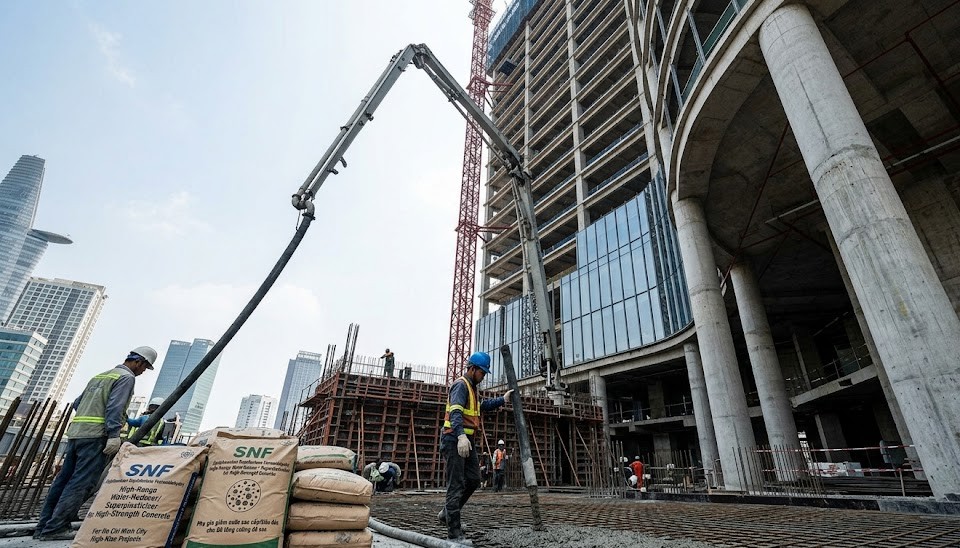
SNF for high-rise concrete is best evaluated as one component of a pumping and placement system. The chemical can improve cement dispersion and help a mix reach its target workability with controlled water content, but it cannot by itself guarantee a pumping height, compressive strength or absence of blockage.
This guide is for ready-mix producers, admixture formulators and project laboratories qualifying SNF for pumped concrete. For current grades, COA parameters and samples, see LigninCorp sodium naphthalene formaldehyde (SNF).
What changes in a high-rise pumping specification?
Concrete must travel through a pipeline while retaining enough mobility and cohesion for placement. Pump pressure is influenced by far more than elevation: horizontal distance, bends, line diameter, pumping rate, aggregate grading, paste volume, temperature and interruptions all matter. For this reason, “suitable for high-rise construction” should be treated as a project qualification result rather than a universal product claim.
The role of SNF in pumpable concrete
SNF adsorbs on cement particles and promotes electrostatic dispersion. Breaking down part of the flocculated structure releases entrapped mixing water, which can increase flow at a fixed water content or support water reduction at a fixed workability. A better-dispersed paste may assist pumping, but pumpability also requires an appropriate mortar volume and a stable lubricating layer at the pipe wall.
SNF should not be described as a viscosity modifier. A mix can be fluid yet unstable, or cohesive yet difficult to pump. Where the project demands long slump retention, very low water-to-binder ratios or tighter viscosity control, formulators may need a compatible retarder, viscosity-modifying admixture, another dispersant chemistry or a blended system.
Information needed before product selection
- cement type, mill source, fineness and recent compatibility history;
- fly ash, slag, silica fume and other supplementary materials;
- aggregate grading, shape, absorption and maximum size;
- target water-to-binder ratio and paste volume;
- required slump or flow at plant, pump inlet and discharge;
- transport time, expected waiting time and concrete temperature;
- vertical and horizontal line lengths, bends, diameter and pumping rate;
- strength, modulus, durability, air and setting requirements.
Recommended qualification sequence
1. Laboratory screening
Test the actual project cement and SCM combination. Use the supplier range as a recommended trial starting range, then identify the lowest dosage that satisfies the complete specification. Record initial workability, retained workability, air, temperature, setting, bleeding and segregation. Compare powder and liquid products on an active-solids basis.
2. Plant batch
Confirm performance at production scale using the proposed charging sequence and mixing time. Laboratory mixing energy can hide sensitivity that appears in a commercial plant. Check moisture corrections and aggregate absorption before attributing a workability change to the admixture.
3. Representative pump trial
Use a line configuration that reasonably represents the project. Measure workability, air and temperature before pumping and again at discharge. Observe pump pressure, flow continuity, restart behaviour after a planned pause, leakage, segregation and the condition of the first and final discharged concrete.
4. Hardened-property verification
Prepare specimens from the point of placement, not only from the truck. Verify specified early and later-age properties using the project curing procedure. Pumping can change air and distribution, so acceptance should be based on representative discharged concrete.
Troubleshooting common symptoms
- Rapid slump loss: review temperature, cement sulfate balance, addition sequence, delay time and retarding strategy.
- High pressure despite adequate slump: examine aggregate grading, paste volume, viscosity and pipeline geometry.
- Bleeding or segregation: do not automatically add more SNF; reassess water, fines, dosage and stability.
- Variable truck-to-truck response: check material moisture, cement consistency, dosing accuracy and mixing time.
- Air change: test the complete admixture combination and confirm air both before and after pumping.
How to specify the supply
A commercial specification should identify product form, active-solids basis where relevant, project standard, required documentation, batch COA items, packaging and traceability. Product acceptance should be connected to agreed test methods rather than a broad claim such as “high-rise grade.” Review the SNF product specification and SNF dispersion mechanism, then contact LigninCorp with the project materials and pumping conditions for a recommended trial plan.
