
SNF (sodium naphthalene formaldehyde) is commonly evaluated as a high-range water-reducing component in concrete admixture formulations. This technical page explains application design and verification; current product specifications and commercial supply are provided by LigninCorp Industrial Chemicals.
Application Objective
SNF disperses cement particles through adsorption and electrostatic repulsion. Depending on the mix, it can increase flow at constant water or support water reduction at a selected workability. It does not independently guarantee self-compacting behavior, strength, durability or slump retention.
Recommended Mix-Design Workflow
- Define target slump or flow, retention time, strength ages and exposure requirements.
- Establish an untreated control with the actual cement, SCMs and aggregates.
- Screen several supplier-recommended dosages on an equal active-solids basis.
- Measure initial and retained workability, air, unit weight, segregation, bleeding and setting.
- Test early and specified-age strength plus project durability requirements.
- Confirm compatibility with retarders, accelerators, air entrainers and other water reducers.
- Verify the selected formulation in a controlled production batch.
Where SNF May Be Evaluated
- Precast and prestressed concrete.
- Pumped and high-workability concrete.
- Ready-mix formulations requiring established cost-performance.
- Cement grouts and selected dry-mix systems.
Set Acceptance Criteria Before the Trial
A trial should have written pass/fail criteria. At minimum, define the workability measurement and timing, permitted air range, setting window, bleeding or segregation limits and required strength ages. For pumped concrete, add measurements before and after pumping. For precast concrete, include finishing, curing and demoulding requirements rather than judging the product from initial flow alone.
Interpreting the Dosage Curve
Increasing dosage normally reaches a point of diminishing return. Plot workability and retained workability against active dosage while watching air, setting and stability. The preferred operating point is the lowest robust dosage that meets the complete specification with a reasonable production tolerance. A supplier range is a recommended screening range, not a guaranteed universal dose.
Important Limitations
Performance varies with cement mineralogy, sulfate balance, fineness, SCM content, temperature and mixing sequence. High fluidity alone does not make a mix self-compacting; passing ability, segregation resistance and applicable test criteria must also be met. Fixed water-reduction or strength percentages should not be transferred between projects.
Review the SNF dispersion mechanism for the chemistry, and use the cement compatibility guide if the response changes between cement sources.
SNF grades and typical properties
| Parameter | SNF 5% Na2SO4 grade | SNF 18% Na2SO4 grade | GAC-SNF-P powder |
|---|---|---|---|
| Sodium sulfate | 5% max | 18% max | 10% max |
| Solids | 91% min | — | 95% min |
| Chloride | 0.4% max | 0.5% max | < 200 ppm |
| Cement paste fluidity | 220 mm | 210 mm | — |
| pH | — | — | 6.5–8.5 |
| Water reduction | — | — | Up to 20% |
Values from current Green Agrochem TDS documents. CAS 36290-04-7 (sodium naphthalene sulfonate formaldehyde condensate). Low-sulfate grades are preferred for liquid admixtures and cold-weather storage, because high sodium sulfate can crystallise from solution. See the SNF product page, SNF 5% grade and SNF high-sulfate grade.
Standards that classify SNF admixtures
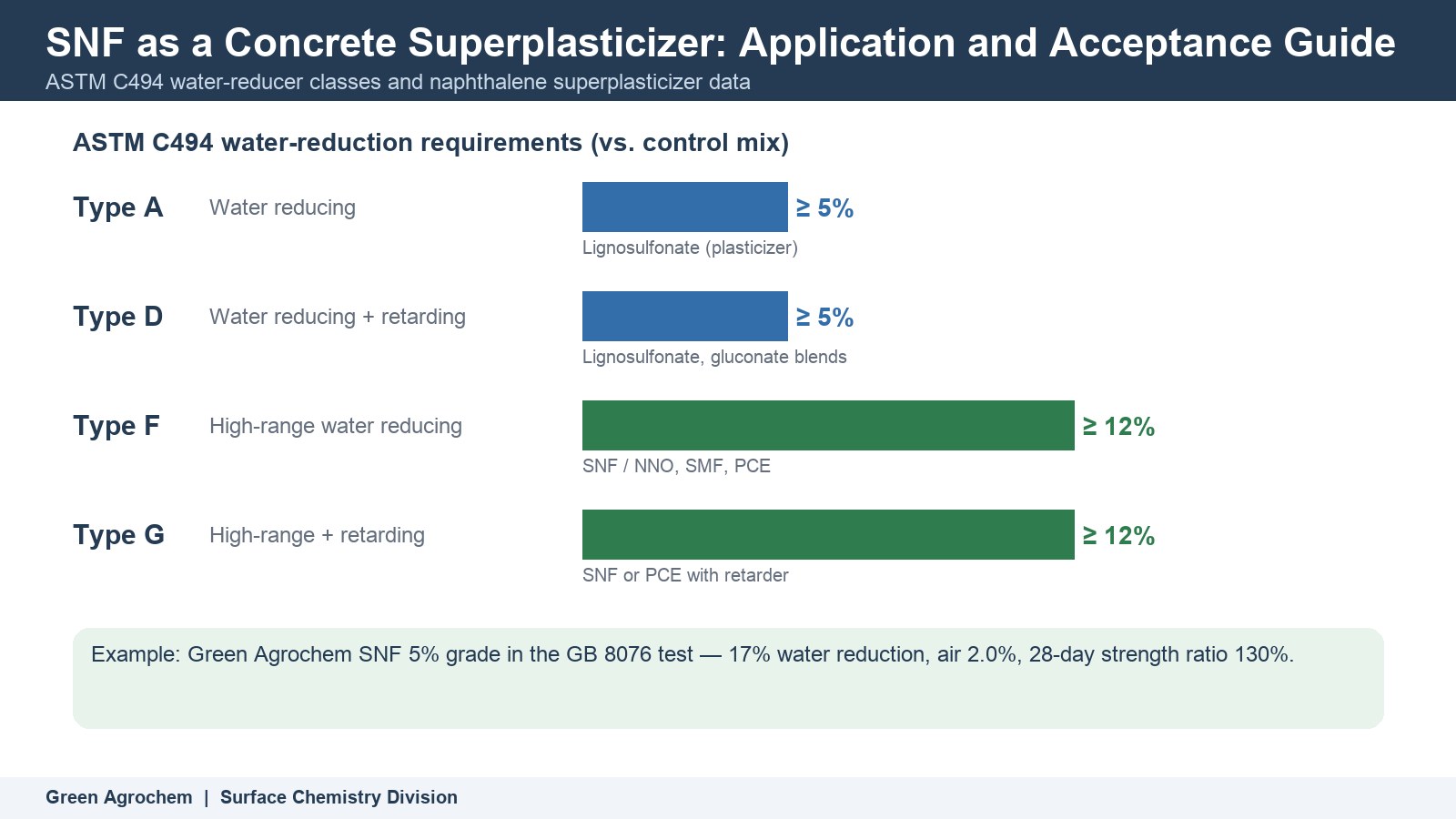
SNF-based admixtures are normally qualified as high-range water reducers: ASTM C494 Type F, or Type G when combined with a retarder, and the corresponding high-range water-reducing classes of EN 934-2. These standards require at least 12% water reduction against a control mix, together with limits on setting time and strength. SNF dispersion is mainly electrostatic, so slump loss is usually faster than with PCE. Blends with sodium gluconate or lignosulfonate are common for slump retention.
References: ASTM C494/C494M, Standard Specification for Chemical Admixtures for Concrete; EN 934-2, Concrete admixtures.
Recommended Procurement Information
Request a current TDS, SDS, lot-specific COA and sample. Provide cement type, applicable standard, target performance, packaging, annual demand and destination through the LigninCorp SNF product route.
