
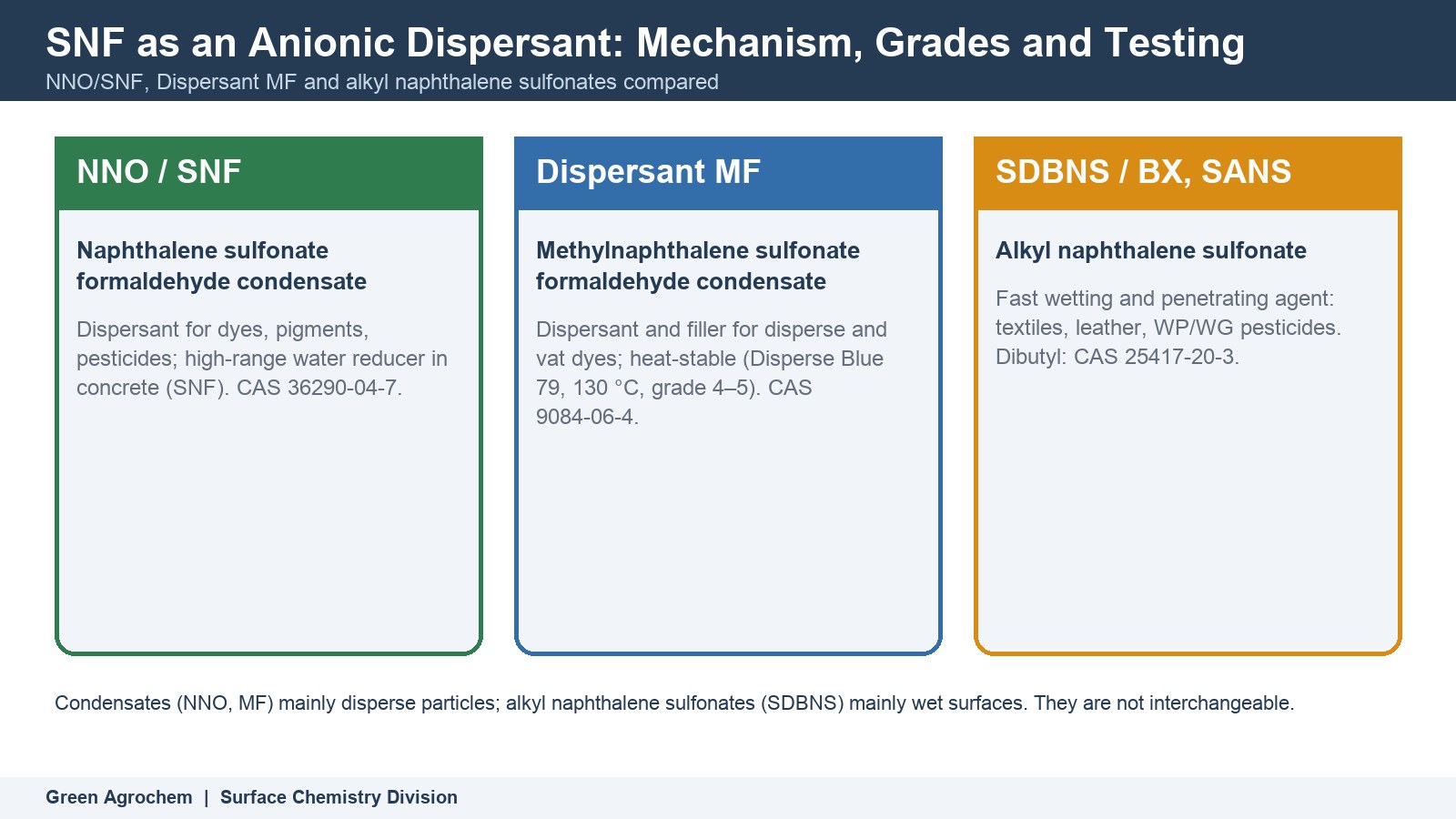
Sulfonated naphthalene-formaldehyde condensate (SNF), also called sodium naphthalene sulfonate formaldehyde or PNS in parts of the market, is an anionic polymeric dispersant. It is often described loosely as an “anionic surfactant,” but its main industrial value is adsorption on compatible particle surfaces and electrostatic dispersion—not universal wetting, detergency or emulsion performance.
This page focuses on industrial and concrete-grade SNF. For commercial grade information, documents and samples, see Sodium Naphthalene Formaldehyde (SNF).
How SNF disperses particles
SNF contains aromatic polymer segments and sulfonate groups. In a compatible aqueous system, portions of the molecule adsorb on cement or other particle surfaces while sulfonate groups contribute negative charge. The resulting electrostatic repulsion can reduce flocculation and release water held within particle clusters.
The response depends on molecular distribution, sulfonation, inorganic salts, active solids and the chemistry of the particles and liquid phase. Steric effects may contribute, but SNF should not be described as working identically to a polycarboxylate ether with purpose-designed side chains.
SNF is not one universal grade
| Buyer application | Primary evaluation | Important boundary |
|---|---|---|
| Concrete and cementitious materials | Flow, water reduction, slump retention, setting, air and strength. | Results are cement-, mix- and dosage-specific. |
| Dry-mix construction products | Dissolution, flow, compatibility, open time and final properties. | Powder form and sulfate content can matter. |
| Mineral or ceramic slurries | Viscosity, solids loading, settling and aging. | Do not transfer concrete results to a mineral slurry. |
| Dye, pigment or pesticide formulations | Dispersion, wetting, particle size, suspension and storage stability. | Use a formulation-specific NNO, MF or related dispersant grade from the specialist division. |
Concrete-grade qualification
SNF can act as a high-range water-reducing admixture in compatible cement systems. It may increase flow at constant water or permit water reduction at a controlled consistency. Strength change is normally an indirect result of the final water-to-cementitious-material ratio, consolidation and curing; adding SNF alone does not guarantee higher strength or lower cracking.
Compare candidates using the project cement, supplementary cementitious materials, aggregates, water and other admixtures. Measure initial flow or slump, retention, air content, setting, bleeding, segregation and strength at the required ages. For a broader selection method, review Naphthalene-Based Superplasticizer.
Recommended trial design
Supplier dosage guidance is a recommended trial range, not a universal specification. Normalize liquid and powder products to active solids.
- Define the target response and a control formulation.
- Confirm active solids, sulfate or other relevant ions and product form.
- Screen multiple dosages while holding water, mixing and temperature constant.
- Check interaction with retarders, accelerators, air agents, polymers and other dispersants.
- Measure immediate and time-dependent performance.
- Confirm the selected grade in a controlled production trial.
SNF versus NNO, MF and PCE
- SNF/PNS concrete grades: selected mainly for high-range dispersion in cementitious systems.
- NNO and MF dispersants: product families used in selected dye, pigment and pesticide formulations; grade identity and application data must be confirmed.
- PCE superplasticizers: a different polymer family whose side-chain architecture can provide another balance of water reduction and slump retention.
These names are not interchangeable purchasing specifications. If the primary application is pesticide, dye or pigment formulation, consult the GREEN AGROCHEM Surface & Interface Technology division.
COA and supplier review
- Exact chemical/product designation and intended application grade.
- Powder moisture or liquid solids, pH and solubility.
- Sodium sulfate, chloride or other ions where the formulation imposes limits.
- Current TDS, SDS, lot-specific COA and stated test methods.
- Packaging, shelf life, storage conditions, traceability and change control.
Limits on technical claims
No fixed water reduction, strength increase, dosage, thermal limit, salinity tolerance or cost advantage applies across grades and formulations. Do not claim guaranteed dye leveling, pesticide adhesion, drilling-fluid stability, wastewater treatability or environmental compliance without relevant test data. Handling controls must follow the current SDS rather than a generic statement about powder PPE.
Send the application, formulation, target performance, current additive, monthly demand and destination to info@greenagrochem.com for grade selection and trial planning.
