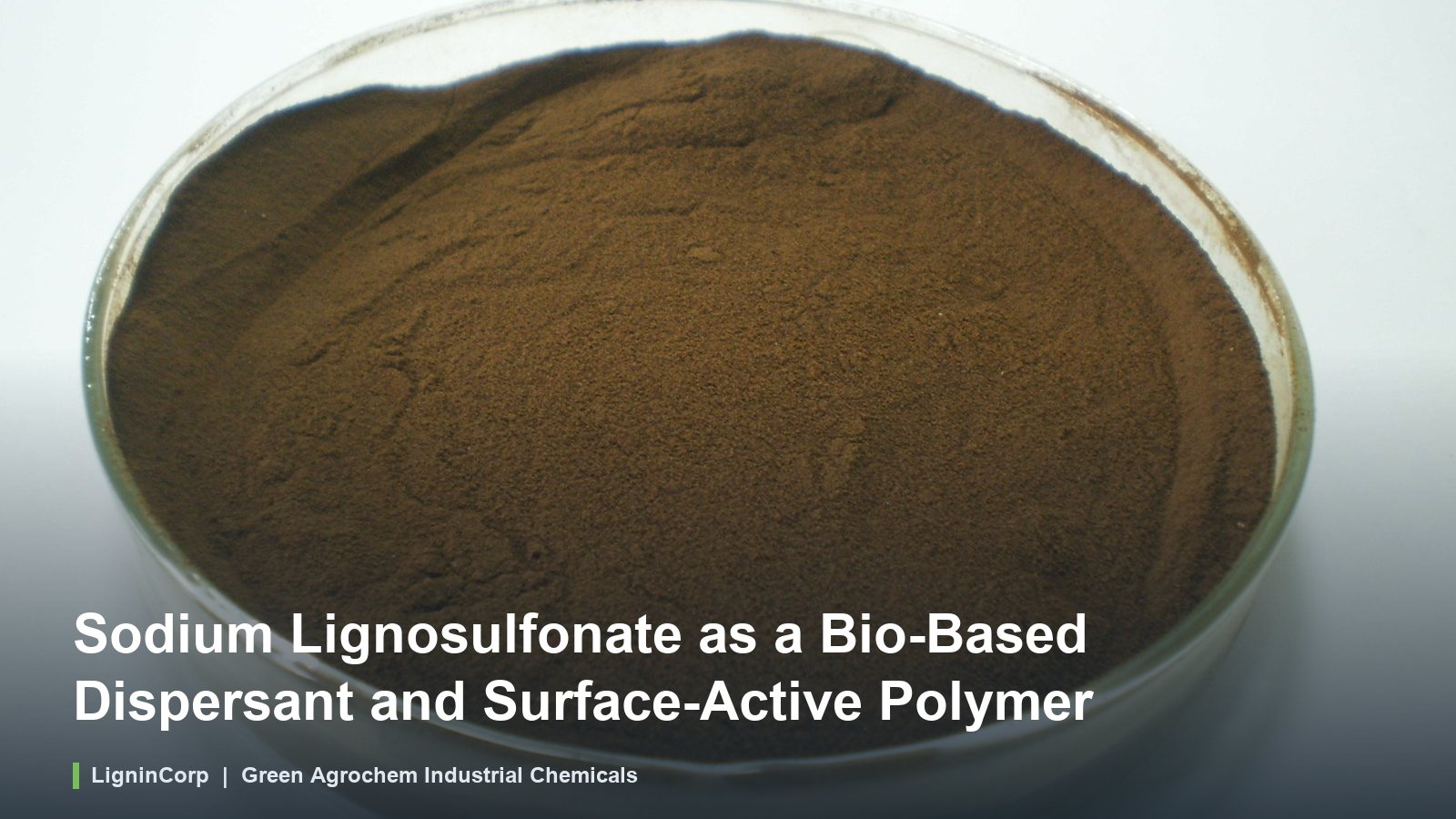
Sodium lignosulfonate is best described as a lignin-derived anionic polyelectrolyte with dispersing, binding and surface-active behaviour—not as a direct, one-for-one replacement for every conventional surfactant. Its heterogeneous aromatic backbone and hydrophilic sulfonate groups allow it to adsorb at solid–liquid and, in some systems, liquid–liquid interfaces. This makes selected grades useful when formulators need particle dispersion, suspension stability, wetting support or emulsion stabilization.
Performance depends strongly on the lignosulfonate grade, substrate, pH, electrolyte level, water hardness and the other ingredients in the formulation. Buyers should therefore select by application testing rather than by the generic name alone.
Why sodium lignosulfonate can be surface-active
Sodium lignosulfonate is a distribution of sulfonated lignin fragments rather than a single small molecule. Sulfonate and other oxygen-containing groups promote water compatibility, while aromatic regions can interact with less-polar surfaces. After adsorption, the polymer may help stabilize particles through electrostatic repulsion and steric effects. Its strongest practical contribution is often dispersion and interfacial stabilization, not maximum surface-tension reduction.
Functions formulators can evaluate
| Function | What to measure | Important limitation |
|---|---|---|
| Solid-particle dispersion | Viscosity, sedimentation, particle-size distribution and redispersibility | High salt, multivalent ions or incompatible cationic additives may reduce stability |
| Wetting support | Contact angle, wetting time and substrate coverage | A dedicated wetting agent may be needed when very low dynamic surface tension is required |
| Emulsion stabilization | Droplet size, creaming, phase separation and ageing stability | It may act as a co-stabilizer rather than the primary emulsifier |
| Binding and film formation | Green strength, abrasion, dust generation and moisture response | Water solubility and colour can limit some end uses |
Variables that control performance
- Molecular-weight distribution and degree of sulfonation: these influence adsorption, charge density, viscosity and dispersion.
- Purity and residual components: reducing sugars, inorganic salts and insolubles can affect colour, foaming and process consistency.
- pH and water chemistry: test in the actual process water; do not assume performance from deionized-water screening.
- Compatibility: conduct jar tests before combining an anionic lignosulfonate with cationic polymers, cationic surfactants or multivalent salts.
- Temperature and shear: evaluate the real mixing order, shear history and storage temperature.
Where it is commonly evaluated
Industrial formulators assess sodium lignosulfonate in mineral and pigment dispersions, ceramics, concrete and cement systems, granulation, dust-control binders and selected emulsions. A grade suitable for one of these uses is not automatically suitable for another. Feed, crop-input and pesticide-formulation applications also have different regulatory and impurity requirements and should be handled by the appropriate Green Agrochem division. For pesticide, dye and pigment formulation work, use the GreenAgrochem.net lignosulfonate dispersant selection guide; this LigninCorp page remains focused on industrial grade selection and procurement.
Recommended laboratory screening
- Define the required function and the pass/fail test before selecting a grade.
- Screen a recommended trial range around the supplier’s starting guidance; avoid treating a generic dosage as universal.
- Compare against the current dispersant or surfactant at equal solids and process conditions.
- Measure initial performance and stability after heat ageing, freeze–thaw or storage as relevant.
- Check colour, odour, foaming, corrosion, filtration and downstream compatibility.
- Confirm the commercial grade against its current TDS, SDS and representative COA before scale-up.
Bio-based does not remove the need for verification
The raw material is derived from lignin recovered during sulfite pulping, which gives it a renewable-carbon origin. That fact alone does not prove a particular grade is non-toxic, readily biodegradable, carbon-neutral or environmentally preferable in every use. Such conclusions require grade-specific safety information, application exposure assessment and, where relevant, lifecycle or biodegradation data.
Procurement checklist
When requesting a sample or quotation, provide the application, formulation pH, water hardness or salinity, solids loading, target viscosity, colour limit, temperature, competing additives and required regulatory documents. Ask for the current specification, TDS, SDS, packaging, lead time and batch-control parameters.
For an industrial grade recommendation, contact info@greenagrochem.com. See the industrial sodium lignosulfonate product page for commercial enquiries. For neutral chemistry and mechanism background, use the Lignosulfonate Knowledge Hub.
