
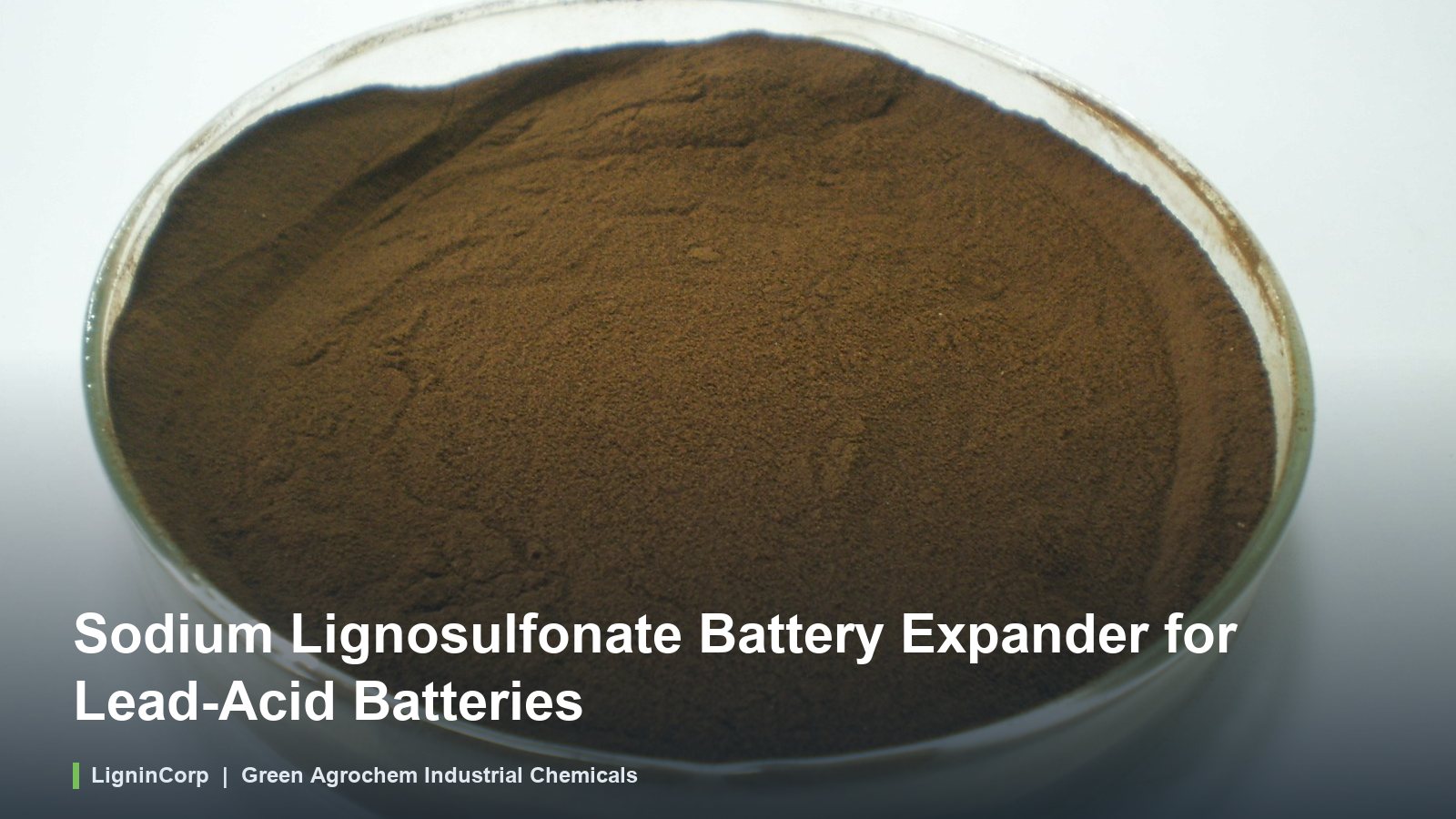
In a lead-acid battery, the negative plate needs an organic expander to keep its sponge lead porous over many charge and discharge cycles. Lignosulfonates are the classic organic expander. Our Sodium Lignosulfonate Battery Expander Grade (GAC-NaLS-Battery) is a sodium lignosulfonate made for this job, used together with barium sulfate and carbon in the expander package.
What the Expander Does in the Negative Plate
- Keeps the active material porous: without an expander, the sponge lead densifies and loses surface area as the battery cycles.
- Controls lead sulfate crystals: it helps form fine PbSO4 crystals on discharge, which convert back to lead more easily on charge.
- Supports capacity and cold cranking: by keeping more active material usable, especially at high discharge rates and low temperature.
- Works with the rest of the package: barium sulfate acts as a nucleation site for lead sulfate, and carbon black or graphite improves conductivity and charge acceptance.
Battery Expander Grade Specification
| Parameter | GAC-NaLS-Battery (typical) |
|---|---|
| Appearance | Brown powder, completely soluble in water |
| pH (10% solution) | 7.0 – 10.0 |
| Lignosulfonate content | 55.0% min |
| Reducing sugar | 5.0% max |
| Sodium sulfate | 6.0% max |
| Water-insoluble matter | 1.0% max |
| Moisture | 5.0% max |
| Ash | 20.0% max |
| Chloride | 0.5% max |
| Bulk density | 0.35 – 0.65 g/cm³ |
| Particle size | 95% passes 80 mesh |
Starting Dosage
| Step | Supplier-recommended starting trial range |
|---|---|
| Negative plate paste | 0.10 – 0.50% of lead oxide weight |
| First lab trial | 0.20 – 0.30% of lead oxide, then adjust with the BaSO₄ and carbon levels |
| Expander premix | Blend evenly with BaSO₄ and carbon black or graphite before adding to the paste |
Final dosage depends on battery design, oxide type, paste density, curing and formation. The TDS asks for pilot plates and full battery tests before production use.
How to Qualify It
- Make test plates at two or three dosages next to your current expander.
- Build test batteries and check cold cranking amps, reserve capacity, charge acceptance, water loss and cycle life, using the test methods your market applies (for example EN 50342-1 or SAE J537 for starter batteries).
- Run a shelf-stability check on charged batteries.
- Lock the dosage and expander ratio, then confirm on a production pilot run.
Where It Is Used
| Battery type | Role of the expander |
|---|---|
| Automotive starter (SLI) | Supports cold-cranking performance and recovery after discharge |
| Motive power / traction | Helps keep active surface area over deep cycling |
| UPS and telecom standby | Supports stable negative plates under float charge |
| VRLA | Used after lab compatibility tests, usually with carbon additives |
Packing and Documents
25 kg woven or kraft bags with a PE liner, or 500 kg / 600 kg jumbo bags on request. Store dry and away from strong oxidizers; shelf life 12 months in the sealed original packing. Documents: TDS, MSDS and a batch COA with each shipment. A calcium-based option is described in calcium lignosulfonate for lead-acid battery expanders; all sodium grades are on the sodium lignosulfonate product page.
Frequently Asked Questions
Why is lignosulfonate used in lead-acid batteries?
It is the organic part of the negative plate expander. It keeps the sponge lead porous and helps form fine lead sulfate crystals, which supports capacity and cold cranking over the battery life.
How much sodium lignosulfonate goes into the negative paste?
The Battery Expander Grade TDS gives 0.10 – 0.50% of lead oxide weight, with a first lab trial at 0.20 – 0.30%. Confirm with pilot plates and full battery tests.
What else goes into the expander package?
Barium sulfate and carbon black or graphite, blended evenly with the lignosulfonate before it is added to the paste.
Sodium or calcium lignosulfonate for battery expanders?
Both are used. The choice depends on your existing expander recipe and test results, so compare them in the same plate trial.
