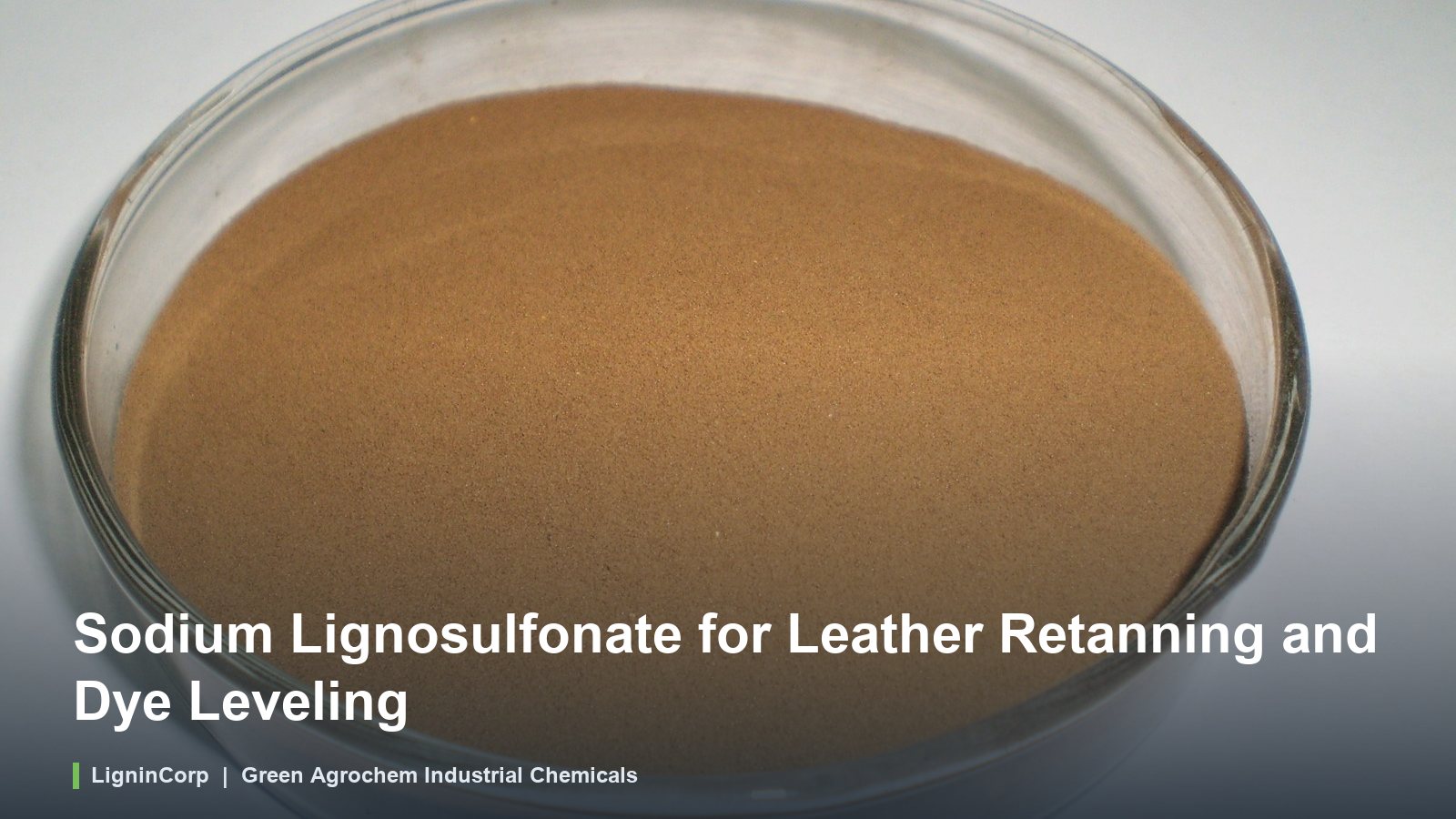
In leather wet-end processing, sodium lignosulfonate is used as a retanning auxiliary and dye-leveling dispersant. It is an anionic, lignin-based polymer that helps tanning agents and dyes spread evenly through the hide. Our Sodium Lignosulfonate Leather Tanning Grade (GAC-NaLS-Leather) is made for this use.
What It Does in the Drum
- Retanning support: helps chrome, vegetable or synthetic retanning agents distribute evenly and penetrate.
- Dye leveling: disperses dye in the float and reduces patchy shade.
- Fullness and feel: can add fullness and a softer, more flexible hand.
- Tannin blends: improves bath uniformity when blended with vegetable tannin extracts.
- Fatliquoring: can act as an auxiliary dispersant once emulsion compatibility is checked.
Why lignosulfonates work as tanning auxiliaries is explained on lignosulfonate.com: sodium lignosulfonate vs traditional tanning agents.
Leather Tanning Grade Specification
| Parameter | GAC-NaLS-Leather (typical) |
|---|---|
| Appearance | Yellow-brown powder |
| pH | 7.0 – 10.0 |
| Dry matter | 95% min |
| Moisture | 5.0% max |
| Lignosulfonate content | 60% min |
| Water-insoluble matter | 1.0% max |
| Sulphate | 2.0 – 5.0% |
| Calcium & magnesium | 0.5% max |
| Reducing sugar | 7.0% max |
| Ash | Around 12.0 – 18.0% |
Starting Dosage
| Use | Supplier-recommended starting trial range | Note |
|---|---|---|
| Retanning support | 1.0 – 4.0% on shaved weight | Start with lab drum trials; adjust by leather type, pH and target fullness |
| Dye leveling | 0.5 – 2.0% on shaved weight | Add after dilution; check dye compatibility and final shade |
| Tannin blends | 1.0 – 5.0% of the blend | Optimise with the full tanning package |
Results depend on hide type, float ratio, water hardness, pH and the other auxiliaries, so confirm each step in a pilot drum before scale-up.
Running a Lab Drum Trial
- Split matched pieces of the same shaved leather into a control and test lots.
- Run your normal retanning and dyeing recipe on the control, and the same recipe plus the lignosulfonate on the test lots at two dosages.
- Compare shade evenness, depth of penetration on a cut cross-section, fullness and softness after drying.
- Check the effluent and any restricted-substance requirements of your customers before switching.
Packing and Documents
25 kg woven or kraft bags with a PE liner, or 500 kg / 600 kg jumbo bags on request. Store dry and out of direct sun; shelf life 12 months in the sealed original packing. Documents: TDS, MSDS and a batch COA with each shipment. Other sodium grades are on the sodium lignosulfonate product page.
Frequently Asked Questions
How is sodium lignosulfonate used in leather tanning?
As a retanning auxiliary and dye-leveling dispersant in the wet end. It helps tanning agents and dyes spread evenly and can add fullness to the leather.
What dosage of sodium lignosulfonate is used in retanning?
The Leather Tanning Grade TDS gives 1.0 – 4.0% on shaved weight for retanning support and 0.5 – 2.0% for dye leveling, as starting trial ranges for lab drum tests.
Can it be used with chrome tanning?
Yes. The TDS lists it as an auxiliary for chrome, vegetable or synthetic retanning systems, after compatibility testing.
Does sodium lignosulfonate replace tanning agents?
No. It is an auxiliary that improves distribution, leveling and fullness; the main tanning is still done by chrome, vegetable tannins or synthetic tanning agents.
