
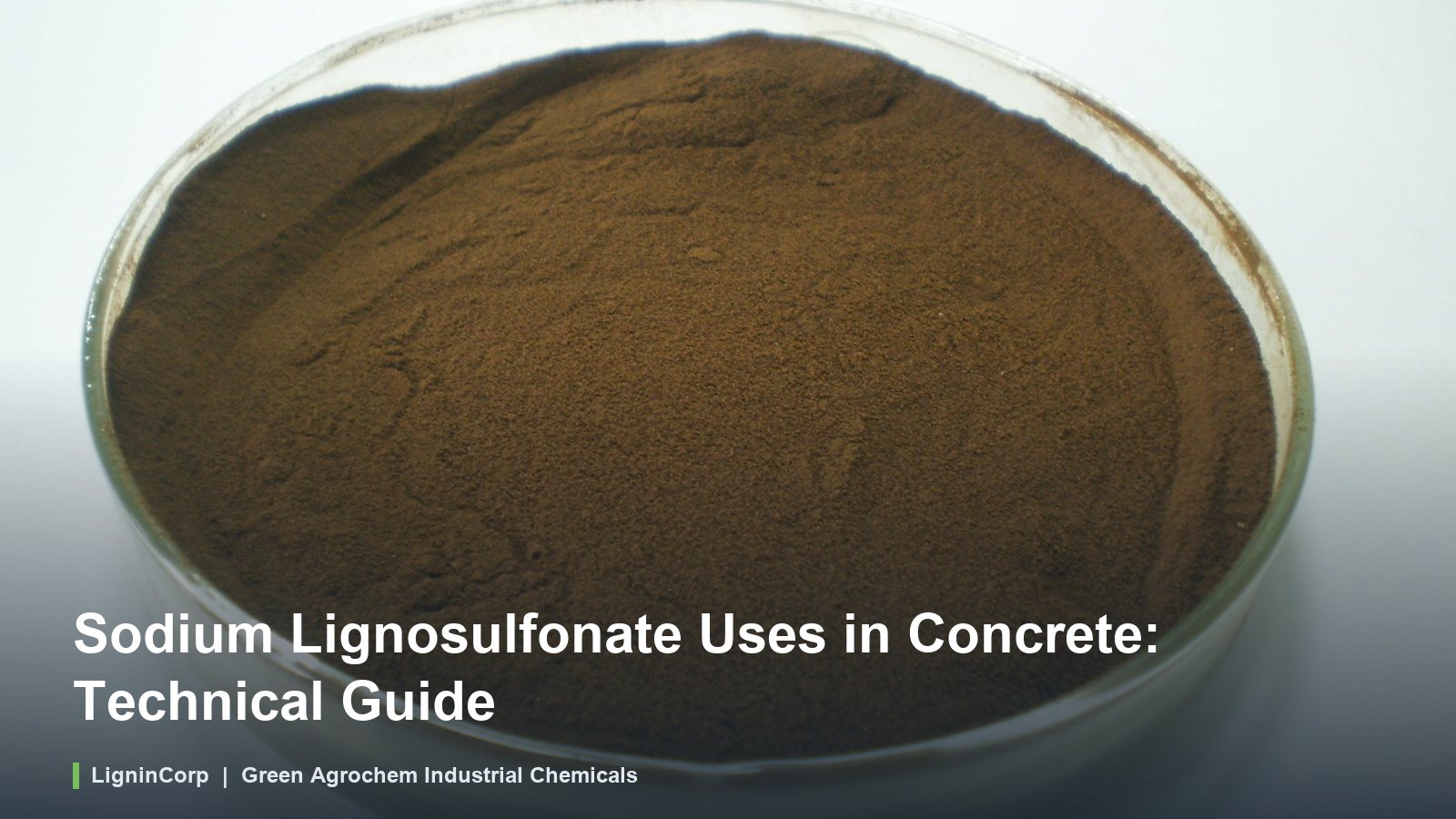
Sodium lignosulfonate is an anionic, water-soluble lignin derivative that can function as a cement dispersant and conventional water-reducing/plasticizing component. This page provides a technical concrete-use reference. Concrete-grade product specifications and commercial supply are handled by LigninCorp Industrial Chemicals; feed-grade material should not be selected for concrete solely because it has the same chemical family name.
How Sodium Lignosulfonate Works in Concrete
Lignosulfonate molecules adsorb on cement particles and increase electrostatic repulsion. The resulting dispersion can release water held inside cement flocs, improving workability at a constant water content or allowing water reduction at a selected consistency. Lignosulfonates may also affect air entrainment and setting behavior, so the complete admixture system must be evaluated rather than judging one ingredient in isolation.
Potential Functions—Subject to Mix Trials
- Workability control: improved cement-particle dispersion may make placement and finishing easier.
- Conventional water reduction: the achievable reduction depends on cement chemistry, dosage, temperature and other admixtures.
- Set control: some grades can retard setting; this may be useful or undesirable depending on the project.
- Cohesion: a compatible formulation may help manage bleeding and segregation, but must be checked experimentally.
- Cost-performance balance: compare total concrete cost and verified performance, not additive price alone.
Where It Is Commonly Evaluated
Typical screening areas include general ready-mix concrete, masonry products, cement grouts, dry-mix formulations and blended admixture systems. Sodium lignosulfonate is not automatically suitable for every cement, high-strength target, self-compacting mix or durability exposure class. Projects requiring high-range water reduction or long slump retention may need SNF or a tailored PCE system instead.
Specification Review
| Check | Reason |
|---|---|
| Solids or moisture | Needed to compare dosage on an equal active-solids basis. |
| pH | Routine batch-consistency and compatibility indicator. |
| Reducing sugars | May influence setting behavior and should be controlled by grade. |
| Water insolubles | Relevant to dissolution, dosing equipment and visible residue. |
| Chloride and alkali contribution | Review against project specifications and applicable standards. |
| Air and set response | Confirm in the actual cement/admixture combination. |
Recommended Laboratory and Plant Evaluation
Use a numerical addition level only when the current technical document for the exact grade identifies the range, revision and calculation basis. Present it as a supplier-recommended starting trial range—not a universal production dosage—and optimize it in the actual mix. Prepare an untreated control and several dosages, normalized to active solids. Record mixing sequence, cement source, SCM content, aggregate moisture and temperature.
- Measure initial slump or flow, air content and unit weight.
- Repeat workability measurements at the required transport and placement times.
- Observe bleeding, segregation, finishing and setting behavior.
- Test early and specified-age compressive strength.
- Run durability tests required by the exposure class; do not infer freeze-thaw, chloride or chemical resistance from strength alone.
- Confirm the selected formulation in a controlled plant batch before routine production.
Claims That Require Project Evidence
No lignosulfonate grade can universally guarantee a fixed water reduction, strength increase, shrinkage reduction, corrosion resistance, chemical resistance or freeze-thaw performance. These outcomes depend on the complete mix design, curing, air-void system, exposure and workmanship. Product approval should therefore be based on applicable standards and project-specific test data.
Concrete-Grade Product Route
For a current TDS, SDS, COA, sample or quotation, use the Sodium Lignosulfonate product page at LigninCorp. Provide cement type, target workability, required standard, estimated consumption, packaging and destination. For neutral chemistry and formulation context, consult the sodium lignosulfonate formula and identity guide. To review the concrete system and request exact-grade documents, a sample or a quotation, contact LigninCorp or email info@greenagrochem.com.
