
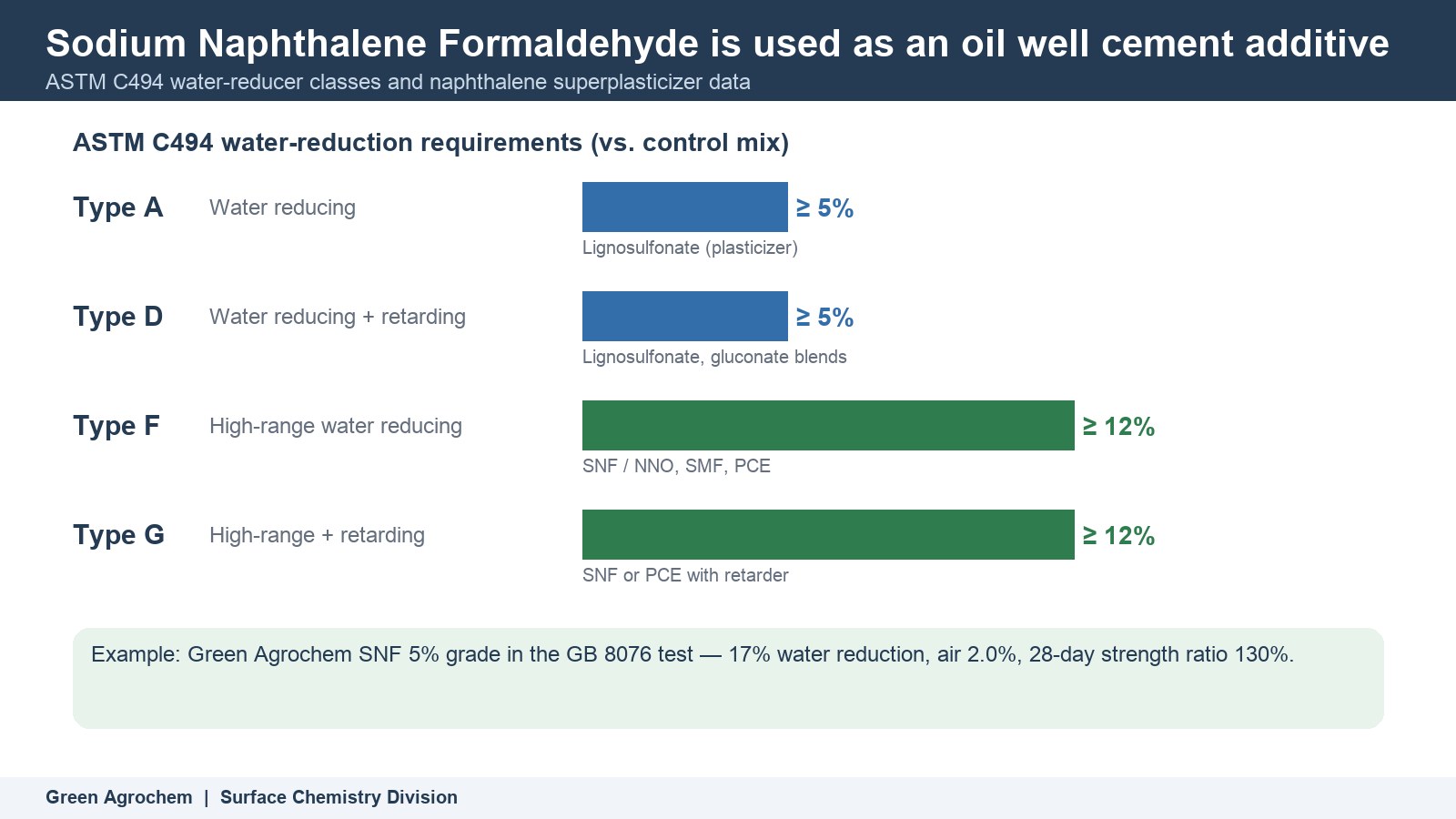
Sodium Naphthalene Formaldehyde (SNF) is an essential, high-performance dispersant and water-reducing additive used in oil and gas well cementing. By preventing the flocculation of cement particles, SNF ensures optimal slurry rheology, allowing for a 15% to 25% reduction in water content. This results in highly pumpable slurries that cure into exceptionally dense, impermeable, and high-strength seals capable of withstanding extreme subterranean temperatures and pressures.
Mechanism of Action in Wellbore Cementing
Oil well cementing requires pumping a cement slurry thousands of feet underground to secure the steel casing and hydraulically isolate distinct geological zones. If the slurry is too thick, it causes dangerous friction pressures; if it contains too much water, the cured cement will be porous and prone to catastrophic blowouts.
SNF resolves these challenges through electrostatic repulsion. When added to the cement mixture, the sulfonate groups in the SNF polymer adsorb onto the surface of the cement particles, imparting a strong negative charge.
- Friction Reduction: The identically charged cement particles repel one another, drastically lowering the slurry’s viscosity and yield point. This allows the slurry to flow smoothly through the casing and annulus.
- Density & Strength: By replacing the need for excess mix-water with chemical dispersion, SNF produces a high-density slurry. Once cured, this cement exhibits minimal porosity, vastly improving its compressive strength and resistance to corrosive formation fluids (like brine and hydrogen sulfide).
Key Applications in Drilling Operations
SNF is highly versatile and is deployed across a wide spectrum of complex cementing operations:
1. Primary Cementing
Used to secure the main casing strings. SNF ensures the slurry remains fluid enough to achieve 100% annular fill, preventing gas migration and providing long-term structural integrity.
2. Extreme Environment Cementing
- High-Temperature Wells: SNF remains chemically stable in extreme wellbore environments, maintaining slurry rheology at Bottom Hole Circulating Temperatures (BHCT) up to 185°F (85°C) without premature thermal degradation.
- High-Salinity (Brine) Conditions: Unlike basic dispersants, SNF resists the coagulating effects of salt, making it ideal for offshore drilling or cementing through massive salt formations.
3. Remedial and Squeeze Cementing
When repairing casing leaks or sealing depleted production zones, the cement must penetrate micro-fractures. SNF lowers the viscosity of the slurry so effectively that it can be “squeezed” into millimeter-thin fissures before setting.
4. Lightweight & Heavyweight Slurries
SNF is highly compatible with extending additives (like fly ash or glass microspheres for fragile formations) and weighting agents (like barite or hematite for high-pressure zones), keeping these complex mixtures uniformly suspended without settling.
Authoritative Application Guidelines
To achieve maximum performance and avoid slurry failure (such as free-water separation or premature setting), drilling engineers should adhere to the following metrics:
- Optimal Dosage: 0.5% to 1.0% By Weight of Cement (BWOC). The industry standard “sweet spot” is typically 0.75%, though this must be adjusted based on specific wellbore conditions.
- Water-to-Cement Ratio: SNF allows for an optimized water ratio of 40% to 60%.
- Compatibility: SNF is compatible with API standard cements (Classes A, G, and H). However, in high-shear mixing, it may induce foaming. It is highly recommended to co-formulate SNF with a compatible defoaming agent.
- Temperature Limitations: For wells exceeding 185°F (85°C), SNF should be paired with a high-temp synthetic retarder (like AM/AMPS polymers) or substituted with Polycarboxylate Ethers (PCE).
