
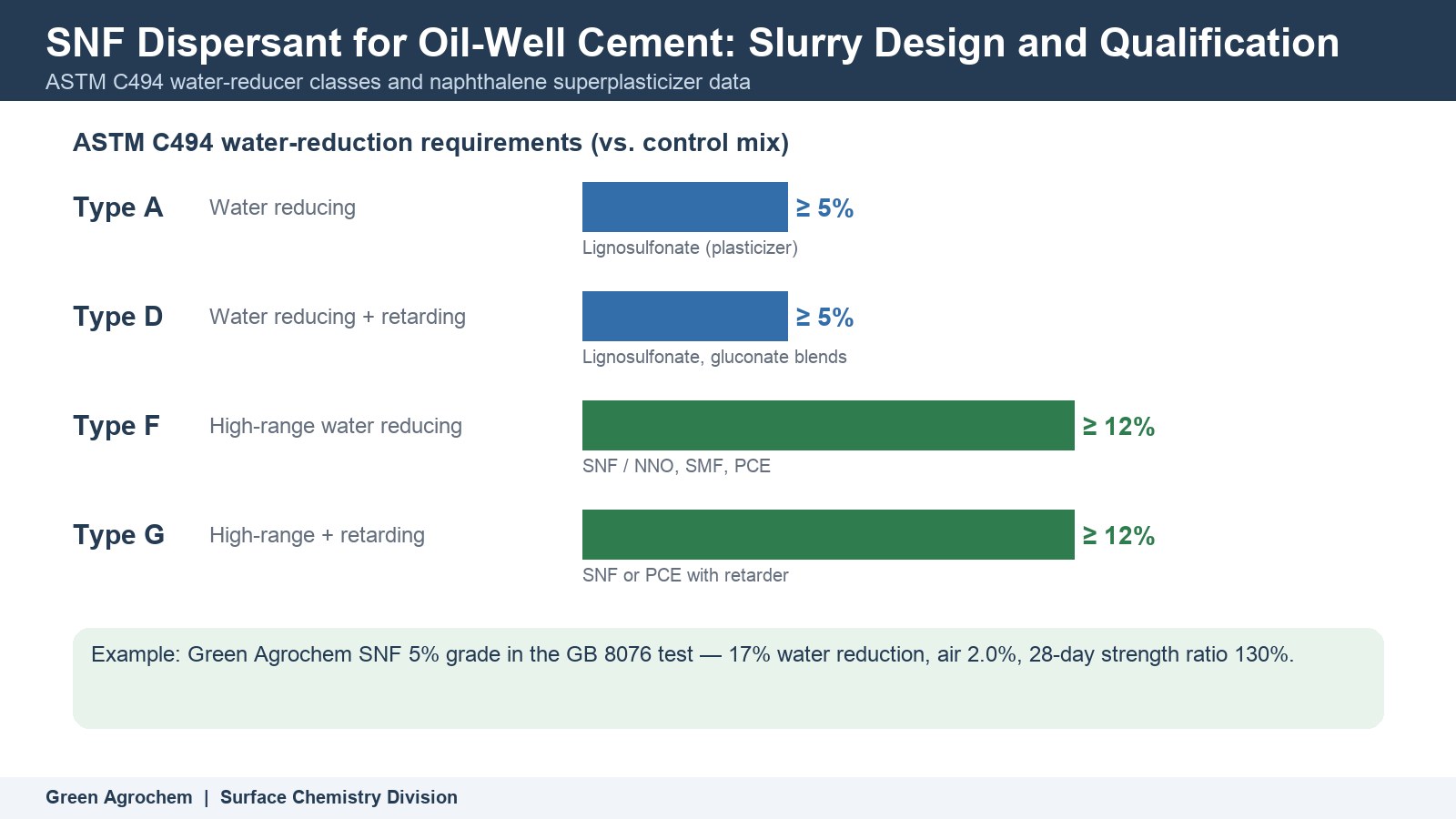
Sulfonated naphthalene-formaldehyde condensate (SNF), also called polynaphthalene sulfonate, is evaluated as a dispersant for selected oil-well cement slurries. By adsorbing on cement particles and increasing electrostatic repulsion, a compatible grade can reduce flocculation and improve rheological control. The result is formulation-dependent: it must be verified with the actual cement, mix water and complete additive package at simulated well conditions.
Nomenclature note: “sodium naphthalene sulfonate” can describe a low-molecular substance, while the cement dispersant is normally the formaldehyde condensate, SNF/PNS. Procurement documents should identify the chemical form, grade and specification rather than relying on the abbreviation SNS alone.
What SNF does in a cement slurry
Fresh cement contains particle agglomerates that immobilize water and increase apparent viscosity. The anionic sulfonate groups of SNF can adsorb at particle surfaces, helping separate agglomerates and release water into the continuous phase. Depending on the formulation, this may lower plastic viscosity or consistency, support pumpability and help achieve the required slurry density without adding unnecessary mix water.
Dispersion is only one part of slurry design. Excessive or incompatible dispersant can contribute to sedimentation, free fluid, unpredictable thickening behavior or an unsuitable rheology profile. A successful design balances pumpability with suspension stability and placement requirements.
Parameters that control performance
| Variable | Why it must be checked |
|---|---|
| Cement source and class | Mineralogy, fineness and lot variation change adsorption and additive demand. |
| Mix-water chemistry | Salinity, hardness and dissolved ions can alter dispersion and compatibility. |
| Temperature and pressure schedule | Surface mixing conditions and downhole exposure affect thickening, stability and strength development. |
| Slurry density and water-to-cement ratio | These influence rheology, free fluid, sedimentation and mechanical properties. |
| Other additives | Retarders, accelerators, fluid-loss additives, antifoams and weighting materials can interact with the dispersant. |
| Mixing order and energy | Addition sequence and shear can change dissolution and measured performance. |
Do not specify a universal dosage
There is no responsible fixed SNF dosage for every oil-well cement system. A supplier’s suggested screening range is a starting point, not a field recommendation. The appropriate concentration is determined by laboratory response curves and the operational window. It should be recorded on the same basis throughout the program, such as percent by weight of cement or concentration per sack, and adjusted only after compatibility and stability checks.
Recommended laboratory qualification
- Characterize the cement lot, mix water, target density and full additive package.
- Prepare an untreated control and several candidate concentrations using the intended mixing sequence.
- Measure rheology at relevant temperatures and assess whether the model used fits the slurry behavior.
- Check free fluid, settling or density variation, fluid loss and static stability as required by the job design.
- Confirm thickening time under the planned temperature and pressure schedule, including an operating safety margin.
- Measure compressive-strength development and any additional mechanical properties required for the well.
- Repeat critical tests with representative cement and additive lots before field use.
Information to request from the supplier
- Product identity and whether it is SNF/PNS condensate rather than a simple naphthalene sulfonate.
- Physical form, moisture or solids, pH with test conditions, sodium sulfate and insoluble matter where relevant.
- Lot-specific certificate of analysis, current technical data sheet and safety data sheet.
- Recommended dissolution, storage and addition procedure.
- Compatibility information for comparable cement systems, clearly identified as guidance rather than a guarantee.
SNF compared with other dispersant families
Lignosulfonate, SNF and polycarboxylate-based materials have different adsorption behavior, temperature response and compatibility profiles. Cost or nominal water reduction alone is not a valid selection rule. The preferred chemistry is the one that produces a stable, pumpable slurry with acceptable thickening time and strength development under the specified well schedule.
Related product and technical pages
- Sodium naphthalene formaldehyde (SNF) product page
- SNF as an oil-well cement additive
- SNF in construction chemicals
Request a grade and documentation review
Send the cement class and source, target slurry density, mix-water composition, temperature/pressure schedule and additive package to info@greenagrochem.com. The technical team can recommend a candidate grade and a laboratory screening plan; final use conditions remain subject to qualification in the complete slurry system.
