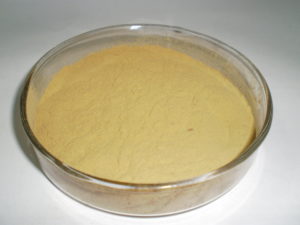
Calcium lignosulfonate is a family of lignin-derived, sulfonated materials supplied with calcium as the principal counter-ion. For industrial procurement, the family name and CAS reference are starting identifiers—not a complete grade specification. Physical form, dry matter, inorganic profile, reducing substances, pH test conditions, insoluble matter and application performance can differ by source and grade.
This guide explains how to identify and qualify an industrial grade. Buyers seeking an offer can review the LigninCorp Calcium Lignosulfonate product family; neutral chemistry information belongs in the Green Agrochem lignosulfonate knowledge guide.
Identity and Production Context
Lignosulfonates are complex, polydisperse materials associated with sulfite pulping and related lignin-processing routes. Sulfonate groups support aqueous behaviour, while the lignin-derived structure and accompanying organic and inorganic constituents influence grade-to-grade response. Calcium lignosulfonate is commonly referenced as lignosulfonic acid, calcium salt, CAS 8061-52-7. A single structural formula or molecular weight should not be used as though this were one discrete small molecule.
The exact manufacturing route must come from the supplier’s current documentation. “Sulfite-derived,” “kraft-derived” and “sulfonated kraft lignin” are not interchangeable descriptions, and the former page incorrectly blended them.
What an Industrial Buyer Should Specify
| Qualification item | Evidence to request | Why it matters |
|---|---|---|
| Exact product identity | Product code, manufacturer, site, supplied form and current TDS/SDS revision. | Separates an offered grade from general family information. |
| Concentration | Powder moisture or liquid solids with test method and limit/typical status. | Controls dry-solids conversion, freight comparison and batch preparation. |
| pH | Result with solution concentration, water, temperature and method. | Values without preparation conditions cannot be compared reliably. |
| Inorganic profile | Relevant ash, calcium, sulfate, chloride or other agreed constituents with methods. | May affect electrolyte-sensitive formulations and customer limits. |
| Organic profile | Lignosulfonate content, reducing substances and grade-specific controlled indicators. | Can influence dispersion, binding, air, setting and compatibility. |
| Insolubles and dissolution | Defined test, water quality, temperature, mixing time and residue result. | Supports screening of make-down, filtration, nozzle and deposit risk. |
| Batch consistency | Representative COAs from multiple recent batches. | Shows routine variation better than one generic typical-value sheet. |
| Regulatory or safety status | Current exact-grade SDS and market/application-specific declarations. | Family-level claims do not establish suitability for a regulated use. |
Functions Are Application-Dependent
Selected calcium lignosulfonate grades may be evaluated as dispersants, binders, plasticizing or set-control components, dust-control binders, granulation aids or formulation auxiliaries. These are possible technical functions, not guaranteed outcomes for every grade. Performance depends on the substrate, formulation, water chemistry, solids, addition sequence, mixing energy, temperature, competing additives and acceptance method.
Applications involving animal feed belong to the Green Agrochem Animal Nutrition division and require feed-grade and market-specific review. Agricultural inputs belong to the Agriculture division. This LigninCorp page addresses industrial procurement only.
Grade Qualification Workflow
- Define the application, approved control, supplied form and critical process/finished-product endpoints.
- Obtain current exact-grade TDS and SDS files plus representative COAs; reconcile units, test methods and specification versus typical values.
- Prepare the candidate under a defined dissolution procedure and compare it with the control on an equal dry-solids basis where appropriate.
- Screen more than one trial level while holding raw materials, water, mixing, temperature, addition order and ageing constant.
- Measure application-specific results such as rheology, particle size, settling, foam or air, setting, strength, binding, dust loss, filtration or finished-product quality.
- Confirm the selected condition at pilot or plant scale and agree incoming acceptance limits before routine supply.
A numerical dosage can be labelled a supplier-recommended starting trial range only when it is supported by the current document for the exact grade and states the calculation basis. It remains subject to validation in the customer’s actual system.
Former Data and Claim Review
| Former page statement | Evidence status | Public treatment |
|---|---|---|
| Reducing sugars “up to 30%” and “less than 5%.” | Conflicting values applied to different or undefined materials; no exact offered grade/document revision. | Quarantined as unverified. Use only a current exact-grade TDS or COA value with method. |
| Average molecular weight 40,000–65,000 Da, with more than 90% between 1,000 and 250,000. | Literature/dossier description of a defined material was presented as a universal product specification. | Not an LigninCorp grade specification. Molecular data require exact material and analytical method. |
| pH about 3–11 for a 1:100 solution. | Extremely broad family statement; not a useful incoming specification. | Request exact-grade pH with preparation conditions and method. |
| Particle size 10–20 µm, calcium content 40–60%, and activity index 0.1 g/g at 25°C. | Unsupported and technically inconsistent with the identified product family. | Quarantined from factual use pending an identifiable source, exact material and method. |
| A layered structure of alternating hydroxyl groups and benzimidazole rings. | Incorrect chemical description for calcium lignosulfonate. | Removed as false; do not use for product identification or mechanism. |
Documents and Enquiry Information
Use the technical document centre to request the applicable TDS, SDS and COA, then compare the exact grade against the intended process. When contacting LigninCorp technical sales, provide the application, current material, target function, dosage basis, critical tests, annual volume, packaging, destination and required regulatory documents. Email: info@greenagrochem.com.
