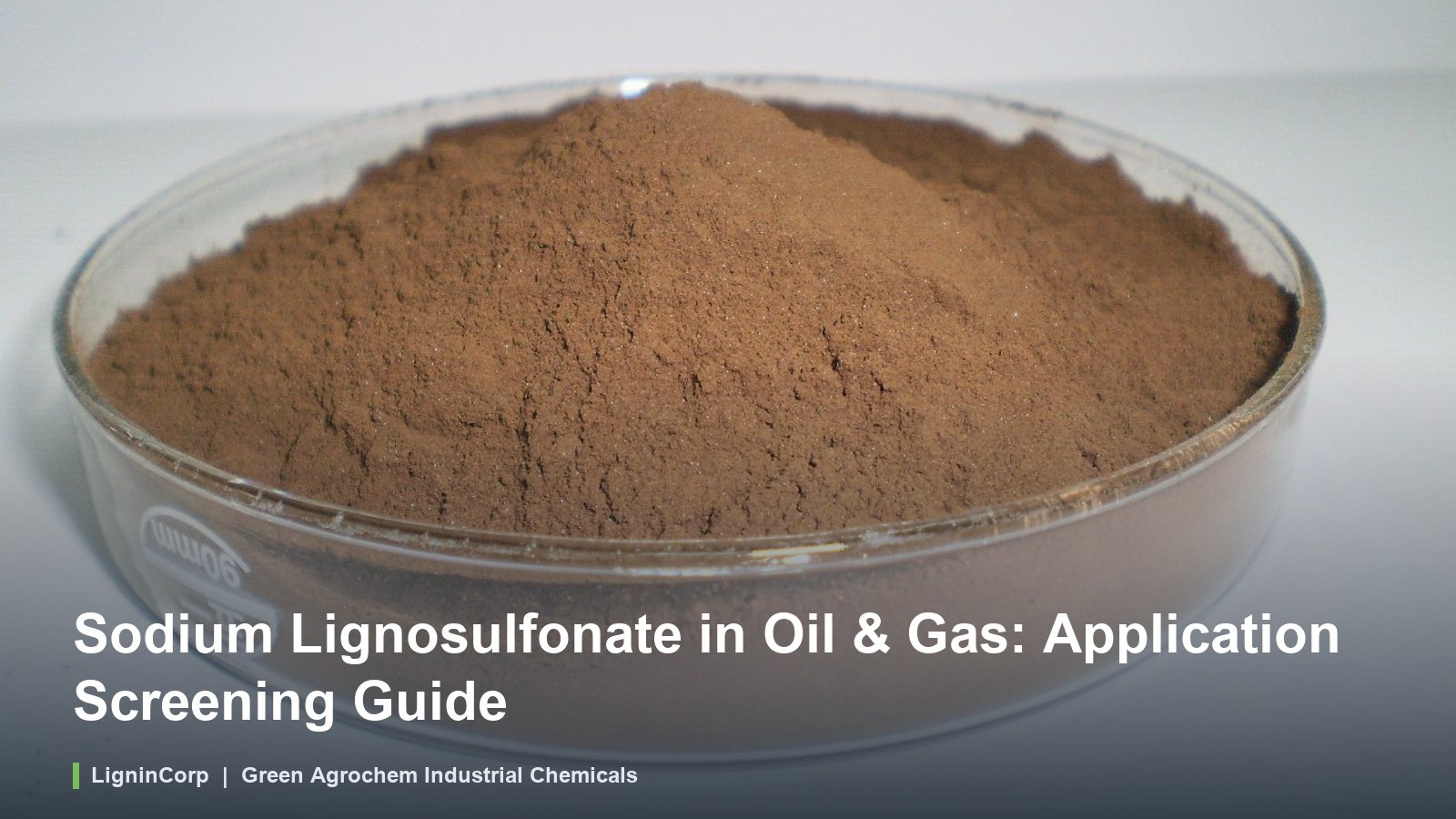
Sodium lignosulfonate is a water-soluble anionic lignin derivative that may be evaluated as a dispersing and rheology-control component in selected oilfield formulations. Its suitability is system-specific: performance depends on grade composition, water chemistry, solids loading, temperature, mixing sequence and compatibility with the complete additive package. This guide outlines a practical screening route for technical and procurement teams rather than presenting universal performance or dosage claims.
Where sodium lignosulfonate may fit
Water-based drilling fluids
In dispersed water-based muds, a suitable sodium lignosulfonate grade may help deflocculate reactive solids and adjust flow behavior. The relevant question is not whether the product “reduces viscosity” in isolation, but how it changes plastic viscosity, yield point, gel development, filtration behavior and solids tolerance in the actual mud. It does not replace mechanical solids control, and it should not automatically be described as a viscosifier, lubricant, shale inhibitor or universal fluid-loss reducer.
Oil-well cement slurries
Some specifically qualified lignosulfonate products are used in cement systems for dispersion and set-control functions. Sodium lignosulfonate should therefore be screened with the actual cement source, mix water and additive package. Thickening time, slurry rheology, free water, fluid loss and compressive-strength development must be tested at the relevant temperature and pressure schedule. A result from drilling mud cannot be transferred directly to cementing service.
Grade identity and documentation
“Sodium lignosulfonate” is a product family rather than one interchangeable specification. Counter-ion identity, solids basis, molecular-weight distribution, residual sugars, ash, sulfate, chloride, insoluble matter, pH and batch consistency can influence formulation behavior. Before testing, confirm the exact grade and request its current technical data sheet, safety data sheet and certificate-of-analysis format. Specifications and typical properties should not be confused with application dosage or guaranteed field performance.
Drilling-fluid screening sequence
- Establish a baseline. Record the untreated mud formulation, make-up water, solids content, density, pH and initial rheology.
- Run a controlled concentration series. Use a supplier-supported starting range only when the exact document, grade and calculation basis are known; otherwise determine a laboratory range experimentally.
- Measure the complete response. Compare plastic viscosity, yield point, gel strengths, filtration and visible stability instead of relying on one viscosity reading.
- Challenge the chemistry. Repeat testing at representative salinity, hardness, calcium or magnesium contamination, solids loading and pH.
- Age the formulation. Hot-roll or static-age testing should reflect anticipated circulating and downhole exposure before a field recommendation is made.
Compatibility and operating limits
Electrolytes, divalent ions, clays, weighting materials, polymers and other treatment chemicals can change the product response. Addition order and shear history may also affect dispersion. Dark color, odor, foaming tendency and solution clarity can matter in handling even when they do not determine technical performance. Claims involving enhanced oil recovery, corrosion inhibition, scale inhibition or hydraulic-fracturing performance require separate formulation-specific evidence and should not be inferred from general lignosulfonate chemistry.
Oil-well cement qualification
For cement applications, evaluate the proposed product within the complete slurry design. Confirm pumpability and rheology, thickening-time response, fluid-loss behavior, free water, sedimentation stability and strength development. Test interactions with accelerators, retarders, fluid-loss additives, defoamers and salts. Laboratory qualification should reproduce the intended cement, water source, mixing procedure and temperature-pressure profile; plant and field trials should follow before routine use.
Buyer and formulator RFQ checklist
- Application and fluid or slurry type
- Required product form, solids basis and packaging
- Make-up water salinity, hardness and expected contaminants
- Operating temperature, pressure and aging conditions
- Target rheology, filtration or cement-qualification tests
- Current TDS, SDS, COA limits and lot-traceability requirements
Related technical resources
For a broader functional overview, see lignosulfonates in oil drilling fluids. For diagnosis of rheology changes, use the drilling-fluid viscosity-control and troubleshooting guide. Procurement teams can also review the oil-well drilling fluids application page and the sodium lignosulfonate product page.
To discuss grade selection and obtain current technical documents, contact info@greenagrochem.com with your formulation, water chemistry and qualification requirements.
