
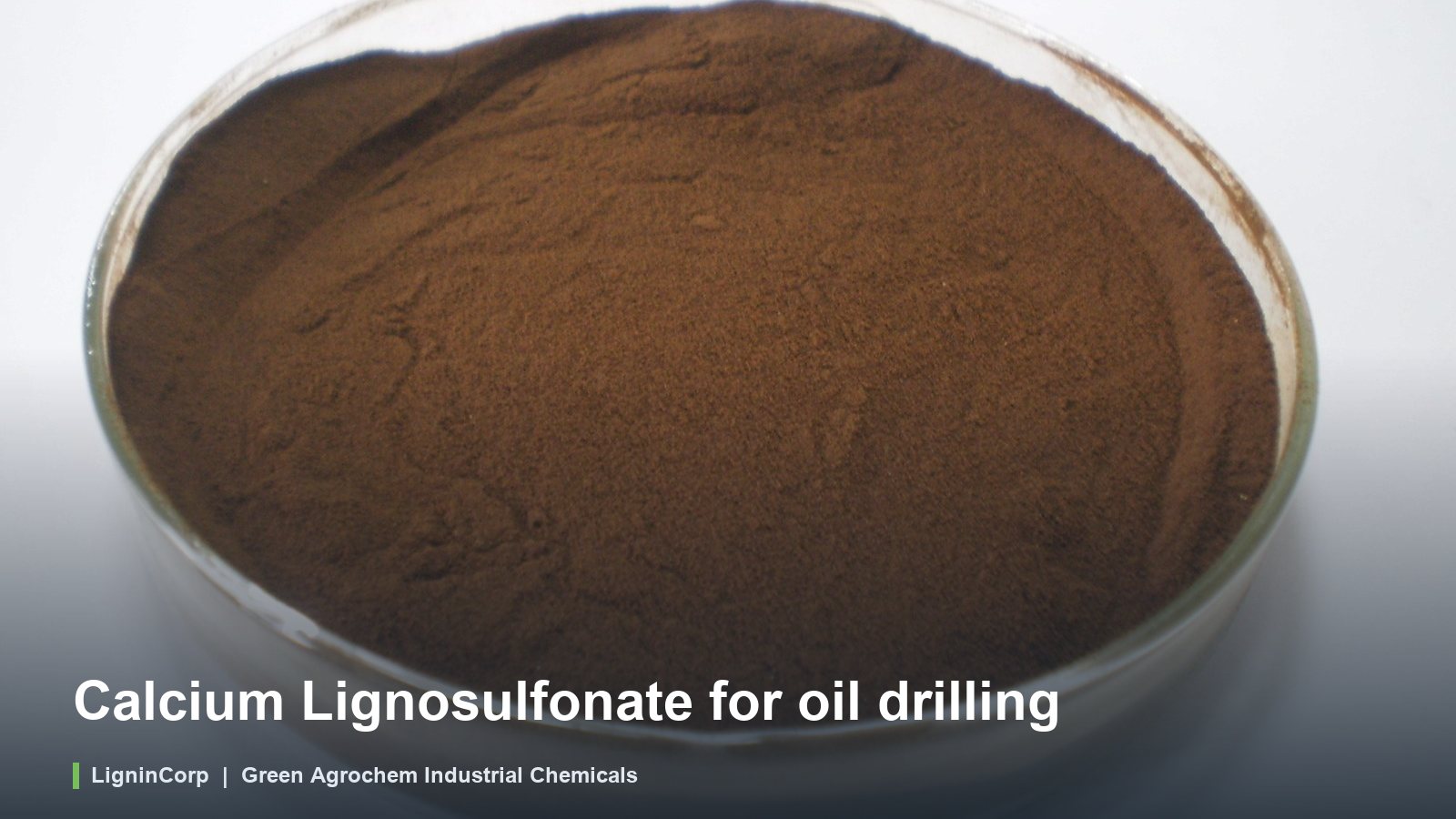
In oil drilling, calcium lignosulfonate has two separate jobs: it thins water-based drilling mud, and it retards the setting of oil-well cement slurries. This page covers the cementing use. For the mud use, see calcium lignosulfonate as a drilling mud additive.
Why oil-well cement needs a retarder
A cement slurry must stay pumpable long enough to be placed behind the casing, then set and gain strength. Downhole temperature speeds up hydration, so deeper and hotter wells need a retarder to extend the thickening time. Lignosulfonates are among the most widely used retarders for Portland well cements; the reference handbook Well Cementing (Nelson and Guillot, eds., 2nd edition, 2006) describes them as a standard retarder class for low to moderate temperatures, often combined with other additives at higher temperatures.
How lignosulfonate retards cement
Lignosulfonate adsorbs on the surface of hydrating cement grains and on early hydration products, slowing the reactions that cause thickening. As a dispersant it also lowers slurry viscosity. The size of the effect depends on the lignosulfonate (molecular weight, sugar content, purification), the cement class and batch, the temperature and the other additives. That is why the dose is set by laboratory tests, not by a fixed percentage.
Testing a calcium lignosulfonate retarder
Run the tests in API RP 10B-2 with the actual cement (for example API Class G or H to API Spec 10A), mix water and additive package:
| Test | What it shows |
|---|---|
| Thickening time at the well’s bottom-hole circulating temperature and pressure | Pumping time available; the main sizing test for the retarder |
| Rheology | Mixability and friction pressure during placement |
| Free fluid and fluid loss | Slurry stability |
| Compressive strength development | That the retarded slurry still sets and gains strength |
Start low and increase in small steps; an overdose can delay strength development at the top of a long cement column where it is cooler.
Other uses in drilling operations
- Thinner and dispersant in water-based drilling mud (see the drilling mud page).
- Dispersant in other water-based slurries on the rig, after compatibility checks.
Earlier versions of this page also listed gel conformance treatments, emulsion stabilisation and mud-pit hardening. We do not have product-specific data for these uses; treat them as research topics and test before any field use.
Grades and documents
For cementing trials we offer the standard grades on the calcium lignosulfonate product page and the dispersant grade. Note the sugar and reducing-matter values on each TDS (for example, reducing sugar around 7% for Grade One and reducing matter 18 – 20% for Grade Three), because sugars strengthen the retarding effect. Each grade has a TDS and MSDS; every shipment has a batch COA. Packing is 25 kg bags or 500 kg / 600 kg jumbo bags.
Frequently Asked Questions
What is calcium lignosulfonate used for in oil drilling?
It is used as a thinner and dispersant in water-based drilling mud and as a set retarder and dispersant in oil-well cement slurries.
How is a lignosulfonate cement retarder tested?
With the API RP 10B-2 procedures: thickening time at bottom-hole circulating temperature and pressure, rheology, free fluid, fluid loss and compressive strength, using the actual cement and additives.
Why does the sugar content of the lignosulfonate matter?
Sugars and other reducing substances also retard cement hydration, so grades with different sugar contents give different thickening times at the same dose. Compare grades in the thickening-time test.
Contact info@greenagrochem.com with the well temperature, cement class and target thickening time for a sample and documents.
