
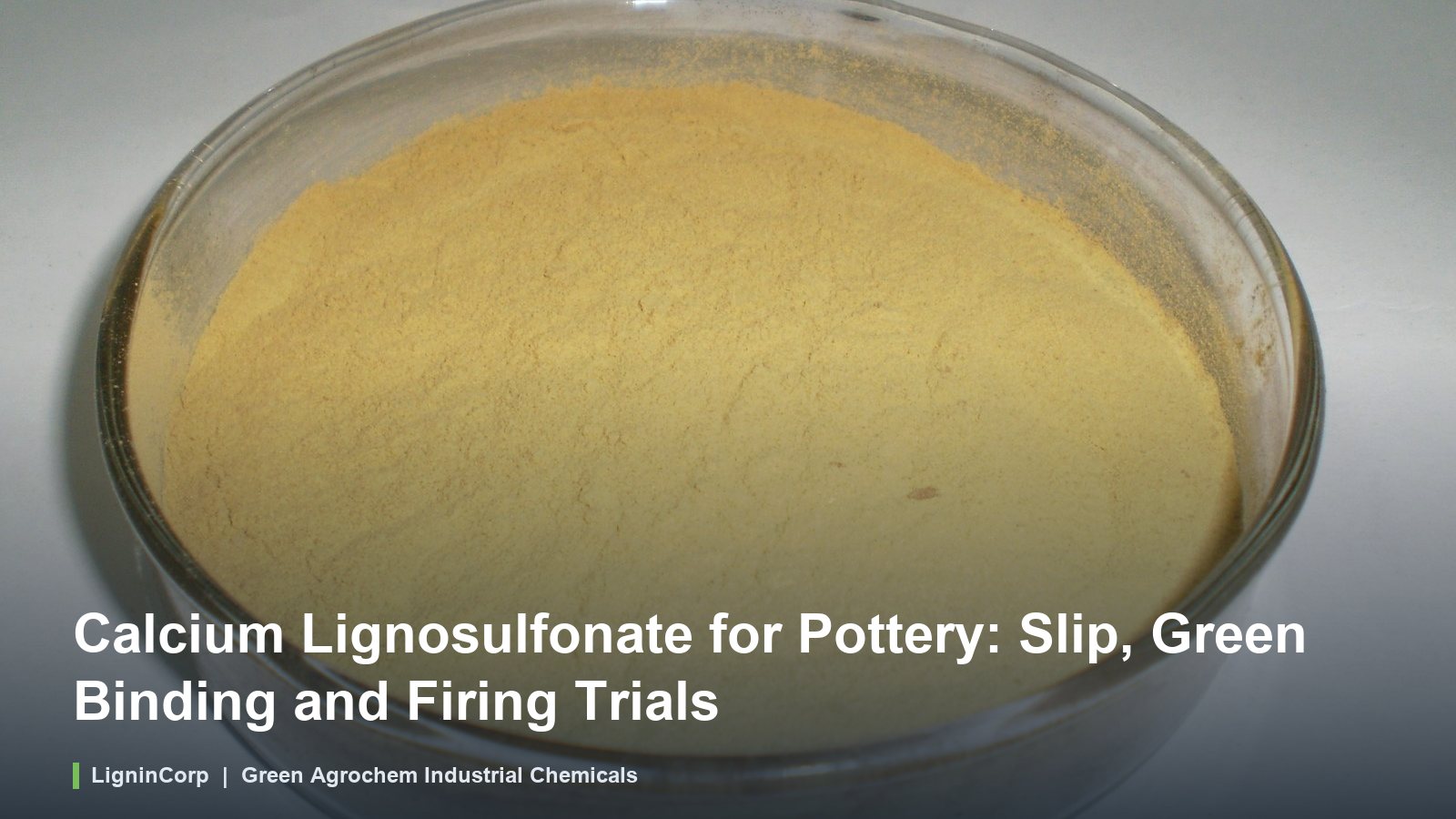
Calcium lignosulfonate may be evaluated in pottery and small-batch ceramic production as a slurry dispersant, temporary green binder or process aid. These functions are different: a grade that lowers slip viscosity may not provide the green strength needed for pressing, and a binder addition can increase viscosity rather than deflocculate the body.
For current product documents and samples, review Calcium Lignosulfonate Dispersant Grade Powder. Industrial producers can also use the Ceramics & Refractories technical route.
Match the Function to the Pottery Process
| Process | Possible role | What to measure |
|---|---|---|
| Slip casting | Deflocculation/dispersion screening to reach target flow at controlled water content | Solids, density, viscosity versus shear, thixotropy, settling, casting rate, drain behaviour and mold release |
| Plastic clay body | Process-aid or temporary binding screening | Plasticity, extrusion/throwing response, drying shrinkage, cracking, green strength and colour |
| Dry or semi-dry pressing | Temporary green binder | Granule flow, compact density, die release, green strength, breakage, drying and burnout |
| Engobe or glaze | Limited dispersion/binding evaluation | Rheology, settling, application weight, drying, colour, pinholes, crawling and fired surface |
Why Grade and Raw Material Matter
Commercial calcium lignosulfonates can differ in molecular distribution, sulfonation, reducing sugars, ash, insolubles, moisture, pH and colour. Clay mineralogy, particle-size distribution, soluble salts, process water and other deflocculants can change the response. Compare additions on a clearly stated as-supplied or dry-product-solids basis; total solids must not be treated as pure lignosulfonate assay and do not assume calcium lignosulfonate is equivalent to sodium silicate, polyacrylate, Darvan-type products or bentonite.
Recommended Laboratory Screening
- Characterize the control body or slip, including dry recipe, water, solids, density and initial rheology.
- Confirm exact product code and current TDS/SDS/COA; define whether dosage is as-supplied or dry solids.
- Run a small dosage ladder without changing water and additive level simultaneously.
- For slips, record viscosity at relevant shear rates and after defined rest periods; check sedimentation and casting behaviour.
- For pressed or plastic bodies, measure green strength, density, drying loss, shrinkage and handling damage.
- Use a firing schedule representative of production and inspect colour, carbon removal, pinholes, bloating, warpage, strength and residue.
Establish the Solids and Firing Window
No universal slip-solids target or clean-burnout temperature is specified. Establish the workable solids and rheology window for the actual clay recipe. Evaluate the firing schedule, atmosphere, body thickness, carbon removal and fired residue together rather than qualifying the additive by peak temperature alone.
Former Benefit and Safety Claims
| Former claim | Status | Required evidence |
|---|---|---|
| Faster casting/mold release, less water, shrinkage, cracking and warping; better surface, green density and strength | Application outcomes without controls or methods. | Measure each outcome against the control recipe under disclosed conditions. |
| Less expensive than sodium silicate or polyacrylates | Unsupported commercial comparison. | Compare current delivered cost on active basis plus dosage, rejects, throughput and quality impact. |
| Non-toxic, biodegradable and environmentally friendly | Unsupported universal safety/environmental claims. | Use exact-grade SDS and relevant test reports; assess process emissions, wastewater and fired residue separately. |
Important Practical Limits
Brown colour may be unacceptable in porcelain, whiteware, light bodies or transparent glazes. Check carbon removal, gas release, black core, pinholes and bloating under the actual body thickness, kiln atmosphere and firing schedule. Liquid products also require microbial/storage control according to the supplier document. Always check interaction with the existing deflocculant and binder package.
Production Qualification and Enquiry
Confirm the selected addition level in a production-scale trial before routine use. For tableware, food-contact articles or other regulated products, obtain product- and destination-market-specific review; additive selection alone does not establish compliance of the finished article.
Use the ceramic and refractory additive selection guide to compare process requirements. For a trial plan, send the clay recipe, forming method, water chemistry, current additive, firing schedule and acceptance criteria through our industrial technical enquiry page.
For a current specification, representative sample and pottery trial discussion, contact info@greenagrochem.com.
Overview of all ceramic uses: calcium lignosulfonate for ceramics. Grades and documents: calcium lignosulfonate product page.
Frequently Asked Questions
Can calcium lignosulfonate be used in pottery clay?
It can be evaluated as a slip deflocculant and green-strength binder in pottery bodies, using controlled trials on the actual clay and firing schedule.
Is it approved for food-contact tableware?
Choosing an additive does not by itself establish compliance of a finished food-contact article; obtain product- and market-specific review.
