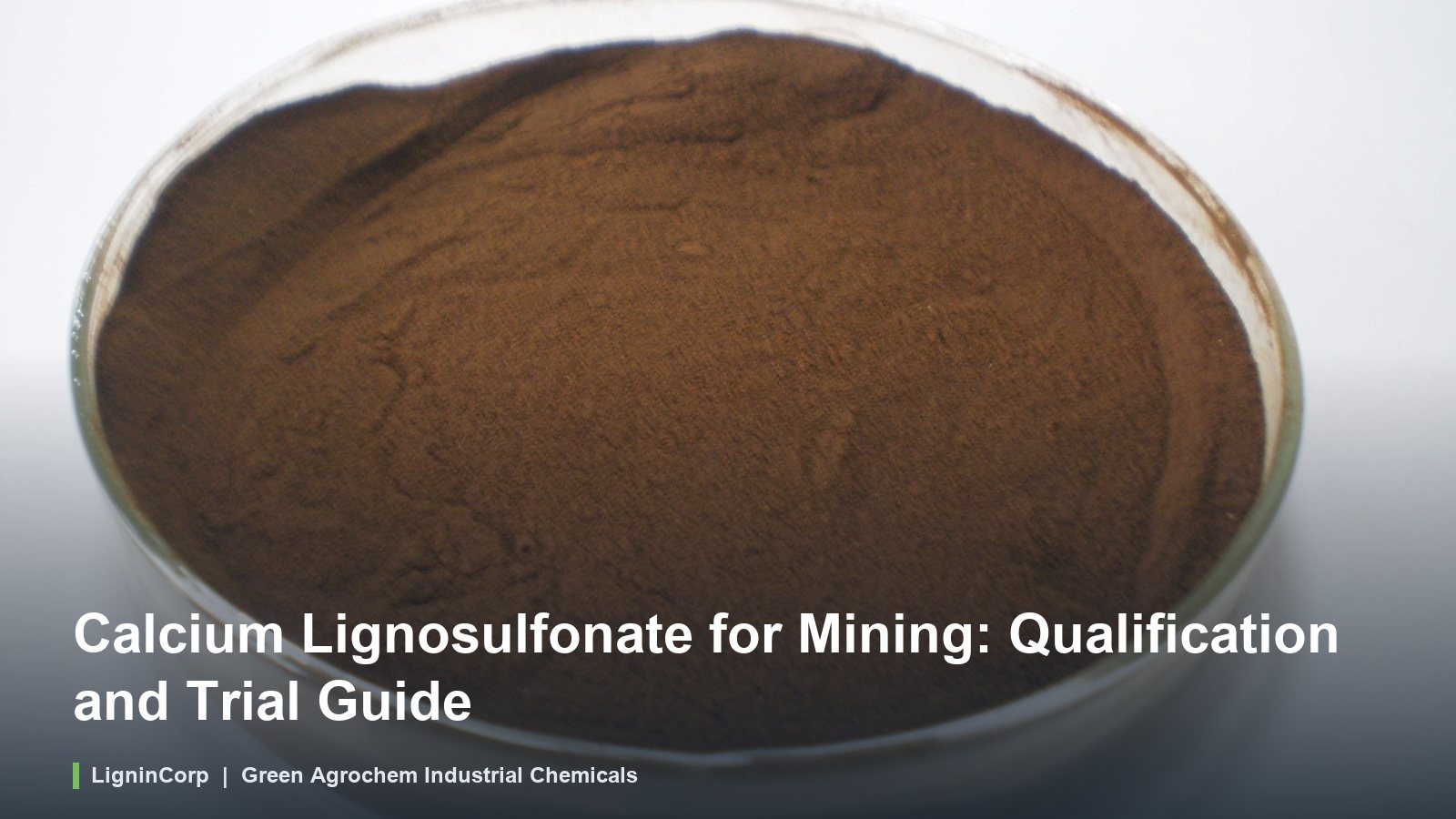
Calcium lignosulfonate can be screened for selected mining operations, particularly binding of mineral fines, treatment of suitable unpaved haul-road surfaces and dispersion in compatible aqueous mineral systems. It is not a universal mining reagent. Ore mineralogy, process water, product composition and the required downstream result determine whether a calcium grade is appropriate.
For current commercial specifications, packaging and samples, see Calcium Lignosulfonate. For a broader comparison of mining and drilling functions, use the Lignosulfonates in Mining and Drilling engineering guide.
Where a calcium grade may be evaluated
| Application | Possible role | Decision measurements |
|---|---|---|
| Ore fines, briquettes or agglomerates | Binder distributed through the moist particle bed before compaction or drying. | Green strength, dry strength, drop resistance, attrition, fines and re-wetting. |
| Mine haul roads | Surface-fines binding and moisture-response support on compatible unpaved material. | Dust response, traffic durability, skid condition, runoff and maintenance interval. |
| Mineral slurries | Dispersion or rheology adjustment where calcium and other ions are compatible. | Viscosity, yield stress, settling, filtration, aging and downstream processing. |
| Selected cementitious mine works | Conventional dispersion or set modification after mix-specific testing. | Flow, air, setting, bleeding, strength and compatibility. |
Binding mineral fines and agglomerates
Calcium lignosulfonate solution can distribute between particles and contribute cohesion as an agglomerate is compacted and dried. Performance is governed by particle-size distribution, surface chemistry, moisture, addition sequence, mixing, compaction pressure and curing or drying profile.
Do not assess only green appearance. Compare green and cured strength, abrasion or attrition, generated fines, moisture sensitivity and behavior in the next process step. A binder that survives transport may still be unsuitable if it introduces unwanted ash, moisture, color or soluble ions.
Mine-road dust-control trials
Performance on unpaved roads depends on fines and clay content, grading, compaction, rainfall, drainage, traffic load, climate and application equipment. Begin with a representative test section and an untreated control. Record weather, traffic and maintenance so the result can be interpreted.
A site plan should consider runoff, nearby water, wet-surface traction, corrosion-sensitive equipment and overspray. Use a measured performance threshold—not a universal calendar interval—to decide when maintenance or reapplication is needed. Calcium lignosulfonate must not be described as permanently suppressing respirable dust.
Mineral-slurry screening
The anionic polymeric structure may modify interactions between compatible particles in water, but the calcium counter-ion can matter in ion-sensitive systems. Test with the actual ore and recycled or fresh process water. Generate a dosage-response curve and measure both immediate rheology and stability after the relevant residence time.
Flotation recovery, grade, filtration and leaching response must be measured directly. A generic dispersion result does not prove selective depression, increased recovery or compatibility with collectors, frothers and modifiers.
Recommended qualification sequence
Treat supplier guidance as a recommended trial range and calculate additions on an active-solids basis.
- Define one primary function and numeric acceptance criteria.
- Characterize mineralogy, particle-size distribution, water chemistry, pH and temperature.
- Compare multiple dosages with an untreated control and the current additive.
- Keep mixing energy, addition order, compaction or aging conditions constant.
- Measure downstream consequences as well as the immediate target response.
- Confirm the selected grade in a controlled plant or field trial.
Grade and COA review
- Product form, appearance and manufacturing site.
- Moisture or liquid solids and the stated test method.
- pH, solubility or insolubles, ash and reducing sugars where relevant.
- Calcium and other ions when process chemistry imposes limits.
- Current TDS, SDS, lot COA, packaging, storage and shelf life.
- Traceability and advance notification of material process changes.
Claims requiring evidence
Do not assume permanent tailings stabilization, automatic flotation improvement, a fixed reduction in water or energy use, non-slip road performance, ecosystem safety or regulatory approval. Tailings dams and other geotechnical structures require qualified engineering design and site-specific assessment; a chemical additive must never be presented as a substitute for those controls. Environmental, biodegradability and non-toxicity statements require grade-specific evidence and review under local requirements.
Send the mineral system, target function, process water analysis, required tests, monthly quantity and delivery location to info@greenagrochem.com for grade selection and a trial plan.
