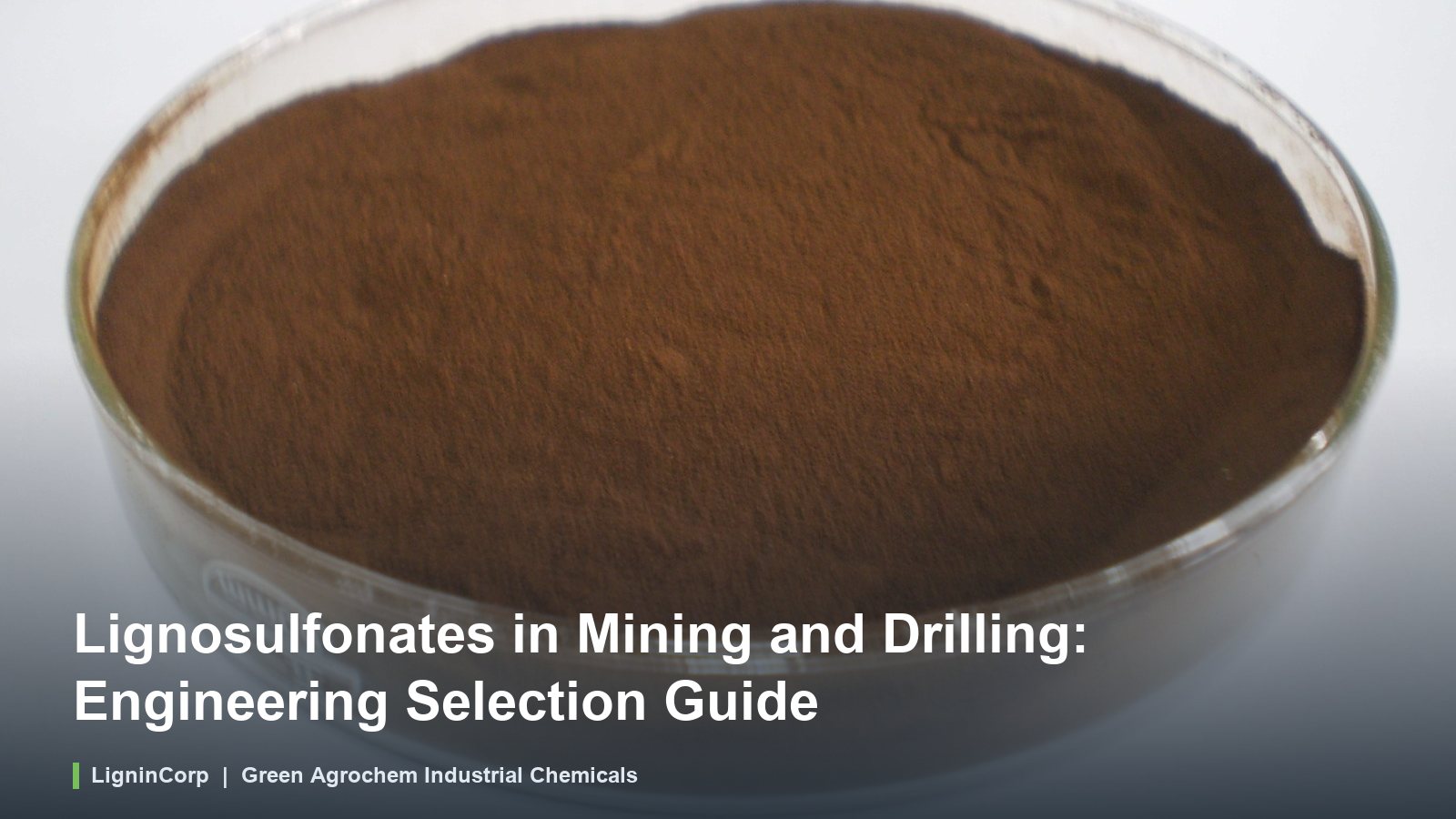
Lignosulfonates are evaluated in selected mining and drilling operations as particle dispersants, binders, dust-control agents and water-based-fluid additives. These are different functions with different qualification tests. Performance depends on product grade, counter-ion, solids, molecular distribution, inorganic content, water chemistry, mineralogy, temperature and the complete additive package.
This page provides an engineering framework for industrial screening. For current commercial grades and documentation, review Sodium Lignosulfonate, Calcium Lignosulfonate and Ferrochrome Lignosulfonate.
Application map
| Operation | Potential function | Key qualification measurements |
|---|---|---|
| Mineral slurry processing | Particle dispersion and rheology adjustment. | Viscosity, yield stress, solids loading, settling and aging. |
| Ore fines and briquettes | Binding during granulation, compaction and drying. | Green and dry strength, attrition, fines, moisture and re-wetting. |
| Mine haul roads | Binding of compatible surface fines for dust management. | Dust response, traffic durability, skid condition, runoff and reapplication trigger. |
| Water-based drilling fluids | Deflocculation or rheology control in compatible clay systems. | Rheology, gel strengths, filtration, thermal aging, contamination tolerance and corrosion review. |
| Cementitious mine works | Conventional dispersion or set modification after mix testing. | Flow, air, setting, strength, bleeding and compatibility. |
Mineral-slurry dispersion
Lignosulfonates can adsorb on compatible mineral particles and alter interparticle forces. A useful response may be lower viscosity at the target solids or improved slurry handling, but mineral surface chemistry and dissolved ions strongly affect the result. Flotation or leaching benefits must not be inferred from a generic dispersion test because reagent adsorption, selectivity and downstream recovery are process-specific.
Build a dosage-response curve with the actual ore, process water and pH. Measure immediate viscosity and performance after realistic residence or storage time. Then check whether the additive changes settling, filtration, flotation selectivity, leach chemistry or product quality.
Binding of mineral fines
For briquettes, agglomerates or granulated fines, evaluate binder distribution, moisture demand, compaction pressure and drying conditions. A formulation that gives good green strength may not provide the required cured strength or water resistance. Compare attrition, drop resistance, generated fines and downstream process behavior rather than judging appearance alone.
Dust control on mine roads
Lignosulfonate treatment may help bind fine particles on suitable unpaved surfaces. Results depend on gradation, clay and fines content, road preparation, compaction, traffic, rainfall, temperature, drainage and application equipment. The treatment plan should include a site-specific application trial, runoff controls, wet-surface traction assessment and a performance-based reapplication trigger.
No universal application concentration, service life or water-saving percentage applies to every road. For a dedicated evaluation method, see Lignosulfonate for Road Dust Control.
Water-based drilling-fluid evaluation
Certain lignosulfonate grades have been used to manage flocculation and rheology in water-based clay fluids. The appropriate chemistry depends on the mud system and operating conditions. Sodium, chrome-free and metal-containing products are not interchangeable, and historical use does not establish suitability under a current environmental or regulatory program.
Screen the candidate in the complete fluid after relevant thermal aging. Record plastic viscosity or an equivalent rheological profile, yield response, gel strengths, filtration, cake characteristics, pH, contamination tolerance and interaction with salts, weighting agents and polymers. High-temperature and salinity performance must be supported by grade-specific data.
Recommended qualification sequence
Use supplier guidance only as a recommended trial range and normalize comparisons to active solids.
- Define one primary function and measurable acceptance criteria.
- Characterize the ore, clay, water, salts, pH and process temperature.
- Compare several additions against an untreated control and current additive.
- Hold mixing energy, sequence, aging and test methods constant.
- Check downstream effects rather than optimizing one laboratory value alone.
- Confirm the selected grade in a controlled field or plant trial.
Supplier and documentation checklist
- Exact grade, counter-ion, product form and manufacturing site.
- Current TDS, SDS and lot-specific COA with test methods.
- Moisture or liquid solids, pH, solubility, insolubles, ash and relevant ions.
- Compatibility or application data generated in a representative system.
- Packaging, storage, shelf life, traceability and change-notification process.
Safety and environmental boundaries
Do not assume that every lignosulfonate grade is non-hazardous, readily biodegradable, approved for discharge or automatically compliant with a regional standard. Review the exact SDS, composition, metal content, local requirements, worker exposure, water management and waste route. Claims concerning reduced toxicity, emissions, water use, recovery or operating cost require application-specific evidence.
Send the operation, mineral or fluid composition, temperature range, target function, current additive and acceptance tests to info@greenagrochem.com for grade selection and a trial plan.
