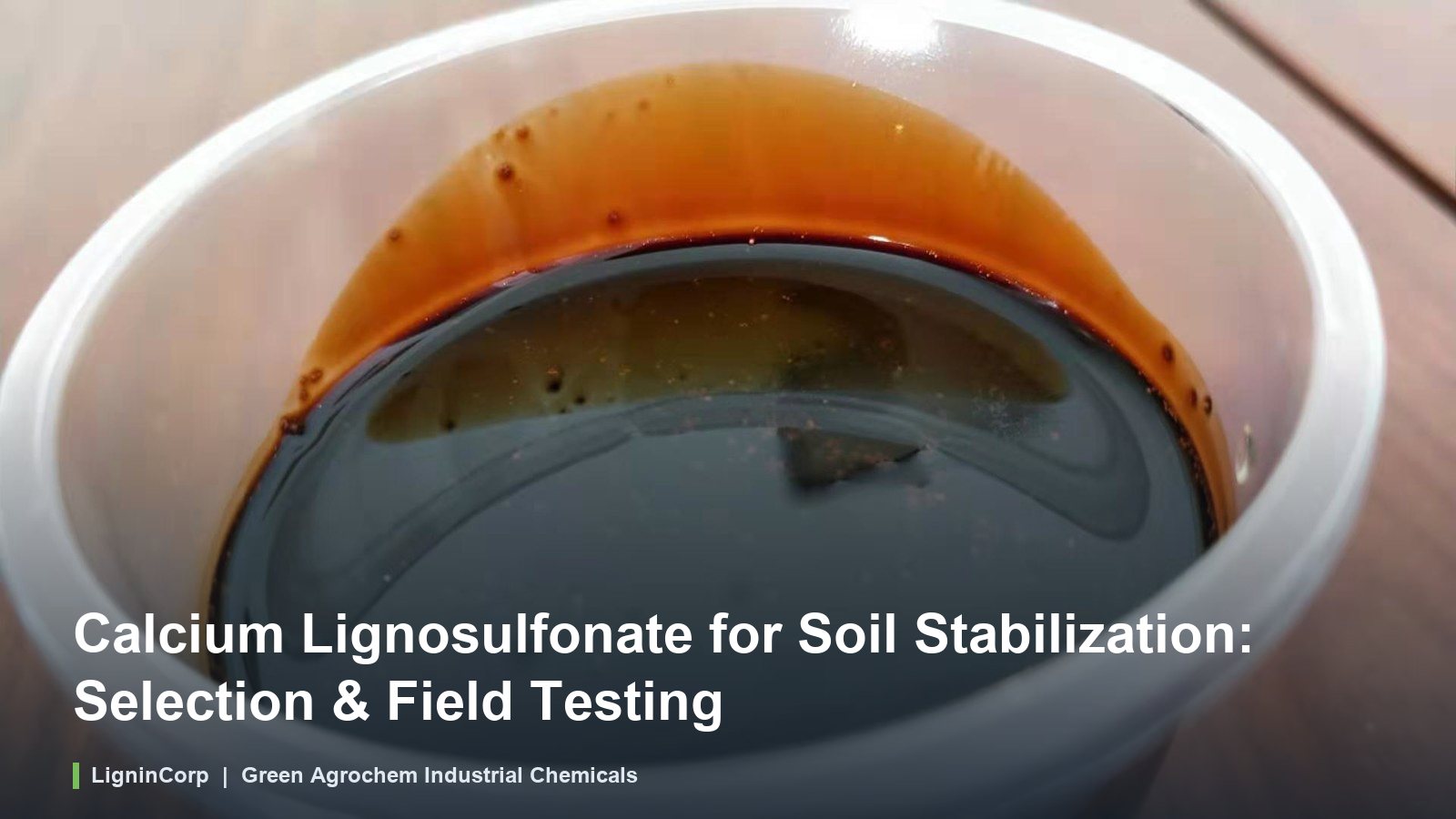
Calcium lignosulfonate is used mainly as a water-soluble surface binder and dust palliative for selected unpaved roads, haul roads, work yards, and similar aggregate surfaces. It can help agglomerate fines and reduce particle loss when the material gradation, moisture, drainage, application method, and maintenance plan are suitable. It should not be described as a universal substitute for engineered structural stabilization.
Surface binding is not the same as structural stabilization
The term “soil stabilization” covers different performance goals. A lignosulfonate treatment may improve surface cohesion, fines retention, compactability, and resistance to traffic-generated dust. These benefits can preserve an unpaved wearing course under appropriate conditions. However, a project that requires verified bearing capacity, subgrade strength, wet-weather durability, or frost resistance needs a geotechnical design and laboratory/field validation.
Federal Highway Administration guidance classifies lignosulfonates as organic, non-petroleum treatments that act as a glue between fine and coarse particles. The same guidance notes that they are effective dust palliatives but may not provide enough strength improvement to be treated as structural soil stabilizers in every application. This distinction should guide product selection and performance claims.
Where calcium lignosulfonate may be considered
- Dust control and fines retention on unpaved roads and industrial yards
- Surface binding on selected mine haul roads and construction access roads
- Reduction of loose aggregate, raveling, or washboarding where the surface contains suitable fines
- Mixed-in treatment of a prepared wearing course when supported by laboratory and test-section results
- Maintenance programs that can accommodate inspection and periodic reapplication
It is generally less suitable for poorly drained locations, surfaces exposed to frequent heavy rainfall or flowing water, frozen material, highly permeable or gap-graded aggregate with insufficient fines, or projects requiring a waterproof structural binder. Because lignosulfonates are water-soluble, rainfall and runoff can shorten service life and create migration concerns.
Mechanism and important variables
After application and compaction, lignosulfonate components can bind adjacent mineral particles and retain fine material within the surface matrix. Performance is governed by the treated material and construction process—not simply by the calcium counter-ion.
| Variable | Why it matters | What to record |
|---|---|---|
| Gradation and fines content | Insufficient fines limit particle binding; excessive clay can change mixing and moisture demand | Sieve analysis and plasticity data |
| Moisture condition | Very dry or saturated material can prevent uniform distribution and compaction | Field moisture relative to the selected compaction target |
| Drainage and rainfall | Standing water and runoff can remove a water-soluble treatment | Crossfall, drainage, rainfall pattern, and erosion exposure |
| Traffic | Axle load, turning, braking, and frequency affect surface wear | Vehicle types, traffic count, speed, and operating pattern |
| Application method | Spray-on and mixed-in treatments produce different penetration and service behavior | Dilution, spray uniformity, mixing depth, passes, and compaction |
| Product consistency | Solids, inorganic content, pH, and insolubles influence handling and delivered active material | Current TDS plus lot-specific COA |
Recommended project qualification process
- Define the objective. Separate dust suppression, surface preservation, and structural-strength requirements.
- Characterize the road material. Test gradation, plasticity, moisture-density relationship, and the engineering property relevant to the project.
- Review site constraints. Assess rainfall, drainage, freeze–thaw exposure, traffic, nearby water, vegetation, and local product-use requirements.
- Compare candidate treatments. Evaluate calcium lignosulfonate against water-only maintenance and other appropriate palliatives or stabilizers.
- Run laboratory trials. Use the actual aggregate or soil and the intended application basis. Test compaction, wet–dry durability, erosion or loss of fines, and strength only where those metrics are part of the design.
- Build a controlled field section. Document preparation, weather, dilution, application rate, mixing depth, compaction, curing, and traffic release.
- Monitor performance. Track dust, surface loss, raveling, washboarding, rutting, rainfall, and maintenance interventions against an untreated or standard-treatment section.
Application rate and construction method
There is no universal application rate for calcium lignosulfonate. Public road-management guidance consistently ties rate and construction method to material properties, traffic, weather, treatment depth, and desired performance. A supplier starting rate is meaningful only when it identifies the exact grade, as-supplied or dry-solids basis, dilution basis, surface area or treated mass, and supporting technical document. Confirm the final rate through a test section.
For spray-on dust control, the surface normally requires grading, correction of potholes and drainage defects, moisture adjustment, and uniform application. A mixed-in process can produce more uniform distribution and may provide longer service than a surface spray, but it requires scarification, controlled mixing, grading, and compaction. Avoid application when runoff is likely or the material is frozen, and follow the project’s environmental controls.
Product and supplier checks
Request the current TDS and SDS, a representative COA, solids or moisture basis, pH, inorganic-salt information where controlled, insolubles, density or bulk density as applicable, storage guidance, packaging, and lot traceability. For liquid products, compare delivered active solids and transport water. For powder products, confirm on-site dissolution and dosing capability.
Claims such as “non-toxic,” “environmentally safe,” “erosion-proof,” or guaranteed service life should not be accepted without product-specific evidence and review against local requirements. Environmental assessment should consider runoff, receiving waters, vegetation, application control, and the complete product—not only the renewable origin of lignin.
Related products and application guidance
- Calcium lignosulfonate dust-control liquid
- Calcium lignosulfonate dust-control powder
- Infrastructure and soil-stabilization application overview
Request a sample and technical review
Send the road or yard area, aggregate/soil test data, traffic profile, climate, drainage, application equipment, performance target, annual volume, and destination to info@greenagrochem.com. LigninCorp can support grade selection and sample evaluation; the project designer remains responsible for confirming field suitability and regulatory compliance.
