
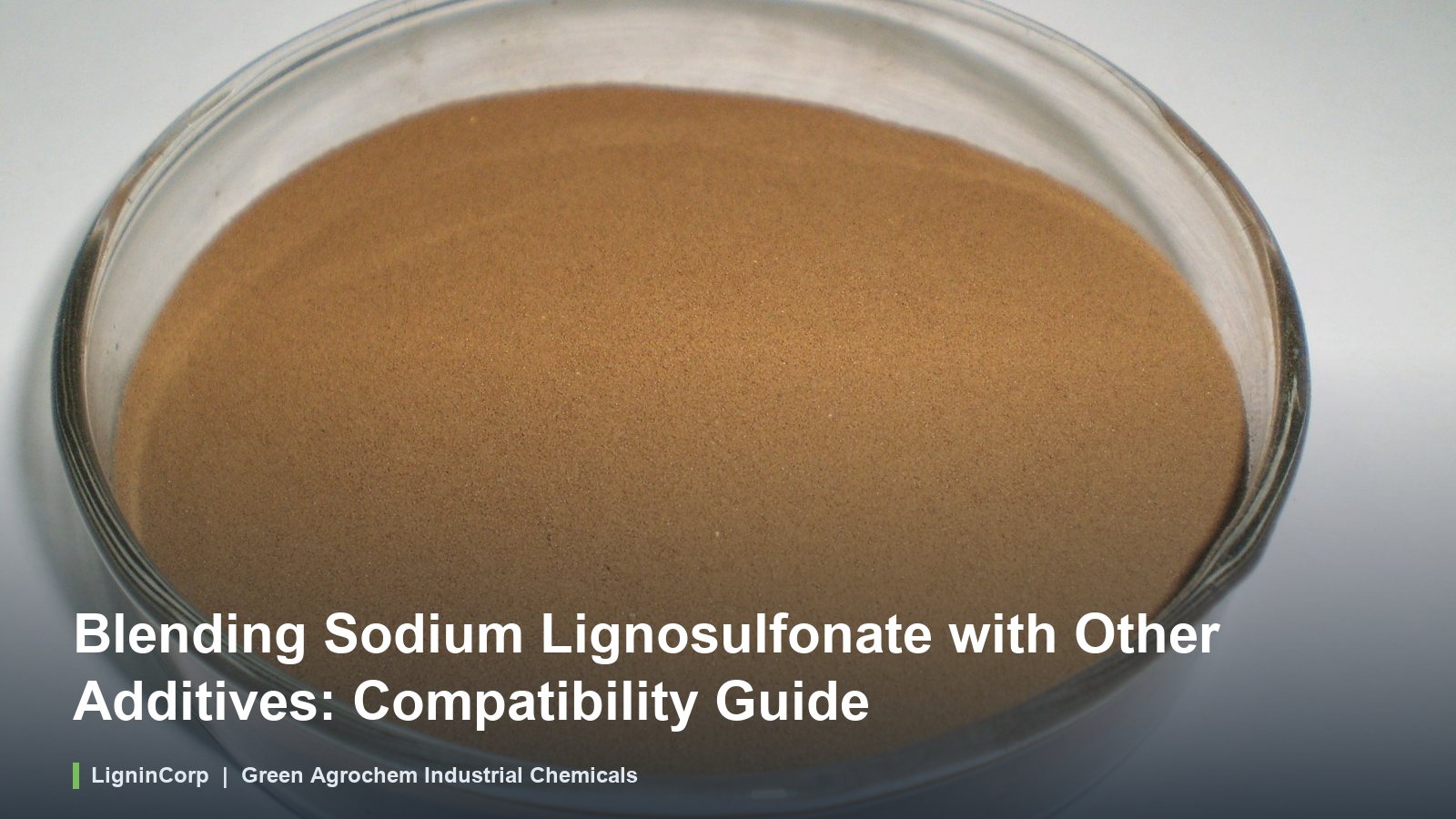
Sodium lignosulfonate can be blended with other formulation components, but compatibility and performance must be established in the complete system. It is an anionic, water-soluble lignosulfonate commonly evaluated as a dispersant, binder, plasticizing component or processing aid. Its effect depends on the grade, active-solids content, molecular-weight distribution, counter-ions, pH and the surfaces present in the formulation.
This guide explains where combination testing is technically reasonable, which interactions require attention and how to design an efficient screening program. It does not imply that every sodium lignosulfonate grade is compatible with every polymer, salt or surfactant.
Why formulate sodium lignosulfonate with other components?
A formulation often needs more than one function. Sodium lignosulfonate may provide wetting, particle dispersion, binding or water-demand control, while another component supplies air control, rheology modification, strength development, preservation or extended workability. A blend should therefore be designed around a measurable performance target rather than the assumption that adding more ingredients automatically improves the product.
Concrete and cementitious systems
In cement-based formulations, sodium lignosulfonate may be evaluated with water reducers, retarders, accelerators, air-control agents and supplementary cementitious materials. Important interactions include adsorption competition, sulfate balance, air entrainment, setting behaviour and loss of workability over time.
Combination with SNF or PCE chemistry can be technically possible, but the response is cement-dependent. A blend may change initial flow, slump retention, air or setting in a way that cannot be predicted from the individual components alone. Test the actual cement, supplementary cementitious materials and mixing sequence. See the Sodium Lignosulfonate Construction Grade and the concrete application guide.
Mineral dispersions, ceramics and pigments
Sodium lignosulfonate can be screened alongside inorganic salts, pH-control agents, defoamers and other dispersants in aqueous mineral systems. Clay mineralogy, particle charge, soluble ions, solids loading and shear history can materially change viscosity and settling behaviour. A stable low-solids test does not prove stability at production solids, so the evaluation should include the intended concentration and storage period.
For ceramic or pigment slurries, record viscosity across the relevant shear range, sedimentation, redispersibility, foam and colour contribution. Brown colour and the natural variability of lignosulfonate may limit use in colour-sensitive or high-whiteness formulations.
Granulation, briquetting and industrial binding
Where sodium lignosulfonate is used as a binder, it may be combined with mineral fines, starch-based materials, molasses, clays or other binder systems. The relevant outcome is not simply wet tack. Measure green strength, dry strength, abrasion or drop resistance, moisture sensitivity, curing or drying demand and the effect on downstream processing.
The optimum addition level depends on particle-size distribution, surface area, moisture and compaction energy. Treat the supplier range as a recommended trial range and confirm the final dosage in the customer’s process. For binder-focused selection, review Sodium Lignosulfonate Binder Grade.
Surfactants, polymers and defoamers
Because sodium lignosulfonate is anionic, combinations with nonionic or anionic components may be easier to screen than combinations with strongly cationic materials. Strongly cationic polymers or surfactants can form complexes, increase turbidity or produce precipitation. High electrolyte concentration, extreme pH and hard-water ions can also alter solubility and dispersion.
A defoamer may be necessary when mixing introduces persistent air, but excessive defoamer can reduce wetting or destabilise a dispersion. Add components in a controlled sequence and evaluate the complete formulation rather than relying only on a beaker appearance immediately after mixing.
Compatibility risks to check
- Precipitation or haze: inspect immediately and after ageing at the intended temperature.
- pH drift: record initial and aged pH because neutralisation state can affect solubility.
- Viscosity change: measure at relevant solids and shear conditions.
- Foam and entrained air: distinguish surface foam from air retained in the final material.
- Colour and odour: qualify acceptability in the finished application.
- Microbial stability: evaluate preservation needs for water-based products during storage.
- Performance loss: confirm that one component does not adsorb, deactivate or consume another.
Recommended formulation-screening method
- Define the required function and acceptance criteria before preparing blends.
- Characterise the sodium lignosulfonate grade, including solids, pH, moisture and relevant ions.
- Run single-component controls and a blank formulation.
- Screen a small matrix of ratios on an equal-active-solids basis.
- Keep water content, mixing energy, temperature and order of addition controlled.
- Measure immediate performance and stability after the required ageing period.
- Confirm the preferred formulation at pilot or production scale before commercial use.
Information to provide when requesting a recommendation
For a useful starting recommendation, provide the application, complete ingredient list, solids content, pH, water hardness, process temperature, mixing sequence, required storage life and target test method. Request the current TDS, SDS and representative COA for the proposed grade. For dispersant applications, see Sodium Lignosulfonate Dispersant Grade, or contact LigninCorp with the formulation conditions.
