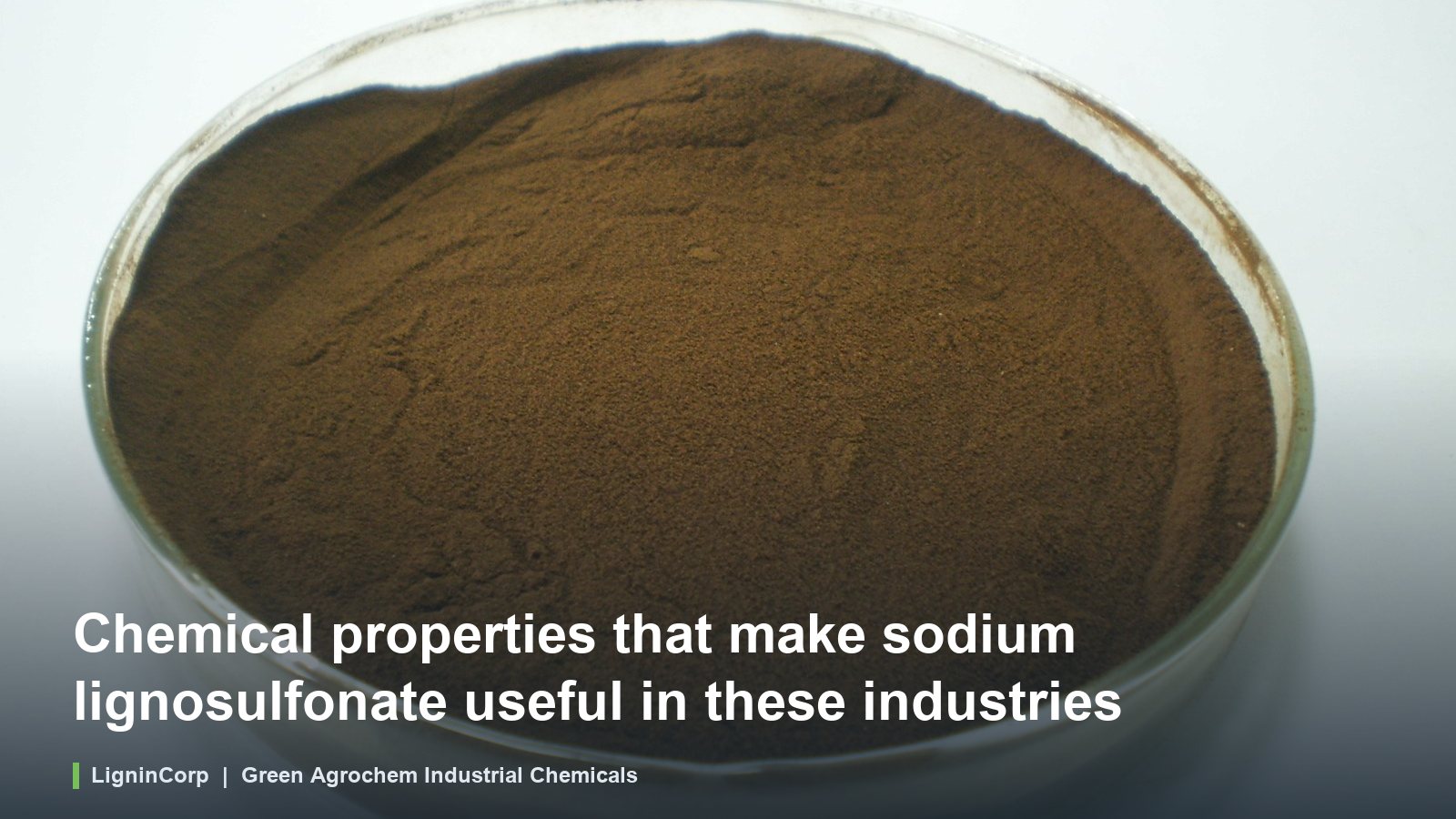
Sodium lignosulfonate has several key chemical properties that make it useful in concrete, cement, and construction industries:
- Dispersant/Plasticizing Properties:
- The sulfonate groups on the lignosulfonate molecule carry a negative charge, which helps disperse and deflocculate cement particles in concrete.
- This improves the fluidity and workability of the concrete mixture, reducing the amount of water required.
- Water-Reducing Ability:
- Sodium lignosulfonate acts as a water-reducing admixture in concrete.
- By dispersing the cement particles, it allows for a reduction in the water content of the mix while maintaining the same workability.
- This increases the strength and durability of the hardened concrete.
- Retarding Effect:
- Sodium lignosulfonate can delay the initial setting time of cement and concrete.
- This provides extended workability and placement time for the concrete.
- Binding/Adhesion Properties:
- The lignin-derived structure of sodium lignosulfonate allows it to interact with and bind to cement particles.
- This improves the adhesion and cohesion within the concrete matrix.
- Compatibility:
- Sodium lignosulfonate is compatible with other common concrete admixtures like air-entraining agents and accelerators.
- This allows it to be used in combination with other admixtures to achieve desired concrete performance.
- Sustainability:
- Sodium lignosulfonate is a byproduct of the paper pulping industry, making it a renewable and environmentally-friendly concrete additive.
Sodium lignosulfonate is a synthetic polymer that is commonly used as a body reinforcement in refractory and ceramic materials. It has several chemical properties that make it useful in various industries. Some of these properties include:
- Thermal insulation: Sodium lignosulfonate has a high thermal conductivity, which means it can absorb and dissipate heat quickly. This property makes it useful in applications where high thermal insulation is required, such as in heat shields and blankets.
- Corrosion resistance: Sodium lignosulfonate is resistant to corrosion, which makes it useful in applications where materials need to be protected from corrosive environments, such as in pipelines and tanks.
- Chemical resistance: Sodium lignosulfonate is resistant to chemical reactions, which makes it useful in applications where materials need to be protected from chemical reactions, such as in pharmaceuticals and cosmetics.
- Durability: Sodium lignosulfonate is a strong and durable material that can withstand harsh environments and high temperatures. This property makes it useful in applications where materials need to be able to withstand repeated exposure to harsh conditions, such as in the automotive and aerospace industries.
- Chemical reactivity: Sodium lignosulfonate can react with certain chemicals to produce new compounds, which makes it useful in applications where chemical reactions are desired, such as in the production of polyethylene and polypropylene.
- Biocompatibility: Sodium lignosulfonate is biocompatible, meaning it is non-toxic and non-allergenic, which makes it useful in applications where materials need to be safe for human consumption, such as in pharmaceuticals and cosmetics.
