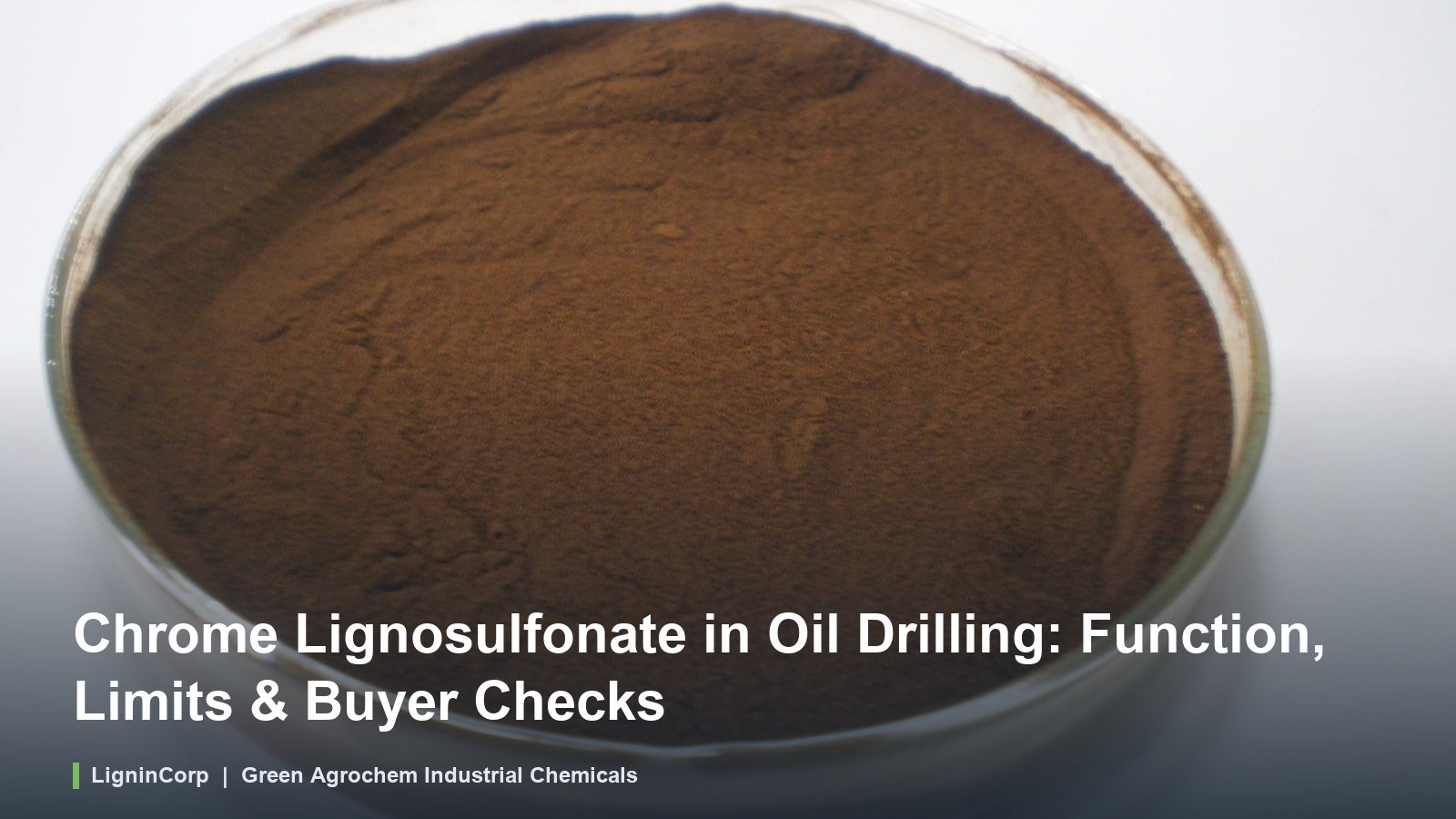
Chrome lignosulfonate has historically been used as a deflocculant and rheology-control additive in selected water-based drilling-fluid systems. Its technical role is to help manage clay-particle interactions, reduce excessive viscosity and gel development, and support more controllable fluid circulation. It is not suitable for every drilling program, and its use must be reviewed against the current product SDS, the operator’s chemical policy, discharge requirements and the regulations of the country and drilling location.
This page explains the function, limitations and qualification steps that matter to drilling-fluid engineers and industrial buyers. For product-grade documentation and commercial evaluation, see the Chrome Lignosulfonate product page.
What chrome lignosulfonate does in a drilling fluid
In compatible water-based muds, lignosulfonate molecules can adsorb on reactive solids and modify particle-to-particle interactions. The intended result is controlled dispersion and lower resistance to flow rather than an unconditional reduction in every rheological parameter. Actual response depends on mud chemistry, solids loading, temperature history, contamination and treatment sequence.
- Deflocculation: helps reduce attractive interactions among compatible clay and drilled-solid particles.
- Rheology control: may help control plastic viscosity, yield behavior and gel development when the treatment is matched to the fluid system.
- Solids management support: can improve the handling of dispersed solids, but it does not replace mechanical solids-control equipment or good dilution practice.
- Filtration-system support: may form part of a broader fluid-loss and filter-cake program; performance must be measured with the complete mud formulation.
Chrome, ferrochrome and chromium-free alternatives
The terms chrome lignosulfonate and ferrochrome lignosulfonate should not be treated as interchangeable without checking the exact product identity and technical documentation. Metal content, manufacturing route and supplied form can affect compatibility, handling and regulatory review.
Chromium-containing products may be restricted or excluded by an operator, jurisdiction or discharge permit. Where this applies, buyers should evaluate chromium-free lignosulfonates or other drilling-fluid thinners against the same test protocol. A substitute should be selected by measured fluid performance and compliance requirements—not by product name alone.
Variables that control field performance
No universal treatment level or guaranteed performance percentage is stated here. The effective addition level must be developed for the actual mud through laboratory and field validation. Important variables include:
- base-fluid salinity, hardness and pH;
- clay type, drilled-solids concentration and particle-size distribution;
- cement, salt, anhydrite or other contamination;
- bottom-hole circulating temperature and thermal-aging history;
- interaction with polymers, fluid-loss additives, weighting materials and lubricants;
- mixing energy, order of addition and available conditioning time;
- target rheology, filtration behavior and solids-control strategy.
Recommended laboratory qualification program
Qualification should use representative base mud, process water and contaminants. Compare an untreated control with several candidate treatments and, where relevant, a chromium-free alternative. Record the product grade, lot, supplied form and calculation basis for every test.
- Measure baseline rheology and gel development using the project’s specified procedure.
- Add the candidate product through a controlled treatment matrix rather than selecting one unverified dosage.
- Condition and thermally age the samples under representative time and temperature conditions.
- Repeat rheology, filtration and compatibility relevant to the intended field use.
- Run contamination and compatibility checks with the actual fluid additives.
- Review corrosion, handling, waste and discharge implications with the current SDS and local requirements.
Recommended practice: establish the starting treatment range from the supplier’s current document for the exact grade, then optimize it through laboratory and field trials. State whether the calculation is based on as-supplied product, dry solids, total mud volume or another defined basis.
Procurement and incoming-quality checks
A technically comparable quotation should identify the exact grade and be supported by current documentation. Request:
- TDS, SDS and a representative COA;
- product identity, supplied form and country of origin;
- declared specification limits, units and test methods;
- packaging, storage and shelf-life information;
- chromium-related declaration appropriate to the destination market;
- batch traceability and change-control information;
- sample availability for qualification in the buyer’s own mud system.
Selection limits
Chrome lignosulfonate should not be described as universally safe, environmentally acceptable or automatically suitable for high-temperature service. Those conclusions depend on the exact composition, exposure scenario, jurisdiction, waste route and test evidence. Final product approval belongs to the operator’s drilling-fluid, HSE and regulatory review process.
Next steps for technical evaluation
Send the mud type, process-water analysis, temperature range, contamination risks, target rheology, current additive program and destination market to info@greenagrochem.com. LigninCorp can then provide the applicable product documents and arrange a sample for controlled qualification. For broader background, review lignosulfonate use in oil drilling.
