
Product Overview
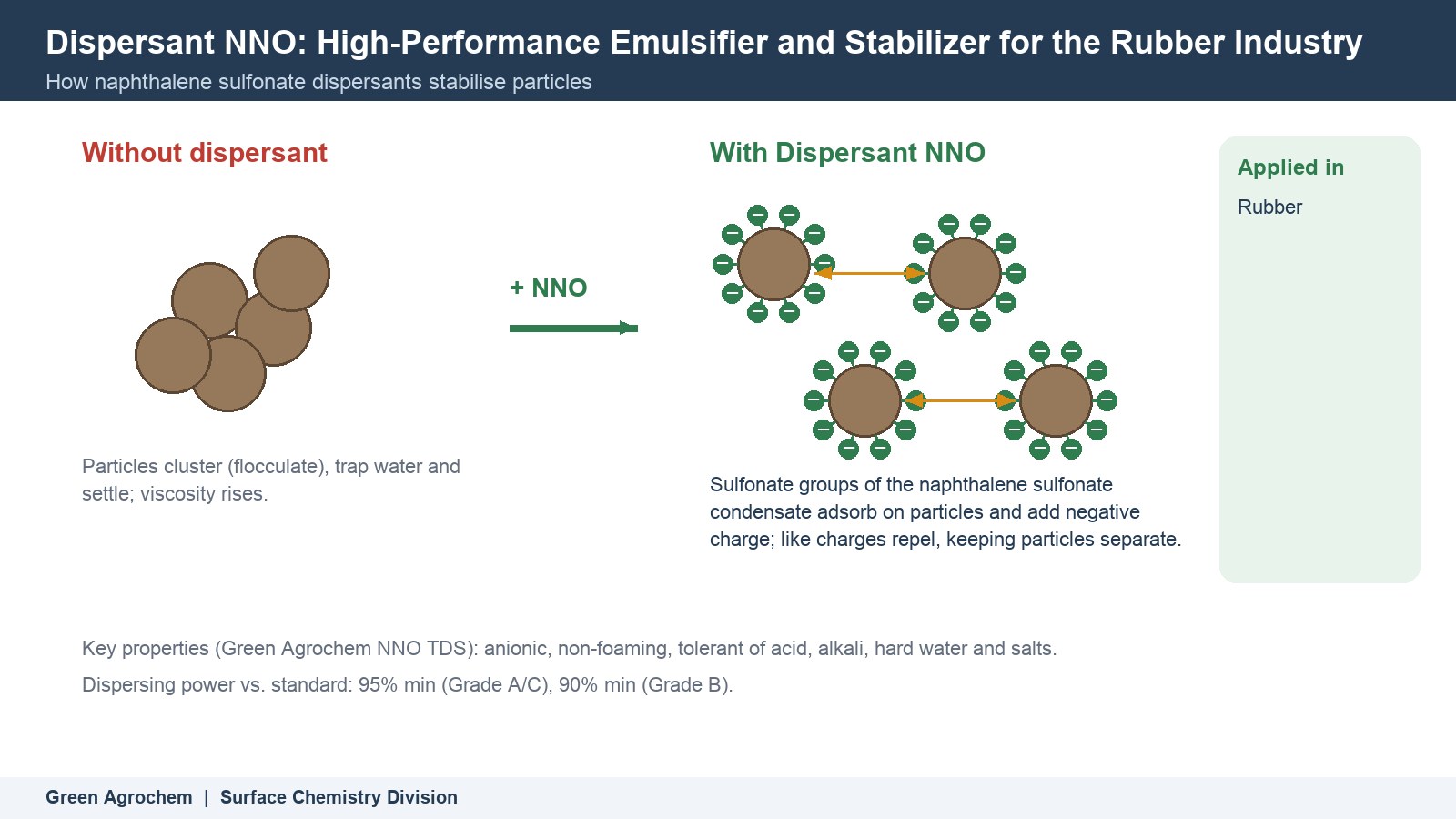
Dispersant NNO is a sodium salt of naphthalene sulfonate formaldehyde condensate (SNF/NSF), classified as an anionic surfactant. It features an amphiphilic molecular structure with a hydrophilic sulfonate head and a hydrophobic naphthalene-based tail. This enables effective reduction of interfacial tension, stabilization of emulsions, and uniform dispersion of solids in aqueous systems.
Key Properties
- Appearance: Light yellow to brownish powder
- Ionic nature: Anionic
- Solubility: Readily soluble in water
- Stability: Excellent resistance to heat, acids, alkalis, and hard water
- Foaming: Low to non-foaming
- Compatibility: Fully compatible with other anionic and non-ionic surfactants
- Dispersion force: ≥95% (standard reference method)
- pH (1% aqueous solution): 7–9
- Sodium sulfate content: ≤22% (typical)
- Moisture content: ≤9%
Primary Functions in the Rubber Industry
Dispersant NNO excels in applications requiring stable emulsions, uniform particle distribution, and enhanced processability:
- Emulsion polymerization: Stabilizes monomer-water emulsions in the production of synthetic rubbers such as styrene-butadiene rubber (SBR) and nitrile butadiene rubber (NBR), ensuring consistent particle size distribution for high-performance end uses (e.g., tires, hoses, seals).
- Latex stabilization: Prevents coagulation and settling in natural or synthetic rubber latex formulations used for dipped goods (e.g., gloves, balloons, condoms).
- Filler and additive dispersion: Promotes homogeneous incorporation of fillers (carbon black, silica, calcium carbonate), accelerators, sulfur, and other vulcanizing agents, reducing viscosity and minimizing defects during compounding.
- Vulcanization uniformity: Contributes to even cross-linking, improving final product properties such as tensile strength, elasticity, abrasion resistance, and durability.
Advantages
- Effective at low dosages (typically 2–4% based on dry weight of additives or monomers)
- Improves product consistency and reduces batch-to-batch variability
- Enhances operational efficiency by minimizing foam-related issues and equipment downtime
- Cost-effective alternative to specialized emulsifiers in many rubber formulations
- Non-toxic, non-flammable, and non-explosive under normal conditions
Recommended Usage
- Dosage: 2–4% by weight of the dry solids (e.g., fillers, monomers, or latex). Adjust based on specific formulation and performance requirements.
- Preparation: Dissolve in water to form a 10–20% solution before addition during mixing, grinding, or polymerization stages.
- Incorporation: Add during the initial emulsification or compounding phase for optimal results.
Handling, Safety, and Storage
- Use appropriate personal protective equipment (gloves, masks, eye protection) to avoid dust inhalation or skin contact.
- Ensure adequate ventilation during handling.
- Store in original packaging in a cool, dry, well-ventilated area away from incompatible materials.
- Wastewater containing NNO should be treated prior to discharge to comply with environmental regulations (e.g., naphthalene-related limits in EU, US, or local standards).
Packaging
- Available in 25 kg woven bags or 500–650 kg jumbo bags (custom options upon request).
- For technical data sheets, samples, pricing, or formulation support, please contact our sales team.
