
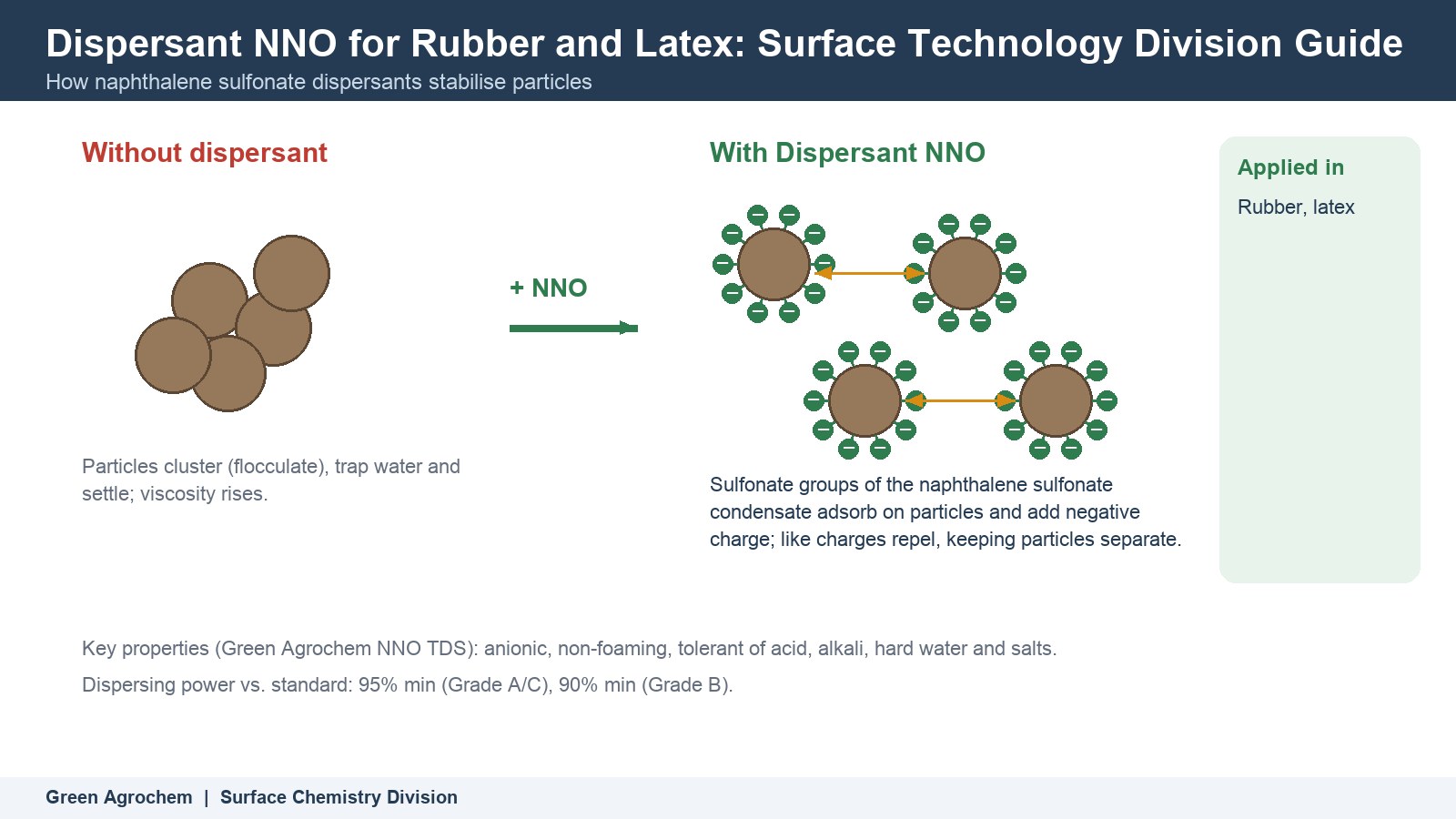
Dispersant NNO used for rubber-compounding dispersions or aqueous latex systems belongs to GreenAgrochem.net, the Green Agrochem Surface & Interface Technology Division. NNO may support the distribution of compatible fillers or pigments, but it is not a universal latex stabilizer.
Use the complete Dispersant NNO for Rubber Compounding and Latex Systems guide for formulation boundaries, dispersion mechanism, compatibility risks, qualification, incoming control and responsible claims.
Former Dosage and Product Data Status
| Former value | Evidence/status | Required treatment |
|---|---|---|
| 2–4% of dry additive/filler weight; example 2–4 g NNO per 100 g dry additives. | No exact NNO grade, supplier document/revision, polymer/latex, filler, dry-active basis or method was identified. | Not a current supplier recommendation. Restore only as an exact-grade starting trial range with its basis and validation conditions. |
| Prepare a 10% solution using one part NNO to nine parts water. | Generic preparation guidance without exact-grade solubility, water quality, temperature or handling source. | Use the current TDS/SDS and plant procedure; verify dissolution and solution stability. |
| Three percent of dry additives in the zinc-oxide example. | Illustrative value without an identified formulation, control or result. | Not production guidance or evidence of performance. |
| Approximately two-year storage stability. | No current exact-grade shelf-life document or packaging/storage conditions were cited. | Use only the current supplier shelf-life statement for the offered grade and packaging. |
Former Performance and Safety Claims
| Former claim | Status | Correct approach |
|---|---|---|
| Keeps natural or synthetic latex uniformly stable and prevents coagulation, settling or separation. | Unsupported universal latex-stability claim; an anionic dispersant may destabilize some systems. | Compare coagulum, grit, mechanical/storage stability, foam and film properties with a matched control. |
| Non-foaming and universally stable to heat, acids, alkalis, salts and hard water. | Unverified compatibility and performance claims. | Test exact water, pH, electrolyte, surfactant package, temperature and process; evaluate antifoam separately. |
| Improves final strength, flexibility, durability and defect rate while reducing processing time and cost. | Unverified compound, manufacturing and commercial outcomes. | Measure dispersion, cure, tensile, elongation, abrasion, ageing and cost-in-use under defined conditions. |
| Non-toxic, non-flammable and safe to handle. | Absolute safety wording unsupported without the exact current SDS and site risk assessment. | Follow the grade-specific SDS, dust controls, PPE and local handling requirements. |
Qualification Information
- Natural/synthetic latex or rubber polymer and final application.
- Solids, filler/pigment identity and particle size.
- Water, pH, electrolytes, surfactants, cure system and addition sequence.
- Current dispersant, target defect, mixing/shear and storage conditions.
- Required dispersion, stability, film, cure and mechanical tests.
Review the current Dispersant NNO product grades and the Surface & Interface Technology Division, or contact info@greenagrochem.com.
Division note: Concrete-grade SNF and other industrial construction procurement remain with LigninCorp.
