
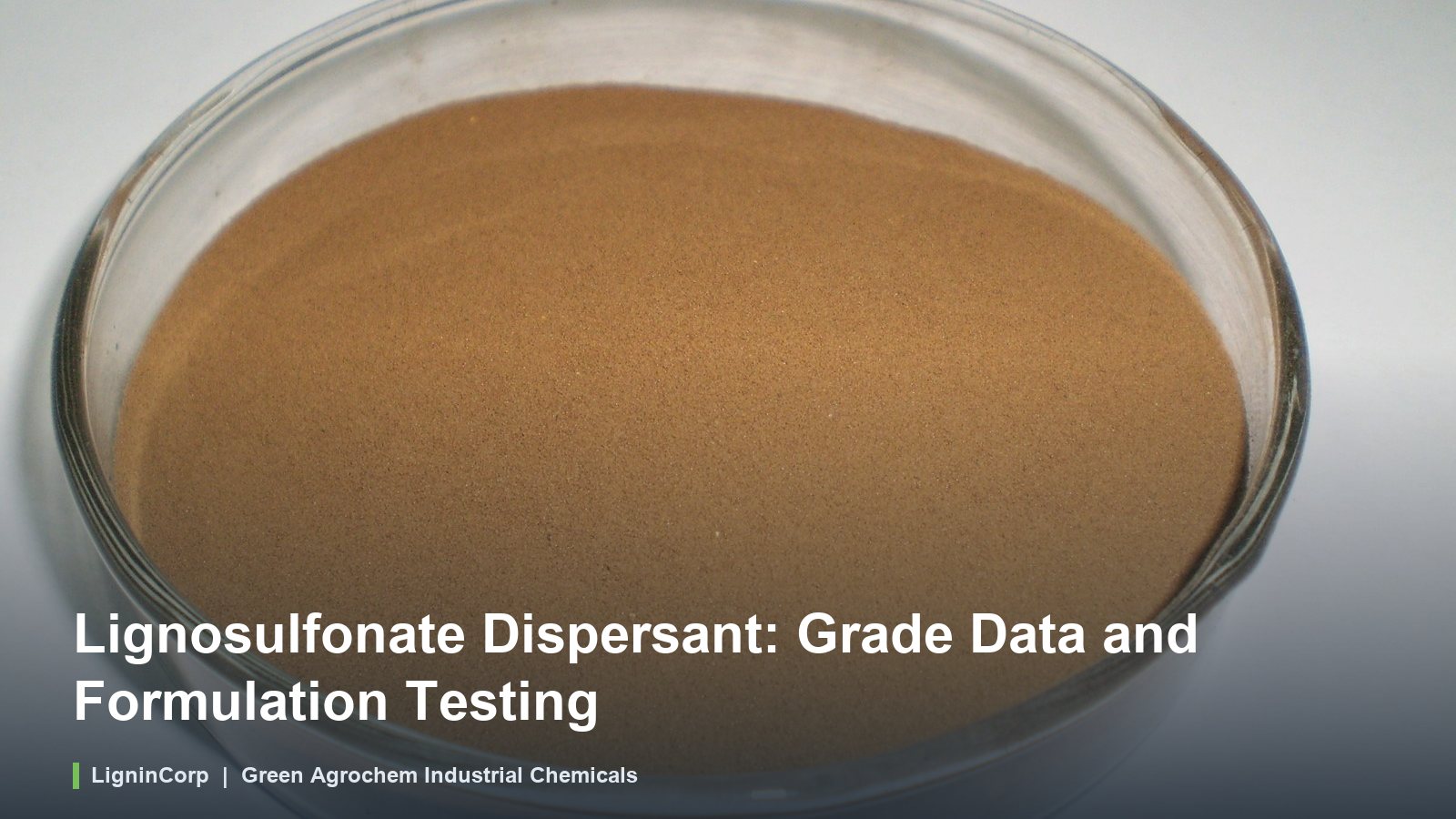
Lignosulfonates can support dispersion by adsorbing on compatible particle surfaces and increasing aqueous compatibility and electrostatic repulsion. Performance depends on the lignosulfonate grade, particle chemistry, solids loading, water quality, pH, electrolyte, shear and other formulation components. “Lignosulfonate dispersant” is therefore a function to verify, not a universal performance guarantee.
For industrial supply, review Sodium Lignosulfonate Dispersant Grade. Agrochemical, dye and pigment formulators can use the GreenAgrochem.net formulation and testing guide.
Our Product Data: GAC-NaLS-Dispersant-P
Source: Green Agrochem, Sodium Lignosulfonate — Dispersant Grade Technical Data Sheet, document GAC-NaLS-Dispersant-P, Rev. 2.0. The document describes these values as typical production results for reference and directs buyers to the shipment COA for batch-specific results.
| Parameter | TDS value | Data type and use |
|---|---|---|
| Appearance | Brown powder | Typical physical property; confirm on shipment COA |
| Dry matter | 95% min | Exact-grade TDS reference value |
| Water-insoluble matter | 0.5% max | Exact-grade TDS reference value |
| Calcium & magnesium | 0.5% max | Exact-grade TDS reference value |
| Lignosulphonate content | 70% min | Exact-grade TDS reference value |
| Moisture | 5% max | Typical value, not a universal value for all sodium lignosulfonates |
The matching demonstration/template COA reports example results of 94.86% dry matter, 0.38% water-insoluble matter, 0.38% calcium & magnesium and 71.4% lignosulphonate content. These are illustrative batch results, not guaranteed results for a future shipment. The signed shipment COA controls the actual lot record.
Supported Application Scope
The Rev. 2.0 TDS identifies screening use in fungicide and other agrochemical-active dispersion, concrete/cement formulations, ceramics, dyes, pigments and agricultural chemical formulations. Application names do not establish efficacy or regulatory suitability. Agrochemical claims and use must be reviewed for the destination market; concrete and ceramic performance must be demonstrated in the actual materials.
No Universal Dosage Is Published
The current GAC-NaLS-Dispersant-P TDS does not state a numerical dosage. Accordingly, this page does not invent or copy a generic recommended range. Request a supplier-supported starting trial range for the exact application and define whether it is based on as-supplied powder, dry matter, lignosulphonate active, total formulation, pigment/mineral solids or cementitious material.
Formulation Qualification Workflow
- Define the dispersion target: wetting, viscosity reduction, particle-size control, settling resistance, suspensibility or process flow.
- Record the exact grade, lot, active/as-supplied basis and current TDS/MSDS/COA.
- Prepare a control and a dosage ladder without changing multiple variables simultaneously.
- Use actual process water, substrate, pH, electrolyte, temperature, shear and addition sequence.
- Measure particle size, rheology across relevant shear, foam, sedimentation or suspensibility, storage stability and application-specific final properties.
- Confirm the selected formula at production scale with agreed acceptance limits.
Grade Selection by Industry
| System | Critical variables | Key acceptance tests |
|---|---|---|
| Ceramic and mineral slurry | Mineralogy, soluble salts, solids, water and competing deflocculants | Viscosity/shear curve, thixotropy, settling, drying and firing |
| Concrete and cement | Cement chemistry, SCMs, water, temperature and other admixtures | Slump/flow, retention, air, setting, bleeding and strength |
| Pigment, dye or agrochemical formulation | Particle surface, active/carrier, electrolyte, pH and preservative package | Wetting, milling, particle size, viscosity, foam, suspensibility and storage |
Safety, Packaging and Storage
The matching MSDS is document GAC-NaLS-Dispersant-P-MSDS, Rev. 2.0. It states that the grade is not classified as hazardous under normal industrial handling based on available data, while fine powder or mist may cause temporary mechanical irritation. Use the current MSDS for ventilation, dust control, PPE, first aid, firefighting, spill response, incompatibilities and destination-country review.
The TDS lists 25 kg lined woven bags; 500 kg or 600 kg jumbo bags; IBC or flexitank; or customer-agreed packaging. Shelf life is 24 months from production in original unopened packaging, stored cool, dry and well ventilated. Confirm that the offered physical form and packaging match the order, and reseal opened bags against moisture.
For ceramics and refractory applications, see the Ceramics & Refractories technical centre. Contact info@greenagrochem.com for the current documents, a representative sample and application-specific trial guidance.
