
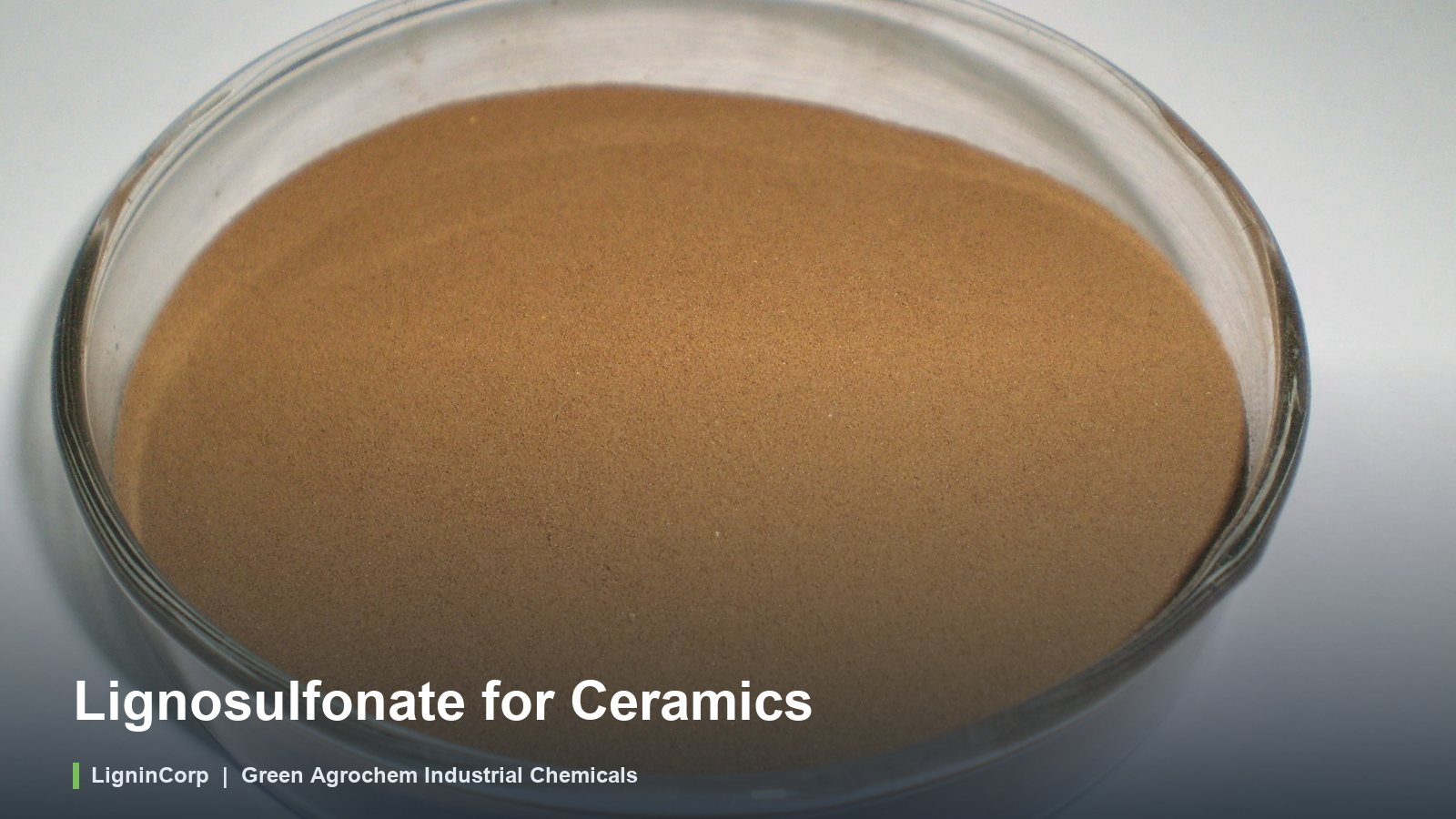
Lignosulfonates are water-soluble lignin derivatives that may support dispersion, temporary binding and process consistency in selected ceramic systems. The useful function is formulation-specific: an additive that lowers slurry viscosity may not provide the required green strength, and a grade that improves binding may not be suitable for a colour-sensitive fired body.
Functions in ceramic processing
| Target | What to evaluate | Common risk |
|---|---|---|
| Slurry dispersion | Viscosity, solids loading and stability | Over-addition, foaming or electrolyte sensitivity |
| Temporary binding | Green strength and handling loss | Burnout residue or colour contribution |
| Spray drying and pressing | Granule flow, moisture and compaction | Uneven density or release behaviour |
| Extrusion or forming | Plasticity, surface quality and drying | Cracking, warpage or excessive water demand |
Choosing sodium, calcium or liquid grades
Sodium lignosulfonate is often screened where dissolution and dispersion are priorities. Calcium lignosulfonate may be considered where temporary binding or the calcium counter-ion fits the body chemistry. Liquid grades can simplify dosing but must be compared on active-solids basis. Product names alone do not establish equivalence.
Recommended qualification sequence
- Characterise the clay, minerals, water and existing additives.
- Confirm the candidate grade’s current TDS, SDS and COA.
- Run laboratory screening against an untreated control and the current formulation.
- Measure rheology, settling, green strength, drying and fired quality using defined methods.
- Confirm the selected condition in a controlled plant trial.
No fixed dosage or guaranteed improvement is stated because the optimum depends on grade solids, raw materials, water chemistry, addition sequence and process conditions.
Related resources
For the ceramic and refractory applications hub, see Ceramic & Refractory Additives. For product screening, review the sodium lignosulfonate and calcium lignosulfonate product pages.
Buyer information for grade review
Provide ceramic type, body or slurry composition, target function, current additive, water quality, process temperature, forming method, drying and firing conditions, colour limit and required packing to info@greenagrochem.com. This allows a candidate grade and a controlled trial plan to be recommended.
