
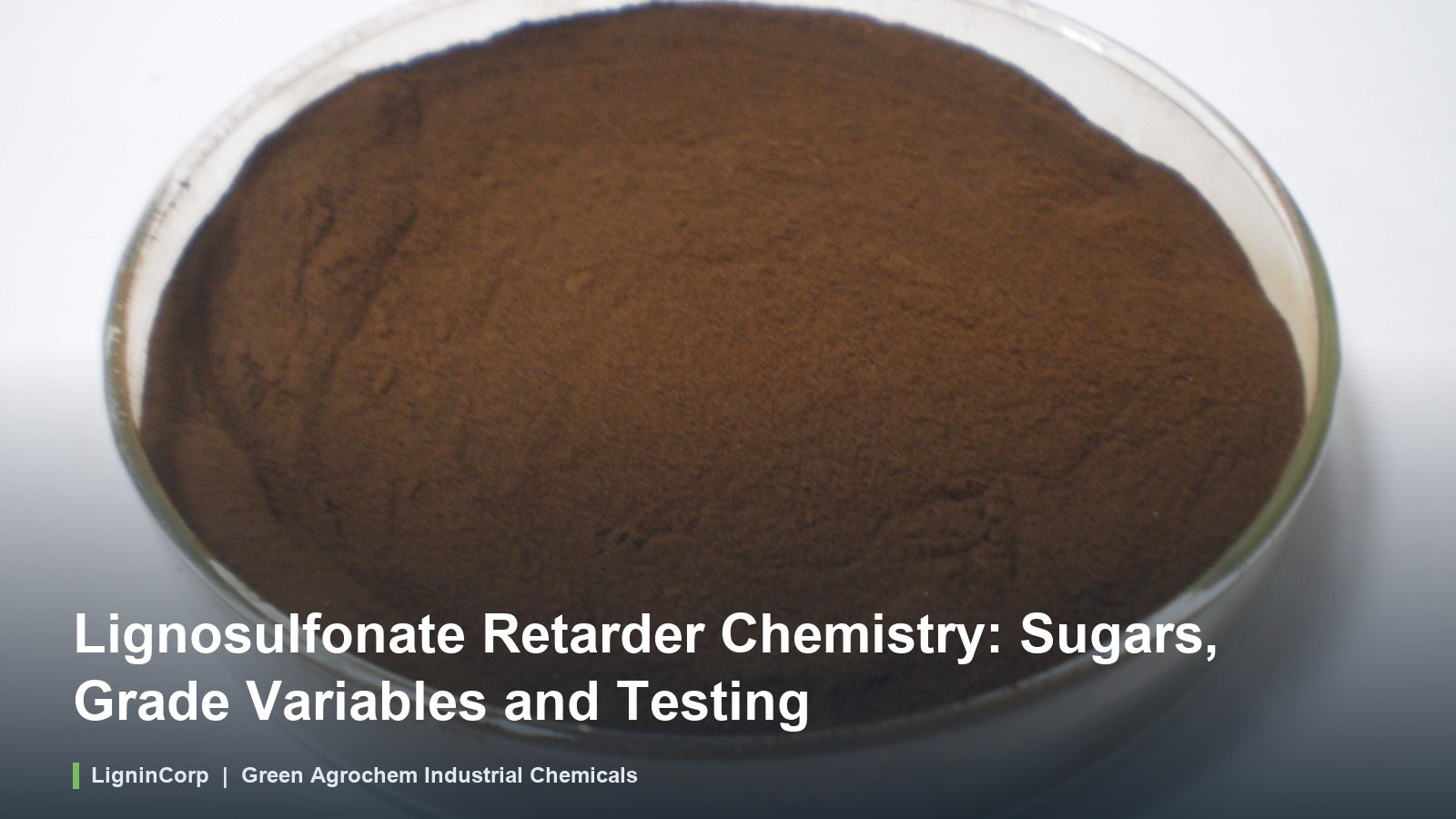
Lignosulfonate retarder behaviour is controlled by more than the product name or counter-ion. Residual sugars, molecular distribution, sulfonation, inorganic salts, pH, solids basis and cement chemistry can all change adsorption, hydration and setting. This page explains how those grade variables should be reviewed before a lignosulfonate is screened as a concrete, mortar or gypsum set-control component.
Why lignosulfonate can delay cement hydration
Lignosulfonate molecules contain sulfonate and other polar functional groups that can adsorb on cement grains and early hydration products. Adsorption changes particle interaction and may slow dissolution or the formation of hydration products at reactive surfaces. At the same time, dispersion may release water held inside cement agglomerates and change workability. The observed result is therefore a combined rheology-and-hydration response, not a fixed delay produced by every grade.
Cement mineralogy, sulfate balance, alkali content, fineness and supplementary cementitious materials affect this interaction. Temperature, addition sequence, mixing energy and other admixtures can alter it further. A grade that produces a suitable working window in one mixture may give too little or excessive delay in another.
Residual sugars matter—but are not the whole explanation
Residual carbohydrates from sulfite-pulping liquor may contribute to retardation, so sugar content is a relevant qualification variable. However, it is not technically sound to attribute all setting effects to sugars or to assume that a lower-sugar grade will have no retarding action. The lignosulfonate structure itself, molecular fractions and interaction with the binder also influence hydration.
Procurement documents should identify how reducing sugars are measured and whether the reported figure is a specification limit or a typical result. Results from different methods should not be treated as directly equivalent without technical review. When setting response changes between lots, compare the COA with the control mixture and examine all material changes rather than adjusting dosage immediately.
Grade variables that deserve review
| Variable | Why it may matter | Qualification question |
|---|---|---|
| Reducing sugars | May contribute to hydration delay and early-strength response | What method, limit and lot result are reported? |
| Molecular distribution | Can influence adsorption, dispersion and solution behaviour | Is the grade modified, fractionated or supplied as a conventional product? |
| Counter-ion | Sodium, calcium and magnesium grades may differ in solubility, salts and formulation compatibility | Which ion and application system were used in the supplier’s supporting tests? |
| Solids or moisture | Determines the true active addition and liquid carrier-water correction | Is dosage stated as supplied or on dry solids? |
| pH and inorganic salts | May affect compatibility and indicate process or grade differences | Are methods and specification limits defined in the current TDS or COA? |
| Insoluble matter | Can affect solution preparation, filtration and dosing equipment | Does the grade meet the plant’s handling and cleanliness requirements? |
How to compare candidate grades
- Confirm the exact product code and obtain the current TDS, SDS and representative COA.
- Normalize powder and liquid additions to a clearly stated dry-solids or as-supplied basis.
- Use one control binder, aggregate condition, water source, temperature and mixing sequence.
- Screen only supplier-supported starting levels, changing one factor at a time.
- Measure workability retention, air, bleeding, initial and final set, early strength and the required later-age properties.
- Repeat the preferred condition with realistic cement-lot, temperature and moisture variation before plant approval.
Data that must not be generalized
A percentage dosage, setting delay, water reduction, strength change or cement saving is an application result unless it is explicitly defined as an exact-grade product specification. Do not convert an old or incomplete result into a “recommended dosage.” A supplier-recommended starting trial range must identify the exact grade, current document revision, calculation basis and application, followed by laboratory and plant validation.
Claims about corrosion, freeze-thaw durability, impermeability, safety or environmental performance require their own product-specific documents and applicable test methods. Biomass origin alone does not establish those outcomes.
Use this page with the main qualification guide
This page focuses on grade chemistry and the reasons setting response varies. For project acceptance, batching records and site-control procedures, use the Lignosulfonate Concrete Set Retarder qualification guide. Buyers can also compare sodium lignosulfonate grades, review the concrete-admixture application route, or request current documents through the technical library.
Send the proposed binder system, temperature range, required working window, current admixtures, test standard and destination requirements to info@greenagrochem.com.
