
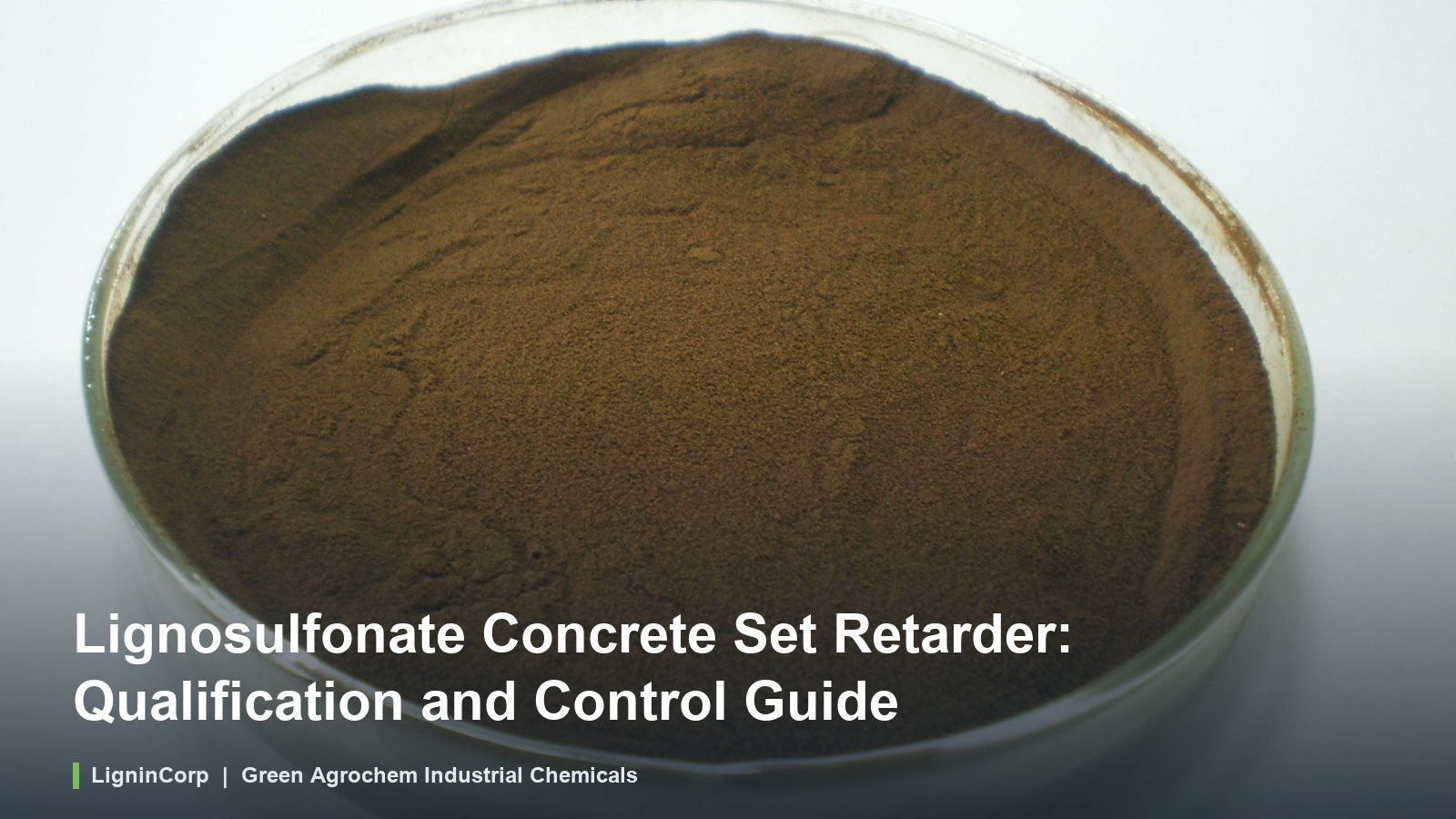
Lignosulfonates can modify concrete setting while also contributing to cement-particle dispersion. This behavior can be useful when a mix needs a longer placement or finishing window, but the amount of retardation is not fixed. Cement chemistry, lignosulfonate grade, active-solids dosage, temperature, supplementary cementitious materials and other admixtures all affect the result.
This guide explains how to evaluate lignosulfonate for set control without assuming a universal dosage or delay. For general functions and grade selection, see Lignosulfonate Concrete Admixtures.
Why setting response varies
Lignosulfonate molecules can adsorb on cement particles and influence dissolution, nucleation and early hydration. Their dispersing action may improve workability, while constituents such as reducing sugars can also influence setting. The combined response depends on the material and the cement system; product name or cation alone does not predict a specific delay.
- Cement: mineralogy, sulfate form and balance, alkalis, fineness and source.
- Lignosulfonate grade: molecular distribution, sulfonation, reducing sugars, insolubles and solids.
- Temperature: concrete temperature, ambient exposure and delivery duration.
- Other materials: SCMs, fillers, clay-bearing fines and admixture interactions.
- Process: dosage, addition sequence, mixing energy and time before discharge.
Application objectives
Potential objectives include maintaining a workable placement window during warm-weather concreting, supporting long transport or staged placement, and managing set in mass placements or complex pours. These are evaluation targets, not guaranteed outcomes. Oil-well cementing and other high-temperature specialty systems require separate products, standards and test methods and should not be inferred from ordinary concrete data.
Recommended set-control trial matrix
Use supplier guidance only as a recommended trial range. A useful program holds the base mix constant and varies one factor at a time.
| Variable | Recommended check |
|---|---|
| Dosage | Control plus several active-solids-normalized levels within the supplier’s screening range. |
| Temperature | Test at representative concrete temperatures for production, transport and placement. |
| Time | Measure workability and air at initial, delivery and finishing intervals. |
| Setting | Use the project or applicable standard method; record initial and final set. |
| Hardened performance | Check early and specified-age strength and required durability criteria. |
Plant and site controls
- Confirm the current TDS, SDS and lot-specific COA before use.
- Convert powder or liquid dosage to active solids and account for liquid carrier water.
- Record cement source, concrete temperature, water, SCMs and all admixture additions.
- Verify addition sequence and mixing time with the trial procedure.
- Monitor slump or flow retention, air, bleeding, segregation and finishing.
- Approve production dosage only after a controlled plant trial.
Risks and troubleshooting
| Observation | Review |
|---|---|
| Excessive set delay | Active dosage, concrete temperature, cement change, reducing sugars and other retarders. |
| Insufficient working time | Temperature rise, haul time, dosage conversion, addition sequence and slump-loss mechanisms. |
| Unexpected air | Air-entrainer compatibility, mixing energy, product grade and aggregate moisture. |
| Bleeding or segregation | Total water, paste volume, fines balance, dosage and placement conditions. |
| Low early strength | Set delay, actual water-binder ratio, air, curing, consolidation and test age. |
Important limitations
- Do not use a fixed temperature threshold or automatically increase dosage in hot weather.
- Do not assume compatibility with accelerators, air entrainers, SNF or PCE systems.
- Incidental air entrainment does not demonstrate freeze-thaw compliance.
- Strength, cement saving, thermal-cracking control and durability require project-specific evidence.
- Environmental and safety conclusions require product-specific documentation and an appropriate assessment.
Product and technical routes
Current industrial grades are available through LigninCorp’s sodium lignosulfonate, calcium lignosulfonate and magnesium lignosulfonate pages. For batching and plasticizer troubleshooting, see Lignosulfonate Plasticizer.
Request a representative sample and validate the selected grade with the actual project materials. Contact info@greenagrochem.com for technical or commercial support.
Set-control acceptance plan for commercial qualification
A retarder approval should define an acceptable working window rather than target the longest possible delay. The plan should connect laboratory screening, plant batching and site placement using the same dosage basis and traceable material lots.
| Qualification stage | Required records | Decision criteria |
|---|---|---|
| Document review | Exact product code, current TDS/SDS revision, representative COA, solids or moisture basis, pH, salts, reducing sugars and insolubles where specified | The proposed grade and calculation basis are unambiguous and documents match the supplied sample. |
| Laboratory screening | Control and stepped supplier-supported trial levels; cement/SCM lots; aggregate moisture; water source; temperature; sequence and mixing time | Required workability window is achieved without unacceptable air, bleeding, segregation, setting or early-strength effects. |
| Plant trial | Batch tickets, scale accuracy, liquid carrier-water correction, discharge times, concrete temperatures and retained samples | Laboratory response can be reproduced at production scale within the quality-control limits. |
| Site validation | Arrival and placement times, slump or flow, air, finishing observations, initial/final set method and strength specimens | The selected grade supports the actual transport and placement sequence while meeting project specifications. |
How to state dosage and setting data
A commercial product page should separate three evidence layers. Product specifications belong to the current exact-grade TDS or COA. A supplier dosage may be shown only as a supplier-recommended starting trial range, with the exact grade, document revision, as-supplied or dry-solids basis and total-cementitious-material basis stated. Water reduction, initial or final set and strength are application-test results and must identify the tested mix, control, method and conditions.
Independent research confirms the need for this separation. One study evaluated low-sugar softwood calcium lignosulfonate at 0.25–0.40 mass % of binder with two Portland cements and compared immediate with delayed addition. A controlled-low-strength-material study reported initial set changing from 16.8 to 28.5 hours and final set from 25 to 35 hours at 0.21% lignosulfonate in that specific CLSM system. These are literature-reported results, not LigninCorp specifications, universal production dosages or guarantees.
- Calcium lignosulfonate rheology and setting study, Cement and Concrete Research (2017)
- Lignosulfonate-modified controlled low-strength material study, International Journal of Geo-Engineering (2024)
Preparing a responsible retarder enquiry
Provide the cement and SCM suppliers and replacement levels, binder content, aggregate moisture and fines, water source, all other admixtures, concrete-temperature range, transport and placement duration, target working and setting window, required standards, packaging, annual demand and destination. This information allows the supplier to propose an appropriate grade and documented starting trial plan without presenting one dosage as universal.
Review the concrete-admixture application route, compare the available sodium lignosulfonate grades, and use the technical document library before requesting a sample. Send the project context to info@greenagrochem.com.
