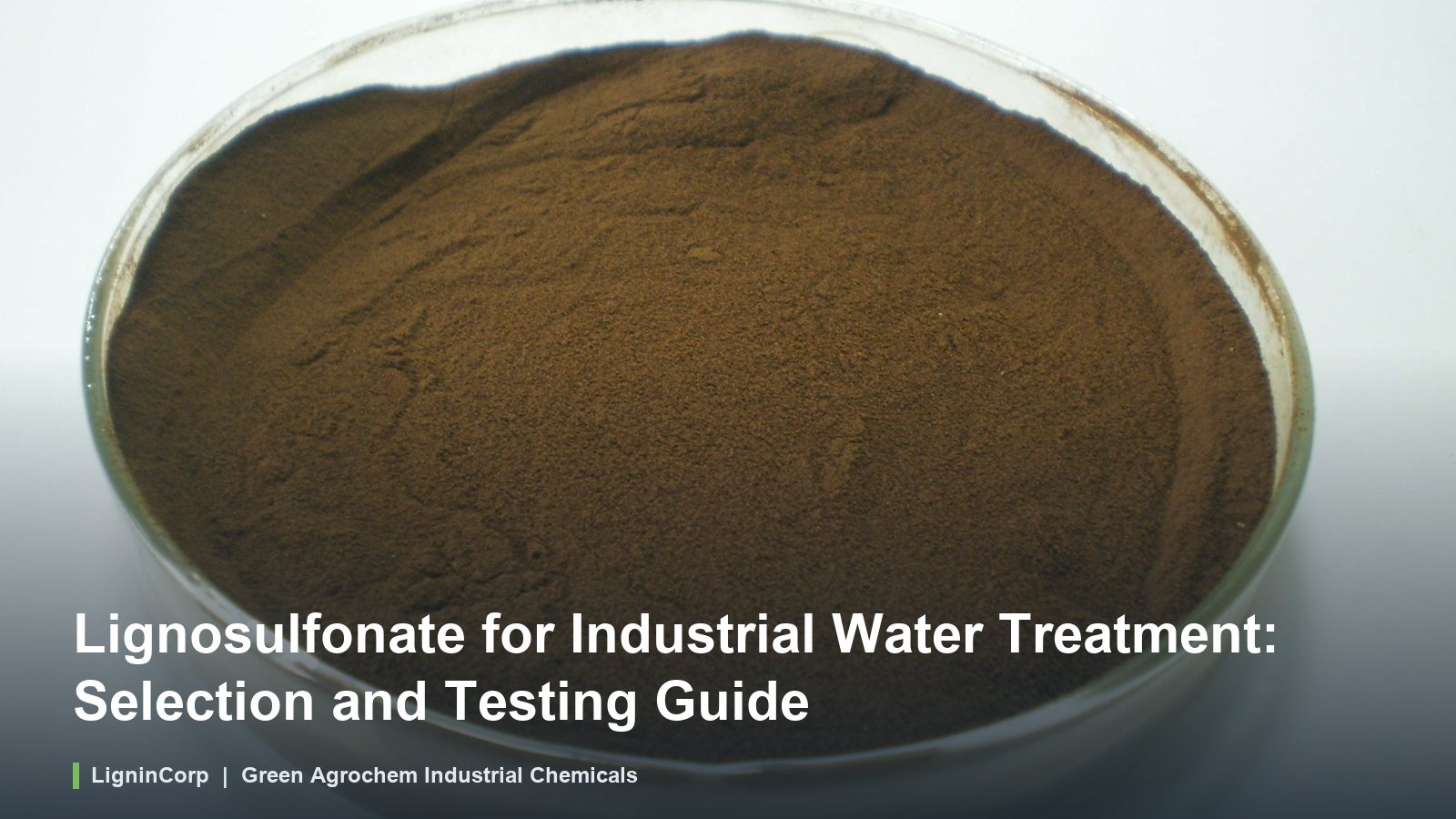
Lignosulfonate can be evaluated as a dispersing, suspension-support or auxiliary formulation ingredient in selected industrial water systems. It is not a complete water purifier and should not be presented as a universal scale inhibitor, corrosion inhibitor, flocculant or contaminant-removal agent. Performance depends on the lignosulfonate grade, water chemistry, suspended solids, pH, hardness, temperature and the other components in the treatment program.
Where lignosulfonate may add value
| Formulation objective | Potential role | Important limitation | Recommended validation |
|---|---|---|---|
| Fine-particle dispersion | Helps separate and suspend compatible mineral or process solids | Does not remove dissolved contaminants | Jar test, settling observation and turbidity comparison |
| Slurry handling | May support flow, pumpability or solids distribution | Response varies with solids mineralogy and ionic strength | Viscosity, sedimentation and recirculation trial |
| Scale-control formulation support | May assist particle dispersion or chelation within a formulated program | Not a standalone guarantee against scale or corrosion | Water analysis and side-by-side formulation testing |
| Process-water additive blends | Can be screened with selected polymers, phosphates or chelating agents | Compatibility and stability must be verified | Blend stability, pH, conductivity and temperature-cycle tests |
How to select a candidate grade
Sodium lignosulfonate is commonly screened where water solubility and dispersion are priorities. Calcium lignosulfonate may be considered when a calcium-based counter-ion is compatible with the process. Liquid lignosulfonate can reduce dissolution and handling steps in systems designed for liquid dosing. The correct choice cannot be made from the product name alone.
Before grade selection, buyers should compare active solids, moisture, pH, ash, reducing sugars, insoluble matter, bulk density or liquid density, viscosity where relevant, molecular-weight distribution where available, and batch-to-batch consistency. TDS, SDS and COA documentation should match the grade supplied for the trial.
Recommended dosage-development method
There is no universal lignosulfonate dosage for industrial water treatment. Establish a recommended dosage window through laboratory screening with the actual water and solids, then confirm it in a controlled plant trial. Begin with several technically reasonable candidate levels selected by the formulator or treatment specialist. Compare the untreated control with each candidate for dispersion, settling, turbidity, viscosity, deposit tendency, foaming, color contribution and compatibility with the complete chemical program.
Report dosage on a clearly defined basis, such as supplied product, active solids, total water volume or dry solids. A dosage transferred from another plant, grade or water source should be treated only as a screening reference.
Information required for technical review
- System type and target function
- Water source, pH, hardness, alkalinity, conductivity and temperature
- Suspended-solids type and concentration
- Existing dispersants, chelants, phosphates, biocides, corrosion inhibitors or polymers
- Operating residence time, recirculation and filtration conditions
- Discharge, potable-water, food-contact or other regulatory constraints
- Required product form, packing, TDS, SDS, COA and sample quantity
Technical boundaries
Lignosulfonate should not be assumed to make water potable, remove every contaminant, replace a designed corrosion-control program or meet discharge limits without verification. Its natural feedstock and production route can influence composition, color, odor and performance. Applications involving potable water, food processing, regulated discharge or sensitive membranes require grade-specific regulatory review and compatibility testing.
Related products and application support
Compare sodium lignosulfonate, calcium lignosulfonate and the Water Treatment Additives application guide. For alternative dispersant or chelation chemistry, the formulation review may also consider Dispersant NNO, Dispersant MF or sodium gluconate according to the actual system requirements.
Frequently asked questions
Is lignosulfonate a water purifier?
No. It may support dispersion, suspension or a broader formulation, but purification and contaminant removal require an engineered treatment process.
Can lignosulfonate prevent scale and corrosion?
It may contribute to some formulated programs, but it should not be described as a universal or standalone scale and corrosion inhibitor. Validate the complete formulation using the real water chemistry and operating conditions.
What is the recommended dosage?
The recommended dosage must be established by testing. It depends on product solids, grade, water chemistry, solids loading, target function and the other ingredients in the treatment program.
Which documents should an industrial buyer request?
Request the current TDS, SDS, COA, specification, sample information and application guidance for the exact grade under evaluation.
