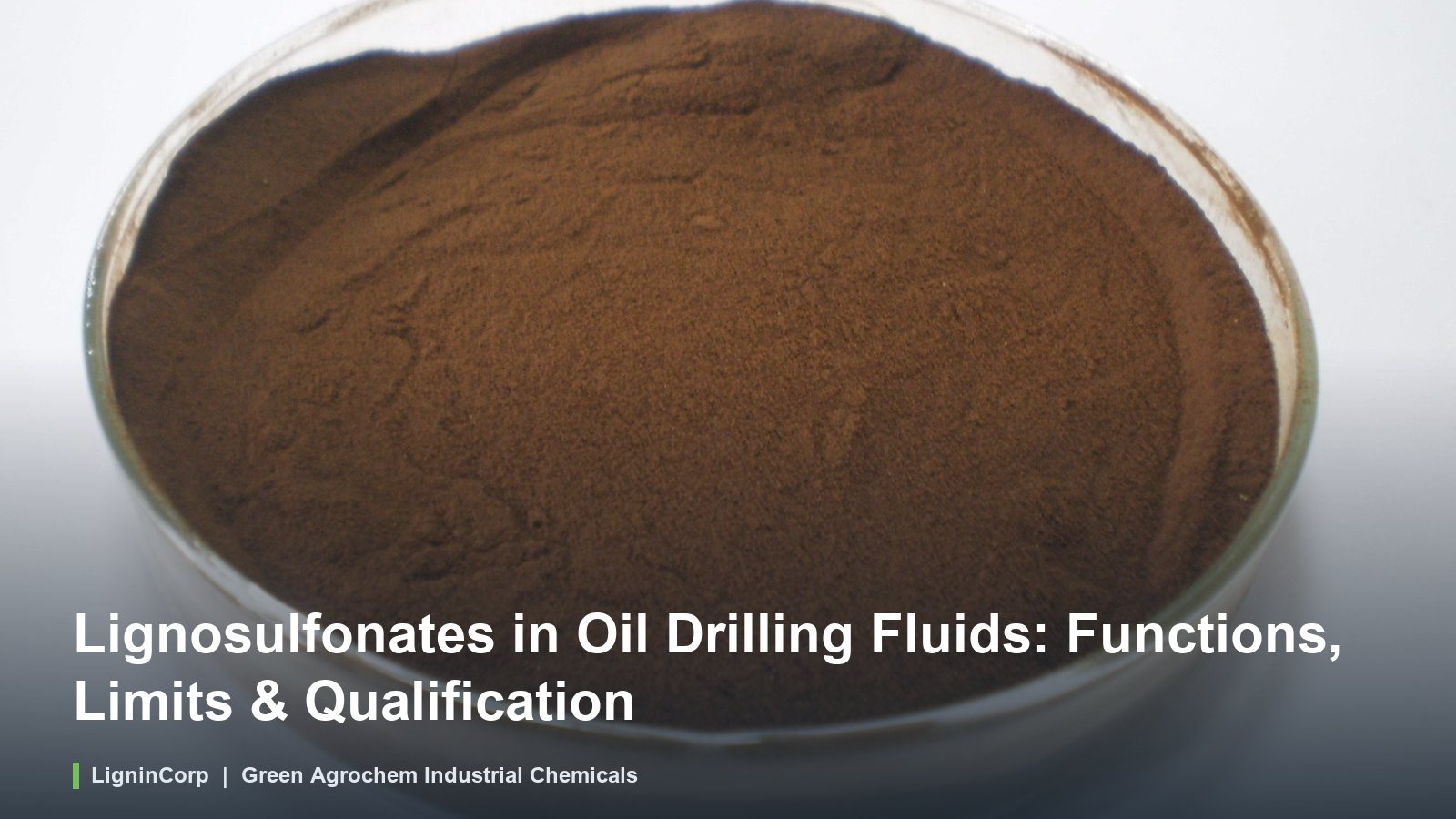
Lignosulfonates are anionic, water-soluble polymers used in selected water-based drilling fluids as deflocculants and rheology-control additives. Their value is not a single guaranteed performance number: it depends on the clay system, dissolved salts, drilled-solids loading, temperature history, pH, mixing sequence and the other polymers already present. A laboratory qualification program is therefore the correct starting point before field use.
Functions in water-based drilling fluids
In a dispersed water-based mud, lignosulfonate molecules can adsorb on reactive solids and modify particle-to-particle interactions. When the grade is compatible with the system, this may reduce excessive flocculation, help control yield point and gel development, and make the fluid easier to circulate after static periods. The result should be judged from the complete rheology profile rather than from viscosity alone.
Lignosulfonates may also support fluid-loss control indirectly by improving solids dispersion and filter-cake packing. This is system-dependent and should not be treated as a substitute for a dedicated filtration-control polymer. In contaminated or highly saline systems, the response may be weaker or different from that observed in fresh-water laboratory mud.
System variables that control performance
- Clay mineralogy and solids loading: bentonite content, drilled solids and particle-size distribution determine additive demand.
- Water chemistry: salinity, calcium, magnesium and other multivalent ions can change adsorption and dispersion behavior.
- pH and alkalinity: maintain the operating window specified for the complete mud system and monitor changes after treatment.
- Temperature exposure: evaluate hot-rolling or aging at a temperature representative of the planned interval.
- Mixing sequence: dilution water, shear, addition order and contact time can materially affect the result.
- Co-additives: test compatibility with filtration reducers, shale inhibitors, lubricants, weighting agents and defoamers.
Grade selection: calcium, sodium and chrome lignosulfonates
Calcium and sodium lignosulfonates differ in counter-ion, ash profile, solubility behavior and their interaction with the fluid’s ionic environment. Chrome lignosulfonate has historically been used where stronger thinning and temperature tolerance were required, but chromium-containing products may face environmental, operator or disposal restrictions. These grades are not automatically interchangeable. Selection should follow the well program, local regulations, supplier documentation and comparative mud testing.
For sourcing and grade discussions, see our chrome lignosulfonate and calcium lignosulfonate dispersant grade pages. Product identity, active-solids basis, moisture, insolubles and batch consistency should be confirmed against the applicable TDS and COA.
Practical limits and troubleshooting
Lignosulfonate treatment is not universal. High concentrations of soluble salts, cement or carbonate contamination, large changes in drilled solids, and prolonged temperature exposure can alter performance. Over-treatment may cause an undesired rheology shift, increased foaming or interactions with other polymers. Color contribution can also matter where fluid appearance is controlled. If the response differs from the laboratory baseline, check water chemistry, solids content, pH, product identity and addition sequence before increasing treatment.
Recommended laboratory qualification
Prepare a representative untreated baseline and add the candidate grade incrementally on a clearly stated basis, such as mass per laboratory barrel or mass relative to the liquid phase. Record mixing energy and conditioning time. Compare plastic viscosity, yield point, gel strengths, filtration, pH and density before and after aging. Where relevant, repeat the test after controlled salt, calcium or solids contamination and observe whether the fluid can recover after shear.
There is no responsible universal dosage for every mud system. The recommended treatment range should be established from the supplier’s current technical data, the mud engineer’s program and the laboratory response under representative conditions.
Field pilot and acceptance checklist
- Confirm product name, manufacturing lot, TDS, SDS and COA before use.
- Define the treatment basis, dilution procedure, addition point and mixing time.
- Establish acceptance limits for rheology, gels, filtration and compatibility.
- Start with a controlled field trial and trend properties after circulation and static periods.
- Document contaminants, temperature exposure and corrective treatments.
- Review environmental and waste-disposal requirements for the selected grade.
Related oilfield guidance
For application context, visit oil-well drilling fluid applications. To request a grade comparison or supporting documents, contact info@greenagrochem.com with the base-fluid chemistry, expected temperature, solids profile and target test methods.
