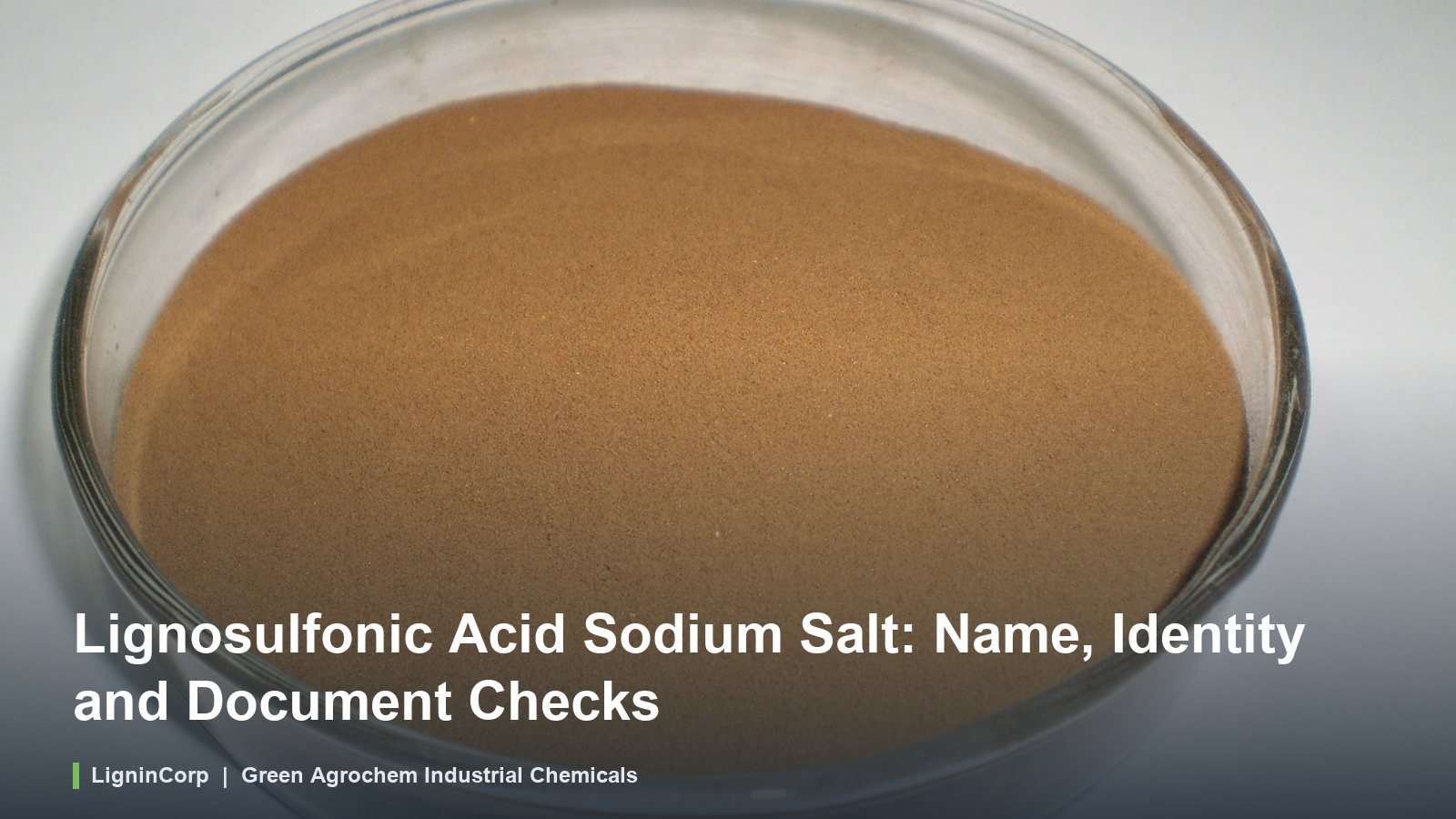
“Lignosulfonic acid, sodium salt” is a formal naming style commonly encountered in safety data, regulatory databases, customs documents and supplier catalogues. In commercial use it normally refers to sodium lignosulfonate: a polydisperse mixture of sulfonated lignin-derived macromolecular fragments with sodium as the principal counter-ion. The name does not define one small molecule or one universal industrial grade.
This page helps procurement and quality teams reconcile names across a quotation, label, TDS, SDS, COA and shipping documents. For the offered material, start with the LigninCorp sodium lignosulfonate product page.
Names That May Refer to the Same Product Family
| Name encountered | Typical context | What it does not prove |
|---|---|---|
| Sodium lignosulfonate / sodium lignosulphonate | Commercial, technical and international spelling variants. | Exact grade, composition, purity or application approval. |
| Lignosulfonic acid, sodium salt | SDS, regulatory or chemical-catalogue naming. | One exact molecular formula or uniform molecular weight. |
| Sodium salts of lignosulfonic acid | Plural description reflecting a material distribution. | Equivalence between suppliers or production routes. |
| Sulfonated lignin, sodium salt | May describe modified lignin rather than sulfite-derived material. | That the process, molecular distribution or impurities match conventional lignosulfonate. |
Why the Name and CAS Entry Are Not Enough
Commercial lignosulfonates vary with biomass, pulping or sulfonation route, purification, counter-ion conversion and finishing. A CAS entry can assist identification and trade documentation, but it does not replace the manufacturer’s exact grade code and current technical documents. Before approving a substitute, compare composition and application performance rather than accepting a catalogue name match.
Document Identity Cross-Check
| Document | Identity field to match | Additional control |
|---|---|---|
| Quotation/purchase order | Manufacturer, product name and exact grade code. | Form, packaging, quantity, Incoterm and required document revision. |
| TDS | Same grade and intended application. | Limits versus typical values, methods and dosage basis. |
| SDS | Product identifier, supplier and composition section. | Revision, jurisdiction, handling, storage and transport status. |
| COA | Grade, lot/batch and manufacturing date. | Results, limits, units, methods and release authorization. |
| Bag/drum/IBC label | Grade, lot and net quantity. | Traceability to the COA and purchase order. |
Properties That Actually Differentiate Grades
Useful differentiators may include powder versus liquid form, moisture or solids, pH, water insolubles, reducing sugars, ash, sodium and sulfate profile, chloride where relevant, apparent density, solution viscosity, molecular distribution and charge-related measurements. Select only those linked to the intended process and confirm compatible test methods.
The structure and property interpretation guide explains how these variables can influence dispersion, binding, cement setting, filtration and formulation stability.
Legacy Identity and Use Claims Requiring Correction
| Former page statement | Status | Correct buyer treatment |
|---|---|---|
| Formula C9H9O4SNa | Oversimplified schematic formula | Do not treat it as the exact formula of the commercial mixture. |
| Molecular weight approximately 200–500 g/mol | Contradictory/technically doubtful | Quarantined; request a defined distribution method for the exact grade. |
| Generally recognized as safe | Unsupported blanket regulatory claim | Confirm exact product, intended use, jurisdiction and regulatory record. |
| Non-toxic or biodegradable | Unsupported family-level safety/environment claim | Use current SDS and relevant product-specific evidence. |
| Suitable for cosmetics, vegetable-oil extraction or wastewater treatment | Unqualified application list | Require exact-grade technical, safety and market documentation before representing suitability. |
These former statements are retained for traceability, not as specifications or claims. Verified information can be restored with the exact grade, source, revision, method and scope.
Supplier Qualification Checklist
- Match legal manufacturer, production location and exact grade across all documents.
- Verify current TDS/SDS revisions and representative COA format.
- Define critical specifications and agreed test methods.
- Confirm application, regulatory and impurity requirements for the destination market.
- Approve a labelled sample and application trial before commercial substitution.
- Set incoming inspection, lot traceability and change-notification requirements.
Technical and Procurement Routes
For the chemistry question, see the group’s Sodium Lignosulfonate Formula guide. For supplier controls, use How to Evaluate a Lignosulfonate Supplier. Current resources are available through the technical document centre. To request an exact-grade TDS, SDS, COA or sample, contact LigninCorp with the intended use and destination-market requirements.
